



Who This Guide Is For
This guide is for people who hold ETH and want to earn staking rewards without running a validator. StakeWise is one of the older names in Ethereum staking. You do not need to know what a validator, a vault, a liquid staking token, an exit queue or a boost loop is. We explain each one in plain words before we use it.
It is also for readers who remember StakeWise from the days of the sETH2 and rETH2 tokens and want to see how it looks now. The product has been rebuilt around “vaults”, which are staking pools run by different operators, and a single liquid token called osETH. A “Boost” feature uses lending to increase the yield, and that is where most of the risk and most of the headline rate comes from.
We opened the live app on a desktop browser, went through every tab and menu we could load, read the docs and the FAQ, and compared the numbers on screen with CoinGecko and DefiLlama. We connected a throwaway MetaMask wallet with a zero balance so we could see what a connected user sees. We signed nothing and sent no transaction. This review has no deposit, stake or unstake step, and it says so wherever it matters.
How We Tested StakeWise
| Area | What we did | Result |
|---|---|---|
| Desktop browser, 1440 x 900 | Opened the marketing site, the Stake page, Vaults, a vault page, Ecosystem, Swap and the menus | Loaded and captured |
| Tabs | Stake, Unstake, Boost and Unboost | Opened each one |
| Wallet | Throwaway MetaMask with zero balance, connect only | Connected, header showed 0x53…A0cD. Nothing signed |
| Amount quote | Tried to type an amount in the stake box | The box stayed locked because the balance was zero. No quote |
| FAQ | Expanded fees, security, risks and unstake questions | Read |
| Create Vault button | Clicked it on the Vaults page | Nothing opened in our test |
| Network | Opened the network menu | Ethereum and Gnosis Chain listed |
| Market numbers | CoinGecko, DefiLlama, GitHub, docs, pulled on November 25, 2026 | Cross-checked |
We used the desktop view only. We did not capture tablet or phone views for this review.
One note on the wallet. The first time we pressed Connect Wallet and approved the request in MetaMask, the page header did not change. It showed the address only after we pressed Connect Wallet a second time. If your first attempt seems to do nothing, try once more.
Quick Verdict
StakeWise is a clear, calm staking app with an honest fee page, a long list of audits and a vault system that shows its numbers. The base yield is modest and the highest figure in the header needs a leveraged loop to reach. The token SWISE has very low trading volume, and the protocol’s deposits have fallen a lot since October 2025.
| Item | Detail |
|---|---|
| Project | StakeWise, site at stakewise.io, app at app.stakewise.io, docs at docs.stakewise.io |
| Products | ETH and GNO staking, vaults, osETH and osGNO, Boost, ecosystem DeFi links, Swap, Bridge, Redemptions |
| Chains | Ethereum and Gnosis Chain |
| Token | SWISE (governance) and osETH (liquid staking token) |
| Our editorial score | 3.9 out of 5 |
| Wallet needed to browse | No |
| Money at risk in our test | None |
What Is StakeWise (Plain English)
Ethereum is run by validators, which are computers that check transactions and add them to the chain. To be allowed to do this, a validator must lock up 32 ETH as a deposit. Most people do not have that much, and many do not want to run a computer all day. Staking pools solve this. You hand over any amount of ETH, a professional operator runs the validators, and you receive a share of the rewards.
StakeWise acts as middleware between stakers and node operators. Think of a shopping mall. The mall owner does not sell shoes or coffee. It gives shops a place to trade and gives shoppers one door to walk through. In StakeWise, the shops are called vaults. Each vault has an operator, its own validators and its own fee. You choose a vault, or you stake from the main page and let the app route the deposit.
When you stake, you can mint a token called osETH. It is a receipt for your staked ETH. The number of osETH in your wallet stays the same, but its worth against ETH rises over time as rewards arrive. You can hold it, trade it or use it in DeFi while the original ETH keeps earning.
The risk side is simple to say. A validator that breaks the rules can be penalized, and the docs say up to 100% of staked funds can be at risk if nodes fail.
Key Facts
| Fact | Detail | Source |
|---|---|---|
| Total ETH locked, in USD | About $615.8 million | stakewise.io |
| Total value locked in the app | 370.44 thousand ETH | App header |
| Total stakers | About 112,880 | App and site |
| Yield range on the Stake page | 2.34% to 6.39% | App |
| Boost yield claimed | Up to 7% APY | stakewise.io |
| Node validators shown | 84 | stakewise.io |
| Rewards paid so far | $61.32 million | stakewise.io |
| TVL on DefiLlama | About $630.6 million, from about $913 million 30 days ago | DefiLlama |
| TVL peak, DefiLlama | About $1.60 billion, October 2025 | DefiLlama |
| TVL split | About $611.9 million Ethereum and $18.7 million Gnosis | DefiLlama |
| Protocol fee on osETH rewards | 5% | FAQ and docs |
| Total fee from the Stake page | About 10% of rewards (5% protocol and a typical 5% vault fee) | FAQ |
| osETH price | About $1,780 | CoinGecko |
| osETH market cap | About $264 million | CoinGecko |
| SWISE price | About $0.0025 | CoinGecko |
| SWISE market cap | About $1.86 million | CoinGecko |
| SWISE supply | 754.4 million circulating of 1 billion | CoinGecko |
| Audits listed on GitHub | 8 reports, 2023 to April 2026 | GitHub |
The App, Page by Page
Marketing site
The marketing site opens with a headline, “Earn rewards on your ETH with StakeWise”, and an Individual and Institution toggle at the top. Below it are headline numbers: $615.79 million of total ETH locked, an APY of up to 6.39% and 112,881 stakers. A StakeWise Boost card says “Earn up to 7% APY with ETH rewards” and “over $200M in deposits”. Another block says 84 node validators, 5 years on mainnet and $61.32 million in total rewards paid. Three trust claims follow: decentralized protection through DVT, which is a way of splitting one validator key across several machines, trustless design through immutable contracts, and a team with a record of disclosed bugs.
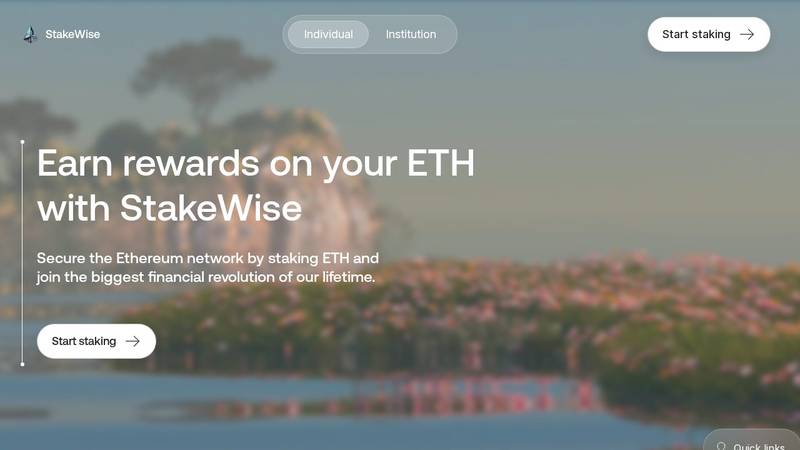
A Vaults block links to partner curated vaults, and a governance block invites SWISE holders to take part. The page uses “up to” figures heavily, so we used the app for the real numbers.
Connecting a wallet
The Select wallet box lists MetaMask, WalletConnect, Ledger, Binance, Coinbase and Check wallet. The box also says that by connecting you accept the Terms of Service and Privacy Policy. We chose MetaMask. After the second try described above, the header showed a MetaMask icon and the short address 0x53…A0cD, and a Balance link appeared.
Stake tab
The Stake page is one box. You enter an amount of ETH, and the main button reads Enter amount until you do. A switch below the box says “Boost received osETH”. Under it, a summary shows an annual percentage yield of 2.34% to 6.39% with a sparkle icon on the high end, 370.44 thousand ETH of total value locked and 112,883 stakers. A link for ETH and GNO appears on the Gnosis network.
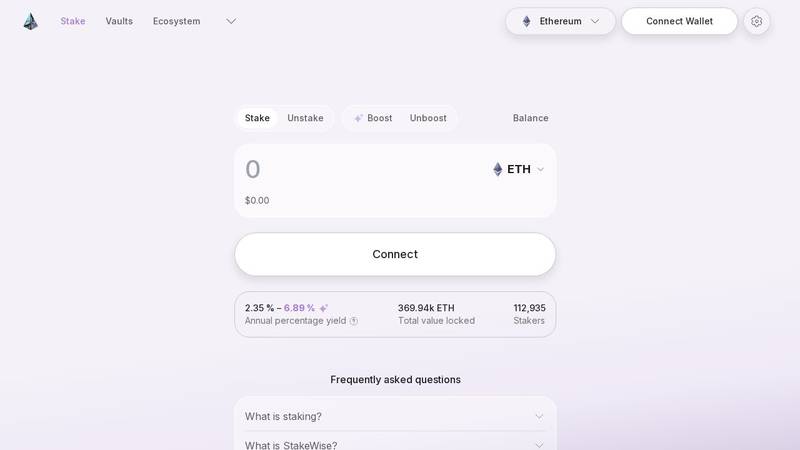
When connected, our box showed Balance: 0.00. The input field was disabled, so we could not type an amount and could not read a quote. That is the honest limit of an empty wallet, and it means we did not see a fee preview or a received-amount line.
Unstake tab
The Unstake tab shows Staked: 0.00 and the same Enter amount button. According to the FAQ, the unstaking period depends on the length of the Ethereum exit queue. StakeWise starts the validator exit as soon as it gets a request, and funds can be claimed when the network releases them. There is no fixed number of days on the page, because the queue changes. Another route is to trade osETH on the market, but the market price may differ from the protocol rate.
The docs also describe redemptions through a queue. You hand osETH to a redeemer contract, receive a ticket, wait for the batch to settle and then claim your ETH.
Boost and Unboost
Boost is the feature behind the 6.39% and 7% numbers, so read this part slowly. The docs say Boost uses osETH as collateral to borrow more ETH on Aave, stakes that ETH, mints more osETH and repeats the loop. The extra yield comes from the gap between the cost of borrowing and the staking reward on the borrowed amount.
That is leverage. It makes gains bigger when the gap is positive, and it can lose money when the gap turns negative. The docs state that StakeWise does not recommend using Boost while its APY is consistently negative. They also say Aave values osETH with StakeWise’s own price feed, not market prices, so a boosted position is not exposed to an osETH depeg. The borrowing market allows up to 93% loan to value and liquidates at 95%, so the buffer is 2%. Above 94.5% anyone can unboost a position on the holder’s behalf.
On the Boost tab the input token is osETH, and ours showed a balance of 0.00. The Unboost tab offered 25%, 50%, 75% and Max buttons. We did not boost anything. A link below the form reads Learn more about boost.
FAQ on the Stake page
Six questions sit under the form, and they carry real information. The fee answer says StakeWise charges a 5% fee on the rewards accumulated by osETH, each vault charges its own fee, typically 5%, and a user who stakes from the Stake page pays a total of 10% of rewards. The risk answer lists three items: smart contract risk, slashing risk and osToken price risk, which is the chance that osETH trades below its inherent value because withdrawals are restricted. The security answer names audit firms: Consensys Diligence, Statemind, Sigma Prime, Halborn, ABDK and Runtime Verification, and says the code is open source with an Immunefi bug bounty.
The Unboost answer mirrors the exit queue logic of unstaking.
Vaults
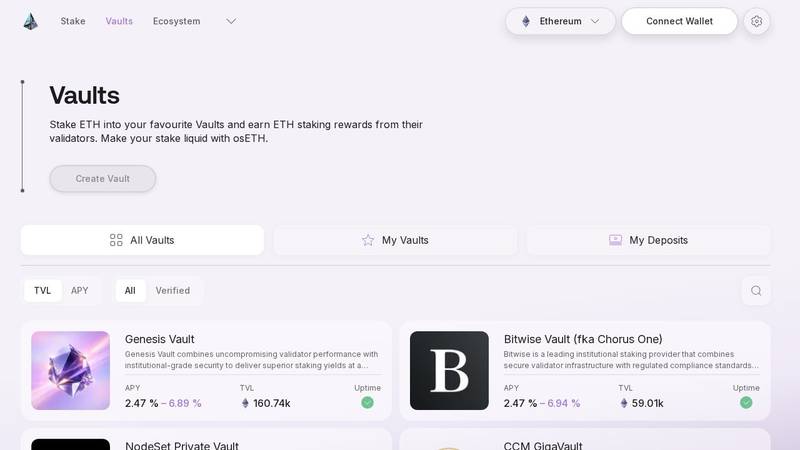
The Vaults page lists staking pools. Sorting by TVL or APY and a filter for All or Verified sit above the cards. Tabs for All Vaults, My Vaults and My Deposits are at the top, with a Create Vault button. The first cards showed:
| Vault | APY range | TVL |
|---|---|---|
| Genesis Vault | 2.46% to 6.39% | 160.72 thousand ETH |
| Bitwise Vault (formerly Chorus One) | 2.47% to 6.60% | 59.30 thousand ETH |
| NodeSet Private Vault | 2.55% to 7.65% | 24.48 thousand ETH |
| CCM GigaVault | 2.34% to 3.29% | 8,671.48 ETH |
Every card shows an uptime tick. The Bitwise card carries a note that by delegating you agree to Bitwise’s terms, which shows vaults can come with their own legal terms. Other cards, such as one named only by an address and one called Nodz, appear below. A vault named by an address has no visible operator on the card, so check who runs it before you deposit.
Clicking Create Vault did nothing in our test. We did not try to find out why.
A vault page
We opened the Genesis Vault. The header says it was created in October 2023, uses MEV Smoothing and is Public. Two tabs, My stats and Vault stats, switch the view. The vault stats chart showed daily rewards of 11.2243 ETH (about $18.42 thousand) on November 9, 2026, with ranges of 1m, 3m, 6m and 1y. A panel on the right showed Your APY 0.00%, Staked ETH 0.00, Minted osETH 0.00 and a Boost row, each with plus and minus buttons. Three tiles showed TVL 160.72 thousand ETH, APY 2.46% to 6.39% and Uptime Excellent.
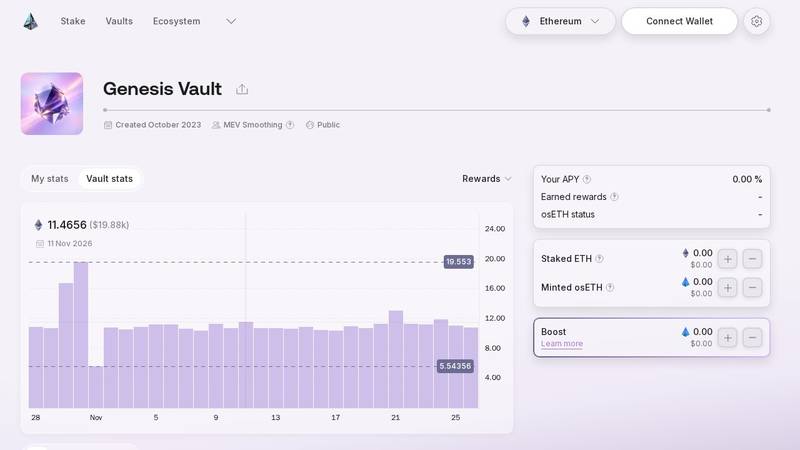
Lower down, an Actions table lists recent stakes, unstakes, queue entries, osETH mints and migrations with value, amount and time. The recent rows included a 13.92 ETH stake two hours earlier, an unstake of 1,250.05 ETH a day earlier and a 300 ETH osETH mint five days earlier. A validators table lists public keys with earned ETH and a per validator APY, which ranged from about 2.09% to 3.78% in the rows we saw. Open data like this lets you judge a vault’s performance for yourself.
Ecosystem
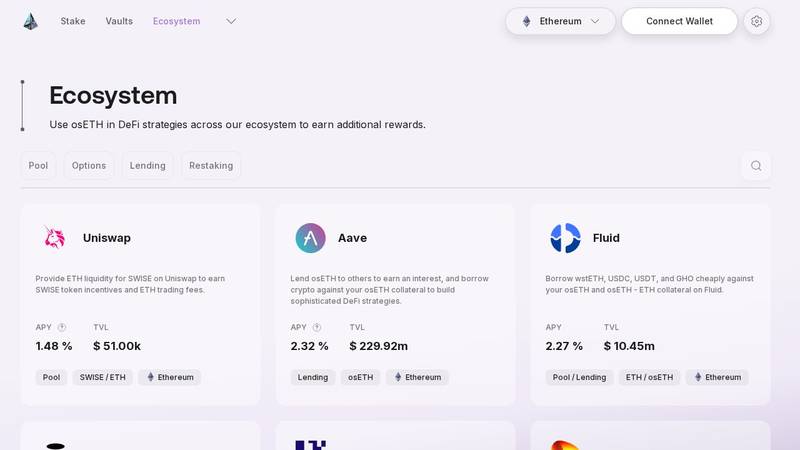
The Ecosystem page lists places to use osETH, with tabs for Pool, Options, Lending and Restaking. Cards showed Uniswap (SWISE and ETH pool, 0.59% APY, $51.64 thousand TVL), Aave (lend osETH, 2.34%, $217.37 million), Fluid (borrow against osETH, 2.10%, $10.28 million), Balancer (ETH and osETH pool, 1.88%, $861.92 thousand), EigenLayer (restaking, points, $2.32 million) and Curve (2.22%, $9.54 million). Most of the osETH in DeFi sits in Aave, which is also where Boost borrows. That concentration is worth noting.
Swap
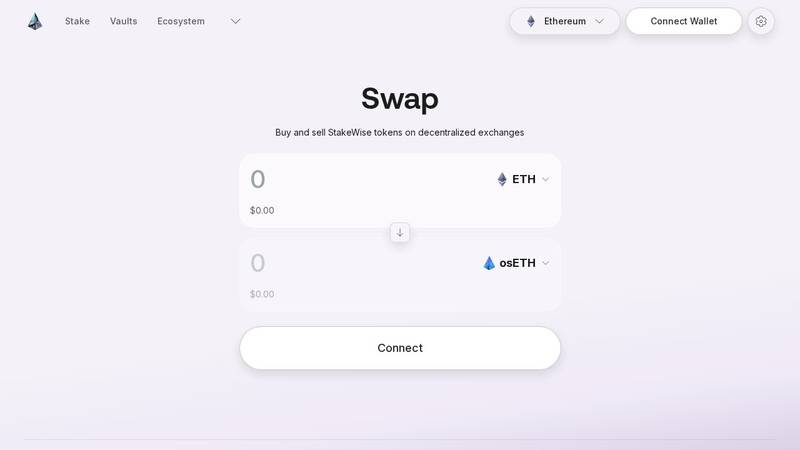
The Swap page lets you buy and sell StakeWise tokens on decentralized exchanges. The two boxes were ETH and osETH, each with a balance of 0.00 and an Enter amount button. We did not run a quote.
Menus
The chevron next to Ecosystem opens a menu with App (Swap, Bridge, Redemptions), Protocol (Forum, Audits, Governance) and Need help (Docs, Contact us). The network menu lists Ethereum and Gnosis Chain. We tested only Ethereum.
The SWISE Token
SWISE is the governance token of StakeWise. Holders vote on protocol decisions through the forum and governance tools, and the token is not needed to stake. You can use the whole app, mint osETH and boost without ever owning SWISE. That is worth knowing, because the headline yield you earn does not depend on this token at all.
The market for SWISE is tiny. CoinGecko showed a price of about $0.00246, a market cap of about $1.86 million and a fully diluted value of about $2.46 million. Of the 1 billion total supply, about 754.4 million were circulating, which is roughly 75%. The all time high was $0.358 on October 27, 2021, so the token is down about 99% from its peak. The all time low on the page was $0.00221, which is close to today’s price. Rank was around 2,197 and 24 hour volume was only about $264.
| SWISE measure | Value | Source |
|---|---|---|
| Price | About $0.00246 | CoinGecko |
| Market cap | About $1.86 million | CoinGecko |
| Fully diluted value | About $2.46 million | CoinGecko |
| Circulating supply | 754.4 million of 1 billion | CoinGecko |
| All time high | $0.358 on 2021-10-27 | CoinGecko |
| All time low | $0.00221 | CoinGecko |
| Change over 24 hours | -3.1% | CoinGecko |
| Change over 7 days | -14.8% | CoinGecko |
| Change over 30 days | -27.0% | CoinGecko |
| Change over 1 year | -74.6% | CoinGecko |
| Volume over 24 hours | About $264 | CoinGecko |
The liquid staking token osETH is a different asset, and it is the one most users touch. CoinGecko showed osETH near $1,780 with a market cap of about $264 million. Its price tracks ETH plus the rewards that have built up, because the token is a receipt whose worth rises against ETH. We did not test buying or selling either token, so we cannot say how deep the real markets are beyond the volume numbers above.
Our view on SWISE is plain. The app and the token are loosely linked, the token’s market is very thin and the one year loss is large. Treat it as a governance ticket for people who want a vote, not as a way to get paid from staking.
Risks, Audits and Incident History
Staking has a few layers of risk, and each one sits in a different place. We list them from the base up.
Smart contract risk is the first. StakeWise holds user ETH in contracts, and a bug could lose money. The team has been through eight audits listed in its GitHub repository: Halborn in May 2023 and August 2023, Sigma Prime in August 2023, Consensys Diligence in March 2024, Sigma Prime again in June 2024 and September 2024, ABDK in September 2025 and Statemind in April 2026. That is a long and recent list. We did not open the PDF reports, so we cannot tell you what each one found or whether every finding was fixed. The core repository showed its last push on October 27, 2026 and is marked with a license field of NOASSERTION on GitHub, which means GitHub could not detect a standard license. It had 16 stars, which says little about quality but shows this is not a heavily watched project. An Immunefi bug bounty page also exists for the protocol.
Slashing is the second. A validator that signs two conflicting messages or goes offline for long enough can lose part of its stake. The docs say up to 100% of staked funds can be at risk if nodes fail. The way to reduce this is to choose vaults with good operators and to avoid putting everything in one vault. The marketing page also points to DVT, a method that splits one validator key across several machines, as a protection.
The third is osETH price risk. The token is meant to follow ETH plus rewards, but on a market it can trade below that value, especially when many holders sell at once. The docs offer the redemption queue as a path back to ETH at the protocol rate, and the wait depends on the queue.
The fourth is Boost leverage, and it is the biggest one for a normal user. Boost allows up to 93% loan to value and liquidates at 95%, which leaves only a 2% buffer. Above 94.5% anyone can unboost the position. The docs say Aave values osETH with StakeWise’s own price feed, which protects against a market depeg but depends on that feed being right. A lot of osETH, about $217 million at the time we checked, sits on Aave, so the loop is concentrated in one lending market. If Aave changed its rules or had trouble, many boosted positions would feel it at once.
The fifth is the exit queue. Unstaking depends on the Ethereum exit queue and no number of days is promised. In a busy period the wait can be long.
The sixth is operator and fee risk. Vault fees on the platform can range from 0% to 100%. The FAQ explains that a vault owner can raise the fee by up to 20% at a time with a 3 day delay, and the Stake page route has a total of about 10% of rewards taken (5% for the protocol and a typical 5% for the vault). Read the fee on any vault page before you deposit, and check it again later.
Finally, the size of the protocol has shrunk. DefiLlama showed a TVL peak of about $1.60 billion in October 2025, a value near $913 million 30 days before our check and about $630.6 million on November 25, 2026. A falling TVL is not a security failure by itself, since ETH’s own price fell during the same period, but it shows less value held in the protocol than a year ago.
On incidents, DefiLlama’s hacks list had no entry for StakeWise when we searched it. That is a good sign and it is not proof of safety. It only says no hack was recorded there.
| Risk area | What we found | Source |
|---|---|---|
| Audits | 8 reports from 2023 to April 2026 | GitHub |
| Bug bounty | Page on Immunefi | Immunefi |
| Hack record | No StakeWise entry | DefiLlama |
| Slashing | Up to 100% of staked funds at risk if nodes fail | Docs |
| Boost | 93% LTV, 95% liquidation, 94.5% unboost trigger | Docs |
| Aave concentration | About $217 million osETH on Aave | DefiLlama and Aave data |
| TVL trend | $1.60B peak, about $630.6M now | DefiLlama |
| Audit PDFs read | No | Not tested |
How StakeWise Compares
This section is a design comparison from public pages, not a product test. We did not stake in Lido, Rocket Pool or any Solana pool for this article.
Lido is the largest liquid staking protocol. DefiLlama showed its TVL at about $16.1 billion, which is about 25 times StakeWise. Its token, stETH, is accepted in more DeFi apps. The tradeoff for a reader is that Lido is large and simple, while StakeWise gives you a choice of vault and operator and shows each vault’s fee.
Rocket Pool has a TVL near $795 million on DefiLlama, close to StakeWise’s size. It stresses a large set of independent node operators and a lower entry barrier for running a node. StakeWise puts the choice at the vault level, and a vault can be run by an institution, a community or a single operator.
Jito is a Solana staking token, which we reviewed in this series. It lives on a different chain with a different reward system based on tips, so the numbers are not comparable. The shared idea is the same: you stake and keep a token that you can use elsewhere.
| Item | StakeWise | Lido | Rocket Pool |
|---|---|---|---|
| Rough TVL on DefiLlama | About $630.6M | About $16.1B | About $795M |
| Choice of operator | Yes, by vault | Curated set | Node operators in a pool |
| Liquid token | osETH | stETH | rETH |
| Leverage option in app | Boost | Not in the main app | Not in the main app |
| Tested by us | Yes, connect only | No | No |
What We Verified and What We Did Not
We verified that the marketing site and the app load on desktop, that the wallet connect works after a second press, that the Stake, Unstake, Boost and Unboost tabs open, that the Vaults list and a vault page show data, that the Ecosystem and Swap pages load, that the network menu lists Ethereum and Gnosis Chain, and that the FAQ answers can be read. We also checked market numbers against CoinGecko and DefiLlama and found the audit list on GitHub.
We did not verify a stake quote, because the amount box was locked with a zero balance. We did not deposit, mint osETH, boost or unboost. The Create Vault button did nothing when we clicked it. The Bridge, Redemptions and Governance pages appeared in a menu and we did not open them. We did not read the audit PDFs, test the exit queue or try a trade on Swap. Anything in this review about those parts comes from the docs or the FAQ and not from our own use.
FAQ
Is StakeWise safe?
It has eight listed audits, a bug bounty and no hack entry on DefiLlama. It is not risk free. Smart contract bugs, slashing and Boost leverage can all cost money, and we read no audit reports.
Do I need SWISE to stake?
No. You can stake ETH, mint osETH and use the app without owning SWISE. The token is for governance.
What does StakeWise charge?
The FAQ states a 5% protocol fee on osETH rewards. The Stake page route adds a typical vault fee, so the total is about 10% of rewards. Individual vaults can charge between 0% and 100%.
What is the yield?
The Stake page showed 2.34% to 6.39%, and the marketing site says up to 7% with Boost. The higher numbers need leverage.
How long does unstaking take?
There is no fixed number. It depends on the Ethereum exit queue. You can also sell osETH on a market, but the price may differ from the protocol rate.
What is Boost and who should use it?
Boost borrows against osETH on Aave to raise yield. It adds liquidation risk with a 2% buffer. We do not suggest it to beginners.
Is the SWISE token a good buy?
We give no price advice. The token has a market cap of about $1.86 million, tiny volume and a one year loss of about 75%.
Can I use a wallet other than MetaMask?
The connect box lists WalletConnect, Ledger, Binance and Coinbase as well. We tested MetaMask only.
Quick Links
| Link | URL |
|---|---|
| Website | https://stakewise.io |
| App | https://app.stakewise.io |
| Docs | https://docs.stakewise.io |
| GitHub | https://github.com/stakewise |
| Audits | https://github.com/stakewise/v3-core/tree/main/audits |
| Bug bounty | https://immunefi.com/bug-bounty/stakewise/information/ |
| DefiLlama | https://defillama.com/protocol/stakewise-v3 |
| CoinGecko | https://www.coingecko.com/en/coins/stakewise |
This article is an independent editorial review for information only. It is not financial advice. Staking and leverage can lose money. Figures were collected on November 25, 2026 and change often. Check the live app and your own risk before using any protocol.