



We tested this on three real devices (every screenshot was taken live on 16 November 2026, not stock images):
| Device | Width | What we opened |
|---|---|---|
| Desktop | 1440px | Website, app, docs, data hub, points leaderboard |
| Tablet | 1024px | Homepage, savings, borrow, swap, staking |
| Phone | 430px | Homepage, savings, borrow, staking, notifications |
We also connected a throwaway MetaMask wallet that holds no funds to the Spark app and walked through every menu: Savings, Borrow (SparkLend and Isolated Markets), SPK Farm, SPK Staking, Points, Swap and Notifications. We opened the deposit window but did not sign any transaction, so we have no personal data on gas costs, withdrawal speed or liquidations. Those parts come from Spark's documentation and are labelled that way.
Quick verdict: Spark is one of the more carefully built places to earn on stablecoins and to borrow against ETH and BTC assets. Its savings pages show where the money sits, its lending market lists only a short set of collateral, and the app publishes independent risk ratings. The trade-offs are heavy reliance on Sky governance, headline numbers that differ by source, a small and volatile SPK token, and several extra products that beginners do not need on day one.
| Item | Detail |
|---|---|
| Best for | Stablecoin savers, ETH holders who want a stablecoin loan, builders and institutions |
| Fees | No account fee, interest is built into rates, network gas applies |
| Custody | Non-custodial, you connect your own wallet |
| Main chain | Ethereum, with savings vaults on several other chains |
| Editorial score | 4.3 / 5 |
What Is Spark? (Plain English)
Think of Spark as a money-market desk that lives on a blockchain. You can park stablecoins there and earn a rate, or you can lock up ETH or BTC-type assets and borrow stablecoins against them. Nobody opens an account for you. Your wallet is your login, and smart contracts do the bookkeeping.
What makes Spark different from a typical lending app is where its money comes from. Spark describes itself as an onchain capital allocator that borrows from the stablecoin reserves of Sky (the protocol formerly known as MakerDAO) and puts that capital to work across DeFi lending, centralised finance partners and tokenised real-world assets such as treasury bills. Users mostly see the simple front end: Savings, Borrow and Swap.
In plain terms: Spark is a savings-and-loans app for crypto dollars, backed by Sky's balance sheet, with a governance token called SPK on the side.
Who built it? The Spark website names Sam MacPherson as CEO in a press item dated 14 July 2026, and the governance docs list Phoenix Labs as a nested contributor. Spark is part of the Sky ecosystem and takes its direction from Sky governance, which is important when you judge the risks later in this review.
Key facts (16 November 2026):
| Fact | Value | Source |
|---|---|---|
| SparkLend TVL | $4.09B | DefiLlama and the Spark app |
| SparkLend total market size | $6.38B | Spark app, Markets page |
| Spark Liquidity Layer allocated | $3.17B | Spark Data Hub |
| Spark Savings total assets | $2.73B | Spark Data Hub |
| Savings users | 308,598 | Spark Data Hub |
| SPK staked | 735.28M SPK | Spark Data Hub |
| Domain | spark.finance (spark.fi redirects) | Spark docs |
Note the domain change. The older spark.fi address now redirects to spark.finance, and the docs warn about lookalike sites, so only use links you reach from the official domain.
How Spark Looks on Your Device
On a Laptop or Desktop Computer (1440px wide)
The homepage is aimed at institutions as much as individuals. It shows a large headline about institutional capital, three headline numbers and an "Open Spark" button in the top right.
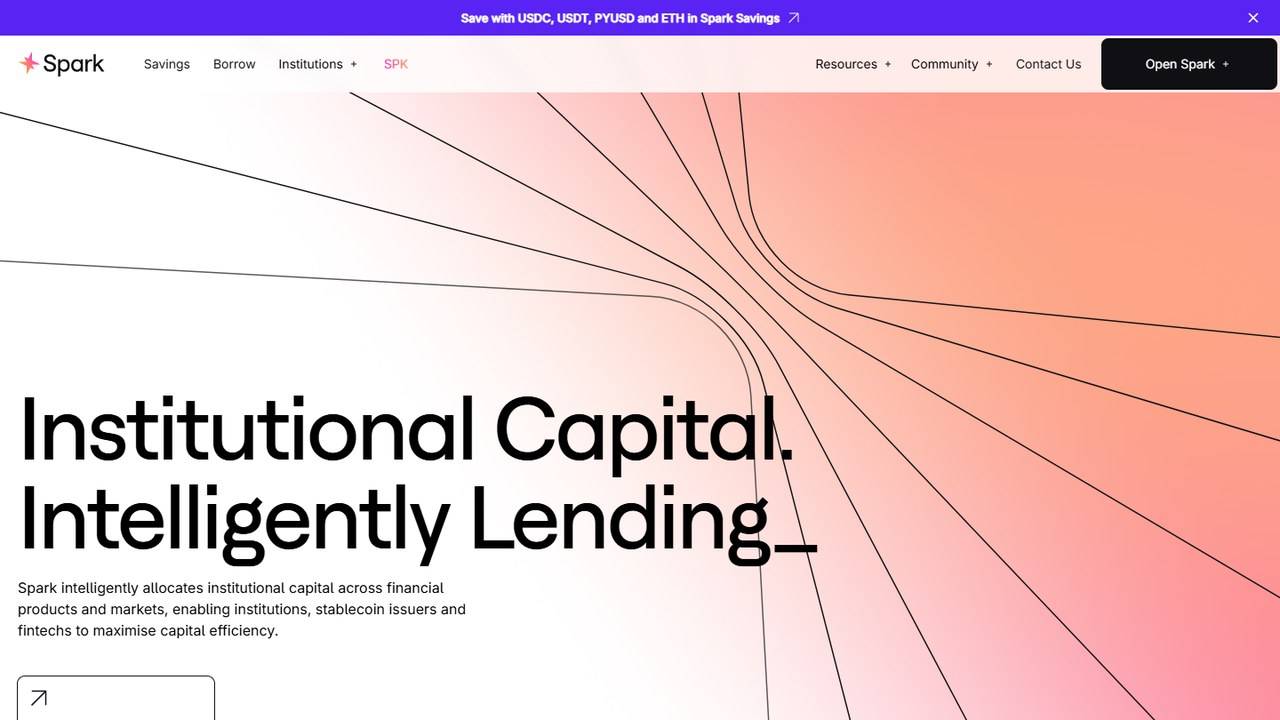
Spark homepage on a 1440px screen. The Open Spark button leads to the app, and the top menu has Savings, Borrow, Institutions and SPK.
The app itself is cleaner. A top bar has Savings, Borrow, SPK, Swap and More, and the wallet button sits on the right.
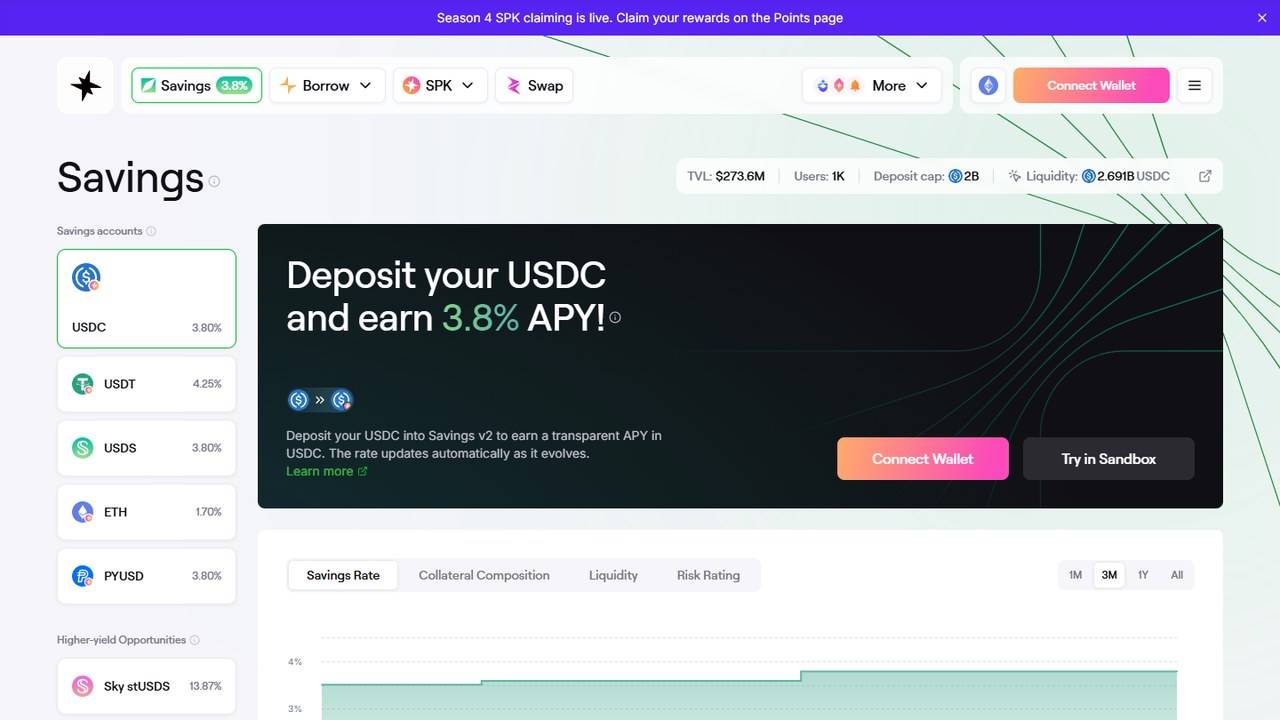
Savings page on desktop. USDC at 3.80% APY, a vault list on the left and four tabs under the main card.
Best for: comparing vaults side by side, reading charts and using the risk tabs.
On a Tablet: iPad (1024px wide)
On tablet the top bar collapses to icons, but the borrow form keeps its two-column layout, so supply and borrow sit next to each other.
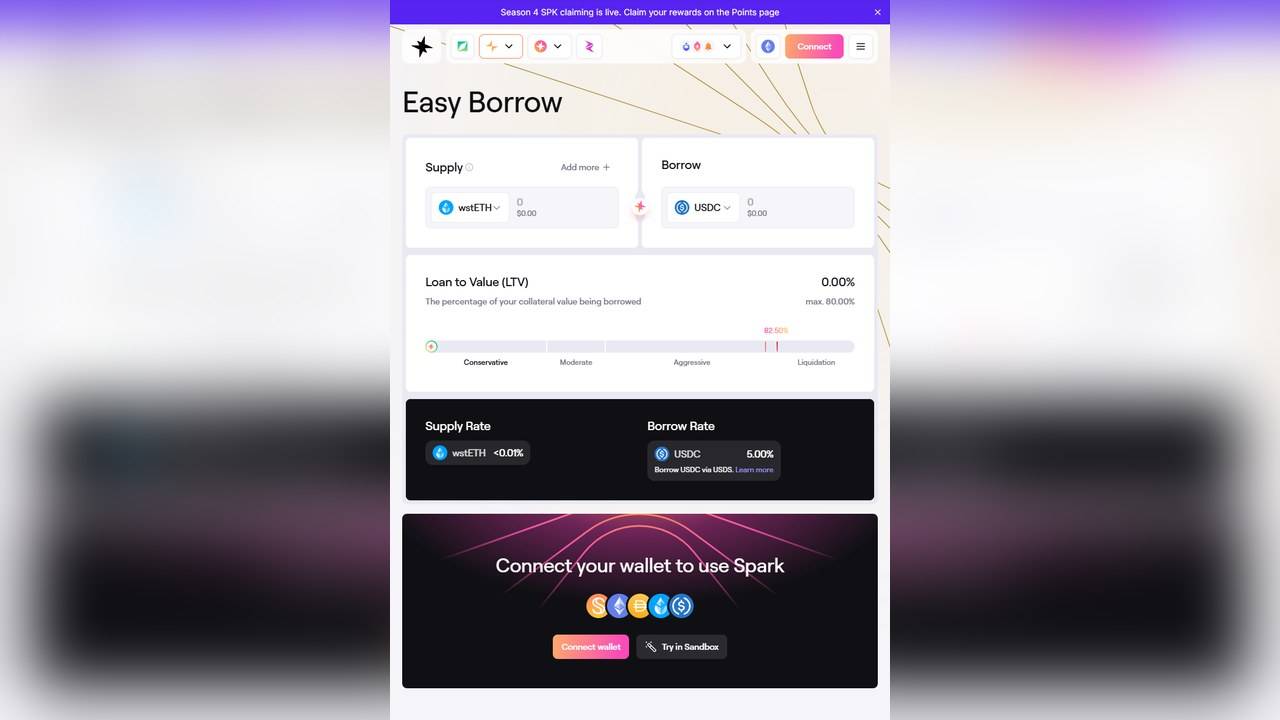
Easy Borrow on a 1024px tablet. The supply and borrow boxes stay side by side and the rates move below.
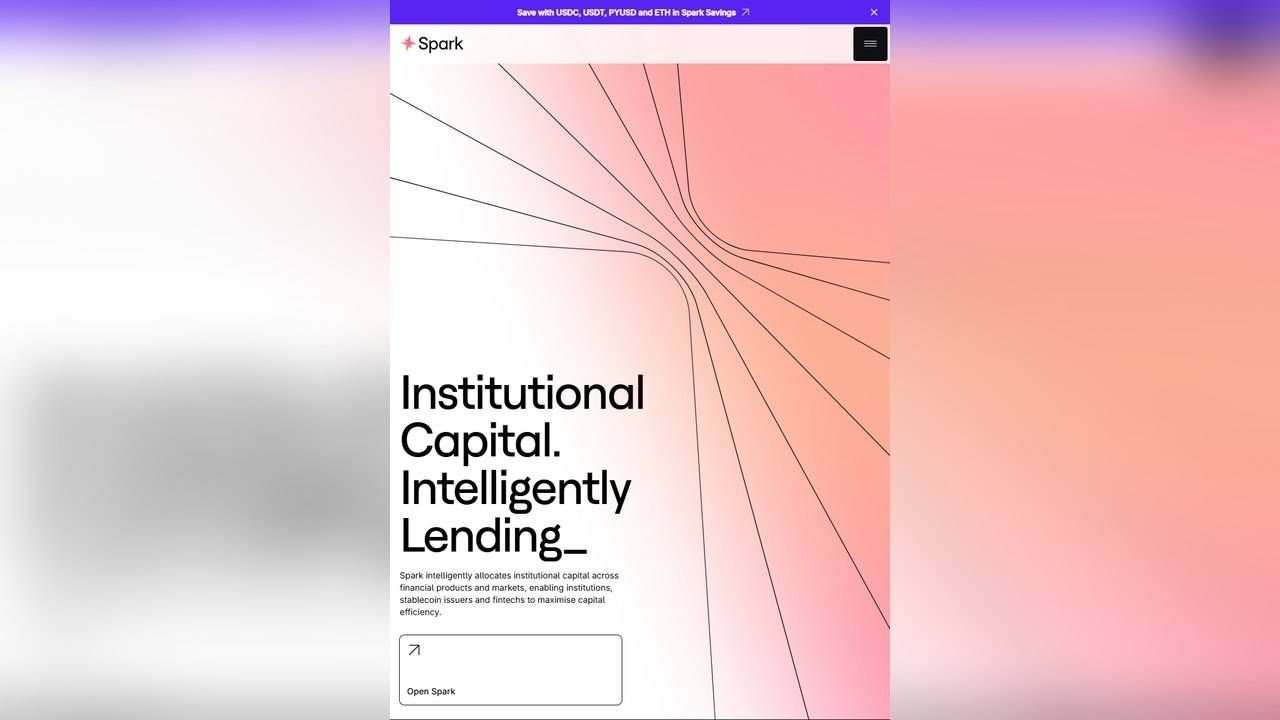
Homepage on tablet. The same headline fits without cropping.
Best for: checking rates and health factors on the couch.
On a Phone: iPhone 16 Pro Max (430px wide)
On a phone the savings vaults turn into a horizontal row of cards, so you swipe to reach USDT and USDS.
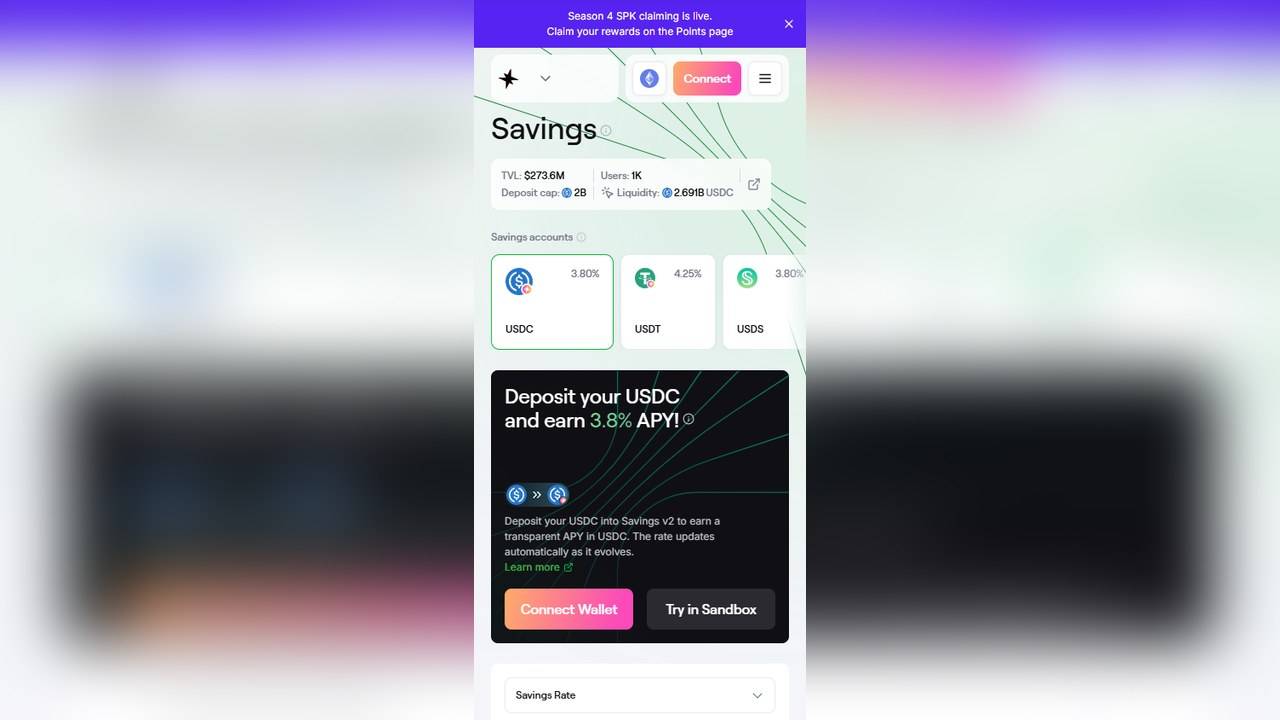
Savings on a 430px phone. The summary box wraps into two columns and the vault cards scroll sideways.
The staking page also fits well, with the multiplier and the Connect Wallet and Try in Sandbox buttons stacked.
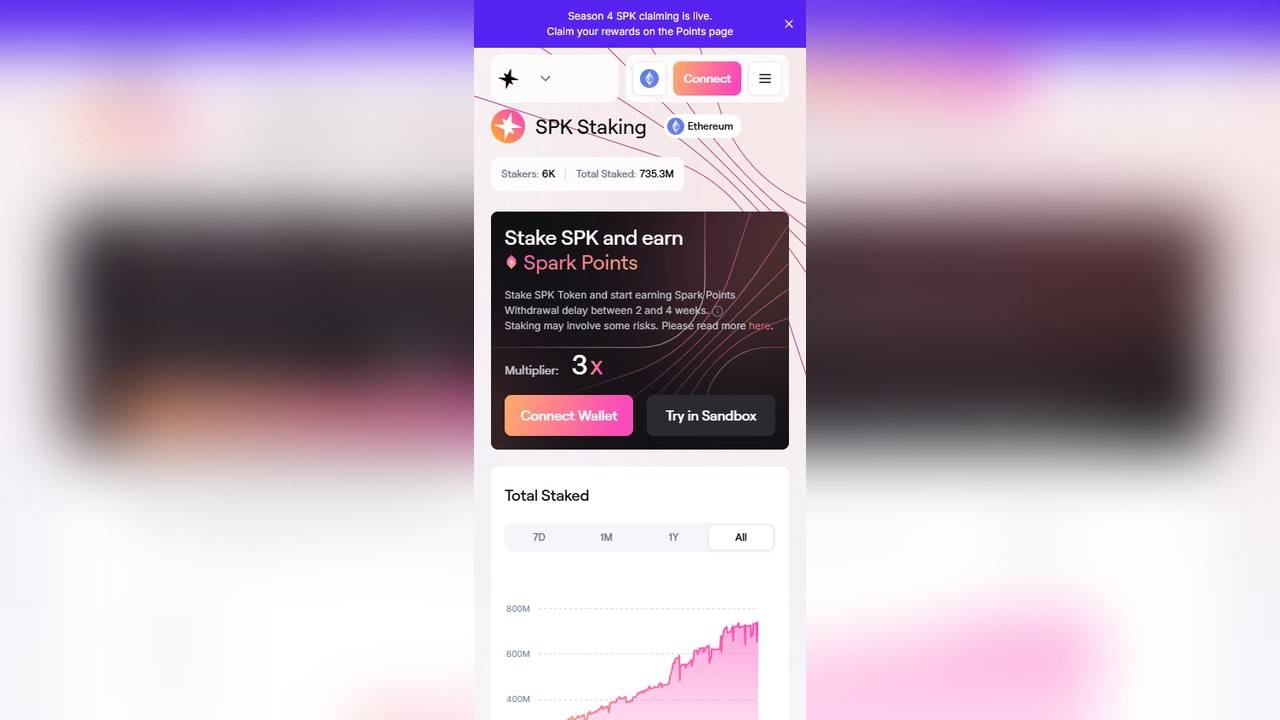
SPK Staking on a phone. Stakers, total staked and the 3x multiplier are all visible without scrolling.
Bottom line on devices: Spark works on all three sizes. Phones are fine for checking numbers and approving simple actions, but the detailed risk tabs read better on a larger screen.
Connecting Your Wallet (Live Screenshots)
The Connect Wallet window lists WalletConnect with a QR code, MetaMask, Institutional Wallets, Rabby, Binance Wallet, OKX Wallet and Bitget Wallet. MetaMask and Institutional Wallets were tagged "Installed" on our test machine because the extension was present.
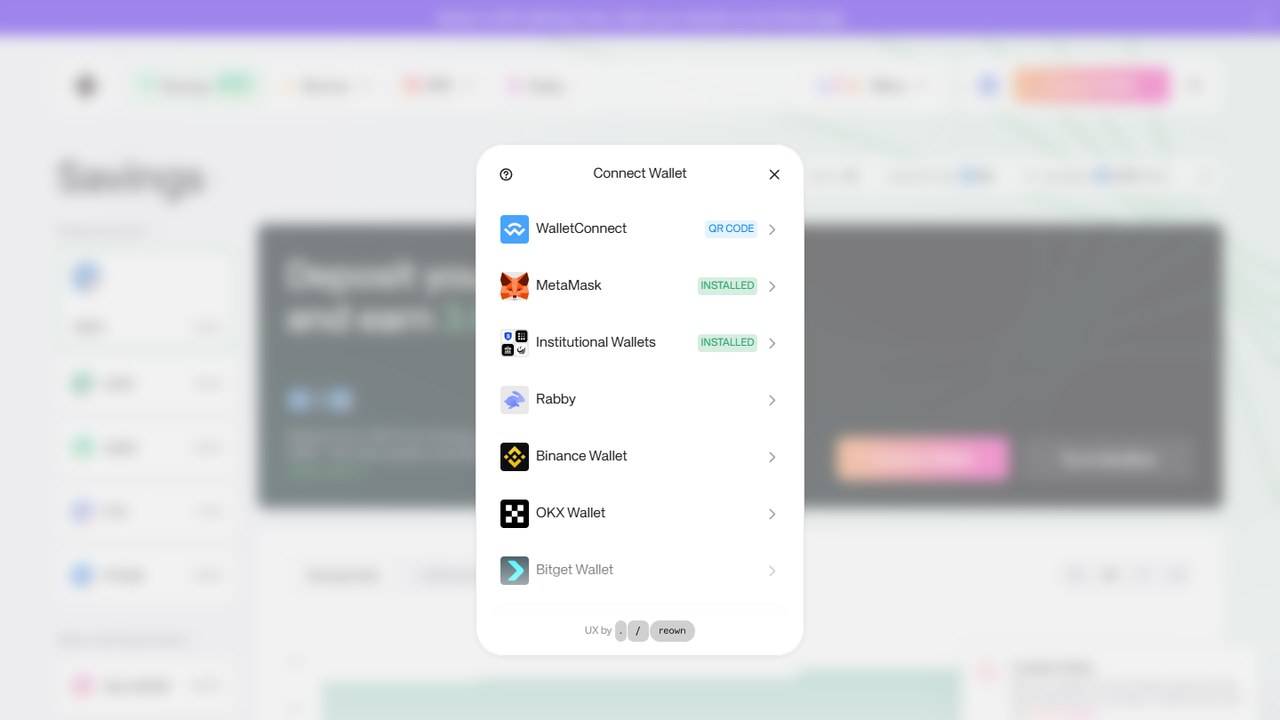
Step 1. The wallet picker. The footer credits Reown for the connection interface.
After you choose MetaMask, the Spark window says "Continue in MetaMask". On our test browser the MetaMask window did not appear by itself, so we opened the extension's notification page by hand. A normal user should see the pop-up automatically, but it is worth knowing in case it hides behind your browser.
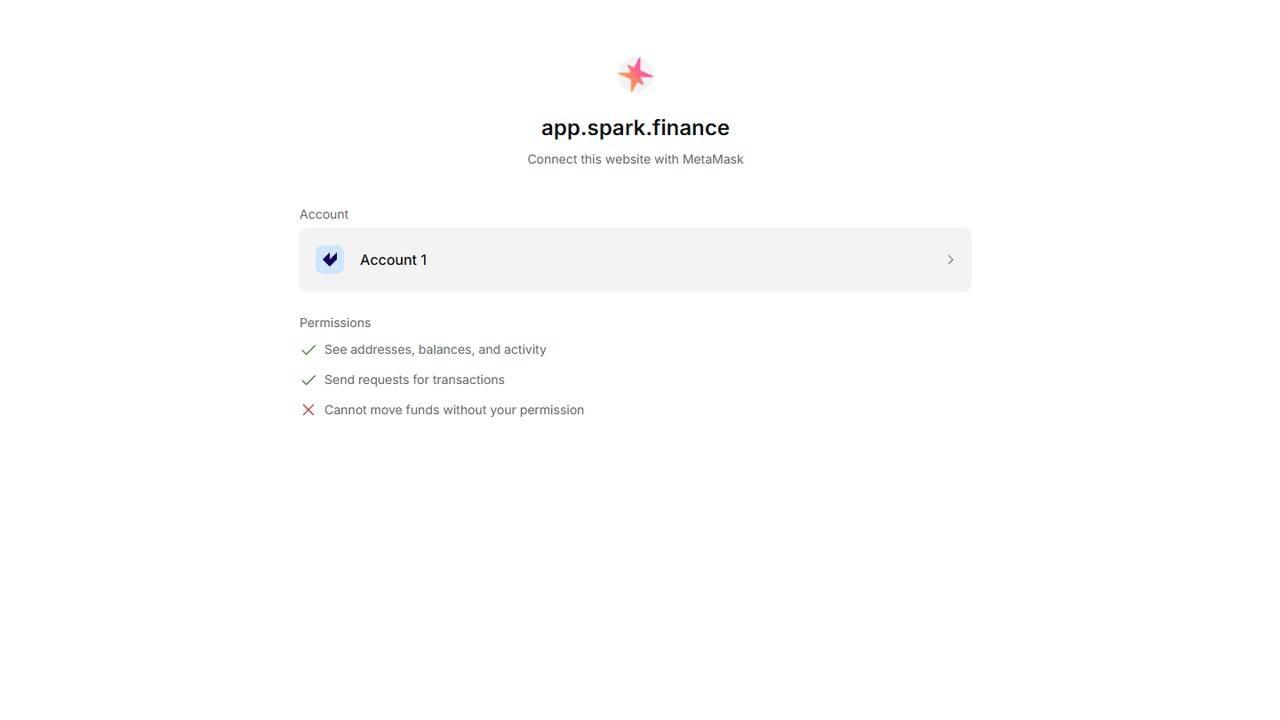
Step 2. MetaMask asks to connect Account 1 and lists what the site can see. It notes the site cannot move funds without permission.
Once connected, Spark shows a Terms of Service and Disclaimer window. You must scroll to the bottom before the Agree and Continue button turns on. The terms include a promise that you are not in a prohibited location and a note that Morpho markets are governed by Spark's terms plus Morpho's own disclaimer.
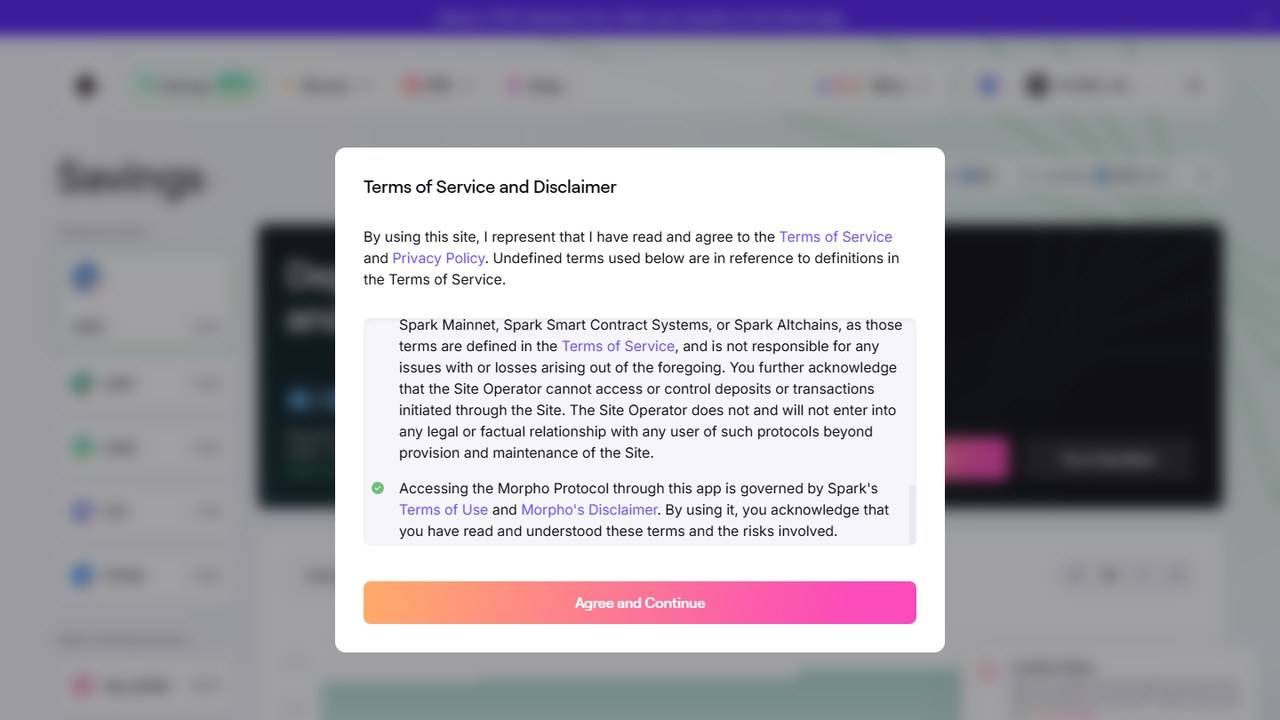
Step 3. Terms and disclaimer. Read it, because it explains who is responsible when something goes wrong.
After you agree, the header shows your shortened address and the Connect button is replaced by a Deposit button on the savings card.
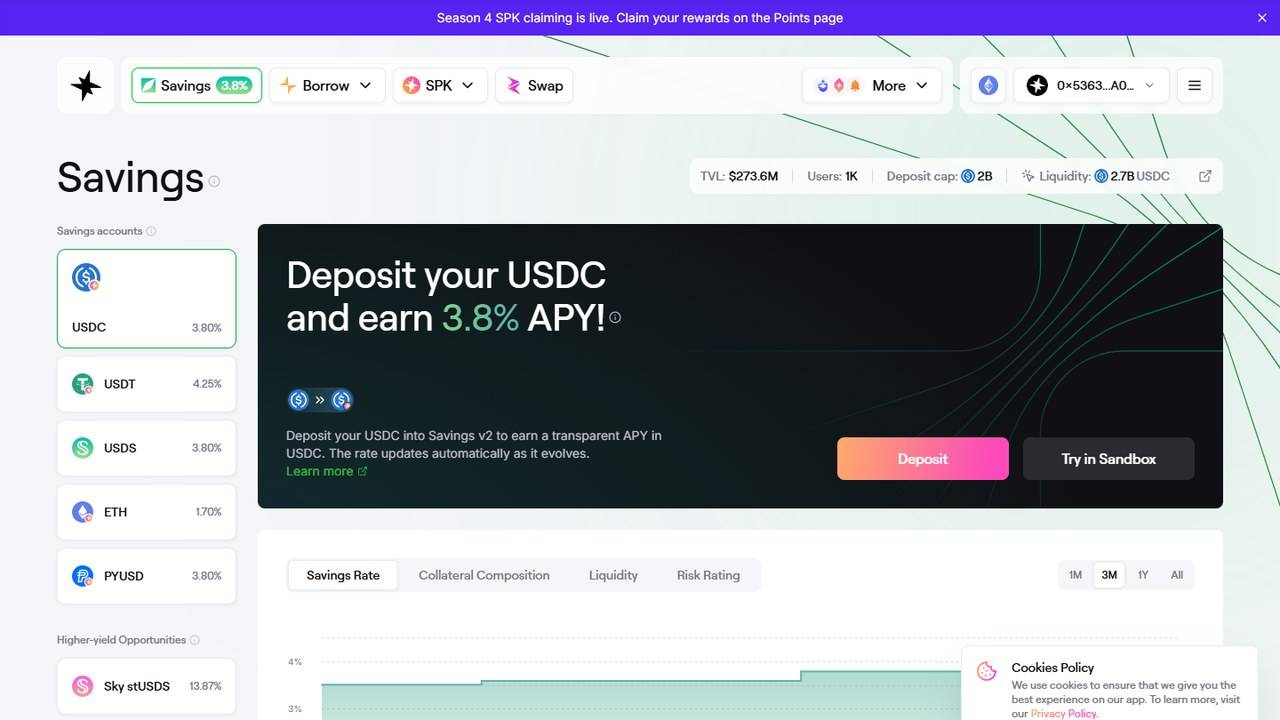
Step 4. Connected. The address shows in the top right and Deposit replaces Connect Wallet.
Spark also offers a Try in Sandbox button next to every action. We did not use it, so we cannot say how closely it matches a real transaction.
Core Features at a Glance
Spark is more than one product. Here is every feature we found in the app and docs, so you can see the full picture before diving in.
| Feature | What it does | Where to find it |
|---|---|---|
| Spark Savings | Deposit stablecoins or ETH into vaults and earn a variable rate | Savings tab |
| SparkLend | Pooled money market, supply assets and borrow stablecoins | Borrow menu |
| Isolated Markets | Single-pair loans powered by Morpho | Borrow menu |
| Spark Liquidity Layer | Allocates Spark's capital across DeFi, CeFi and tokenised assets | Behind the scenes, shown in the Data Hub |
| Swap | Fixed-rate conversion between USDS, USDC and DAI | Swap tab |
| SPK Farm | Deposit USDS to earn SPK tokens | SPK menu |
| SPK Staking | Stake SPK to earn Spark Points | SPK menu |
| Spark Points | Seasonal rewards programme with referrals | More menu |
| Notification Center | Email or Telegram alerts for health factor and account changes | More menu |
| Integrator tools | Referral codes, reporting dashboard, ERC-4626 vaults | Docs |
1. Spark Savings (Earn on Stablecoins)
The vault list
Each savings account is a vault. When you deposit, you receive a vault token that grows in value as interest accrues. These tokens follow the ERC-4626 standard, so they can move to other apps and still earn.
| Vault | Token | Asset | Yield source |
|---|---|---|---|
| Spark USDC | spUSDC | USDC | Spark Liquidity Layer |
| Spark USDT | spUSDT | USDT | Spark Liquidity Layer |
| Spark PYUSD | spPYUSD | PYUSD | Spark Liquidity Layer |
| Spark ETH | spETH | ETH | Spark Liquidity Layer |
| Spark USDG | spUSDG | USDG | Spark Liquidity Layer |
| Savings USDS | sUSDS | USDS | Sky Savings Rate |
| Staked USDS | stUSDS | USDS | SKY-backed lending, run by Sky |
| Savings USDC (legacy) | sUSDC | USDC | Sky Savings Rate |
| Savings DAI (legacy) | sDAI | DAI | DAI Savings Rate |
The live app on 16 November 2026 showed USDC at 3.80%, USDT at 4.25%, USDS at 3.80%, ETH at 1.70% and PYUSD at 3.80%, and the Data Hub showed an overall Liquidity Layer APY of 4.30%. Rates are set through governance and move over time, so treat these as a snapshot.
Three tabs worth reading before you deposit
Under the main card are four tabs: Savings Rate, Collateral Composition, Liquidity and Risk Rating. This is the most beginner-friendly part of the app, because it answers the question "where is my money".
Collateral Composition. For the USDC vault the chart showed total supply of about $273.6M, split 96.35% USDS ($263.6M) and 3.65% USDC ($10.0M).
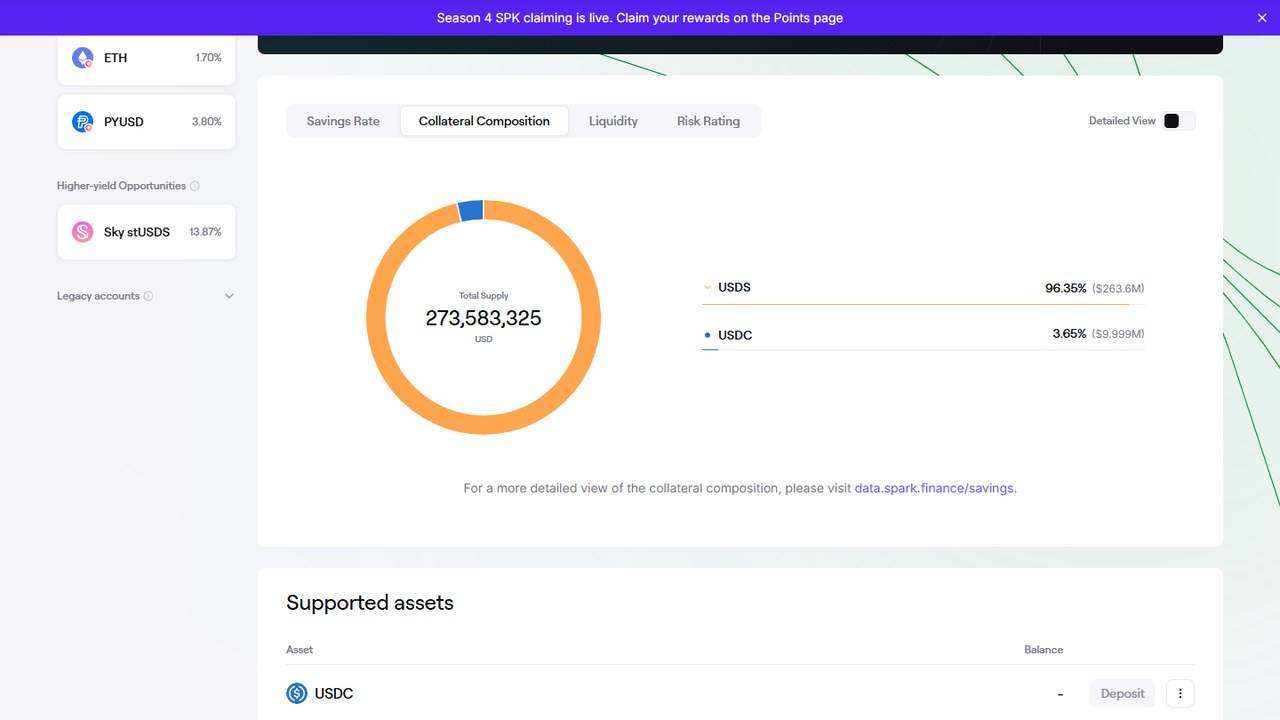
Collateral Composition tab. Most of the vault sits in USDS, with a small slice held as plain USDC.
Liquidity. This tab shows how quickly you can get out. About $2.70B was available, with 99.15% in the PSM, 0.45% in PSM3, 0.37% idle and 0.04% in SparkLend. A note says the maximum withdrawal is 400M USDC per request, that the Liquidity Layer will refill liquidity in the next block if needed, and that the display can lag by 5 to 10 minutes.
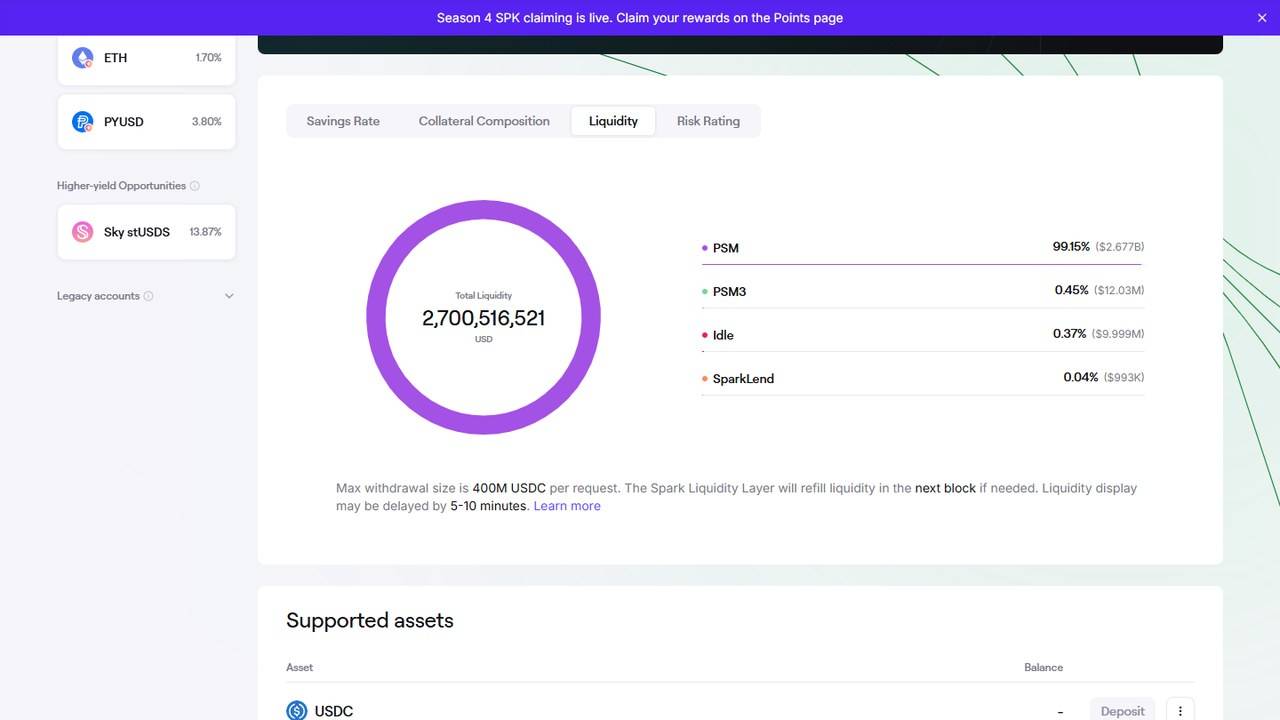
Liquidity tab. Almost all of the available liquidity sits in the PSM, a Sky swap module for stablecoins.
Risk Rating. The rating is provided by Credora, a separate risk analytics firm, not by Spark. The USDC vault was rated A- with a Probability of Significant Loss of 0.65%, last updated 9 November 2026. The sub-scores were Asset Quality 4.5, Governance 4.2, Peg Track Record 4.5 and Protocol Security 4.3, each out of 5.
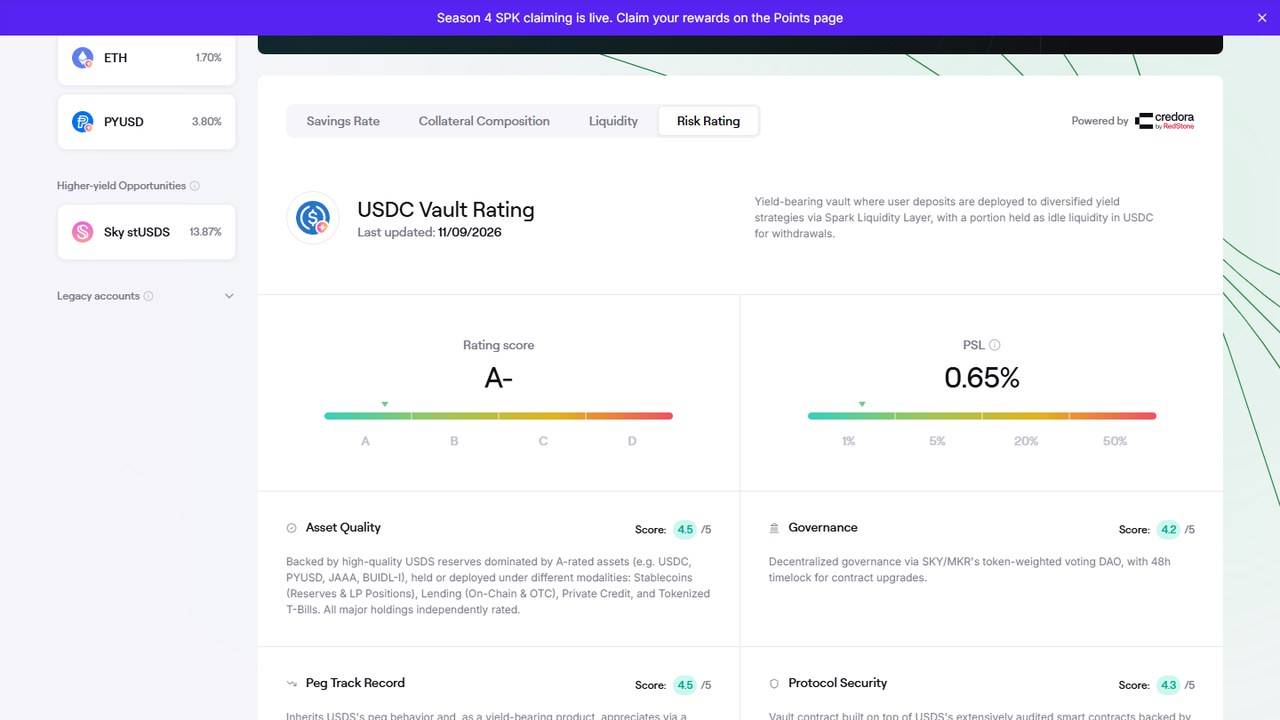
Risk Rating tab. Governance is described as a token-weighted vote with a 48-hour timelock on contract upgrades.
The Spark docs list an older Credora table dated 29 June 2026 with the USDC vault at 0.49%, ETH at 0.39% (A), PYUSD at 0.15% (A), USDT at 0.46% (A-), USDS at 0.52% (A-) and stUSDS at 1.03% (B+). The in-app figure of 0.65% is newer, so the docs table is already out of date. Ratings are model-based opinions, not guarantees.
How to deposit (step by step)
- Open the Savings tab and choose a vault.
- Press Deposit. A window titled "Deposit to USDC Savings" opens.
- Type an amount. The window shows Current APY, Savings Balance and Outcome.
- Under Actions you will see two steps: Approve USDC, then Deposit USDC.
- Press Execute and confirm each step in your wallet.
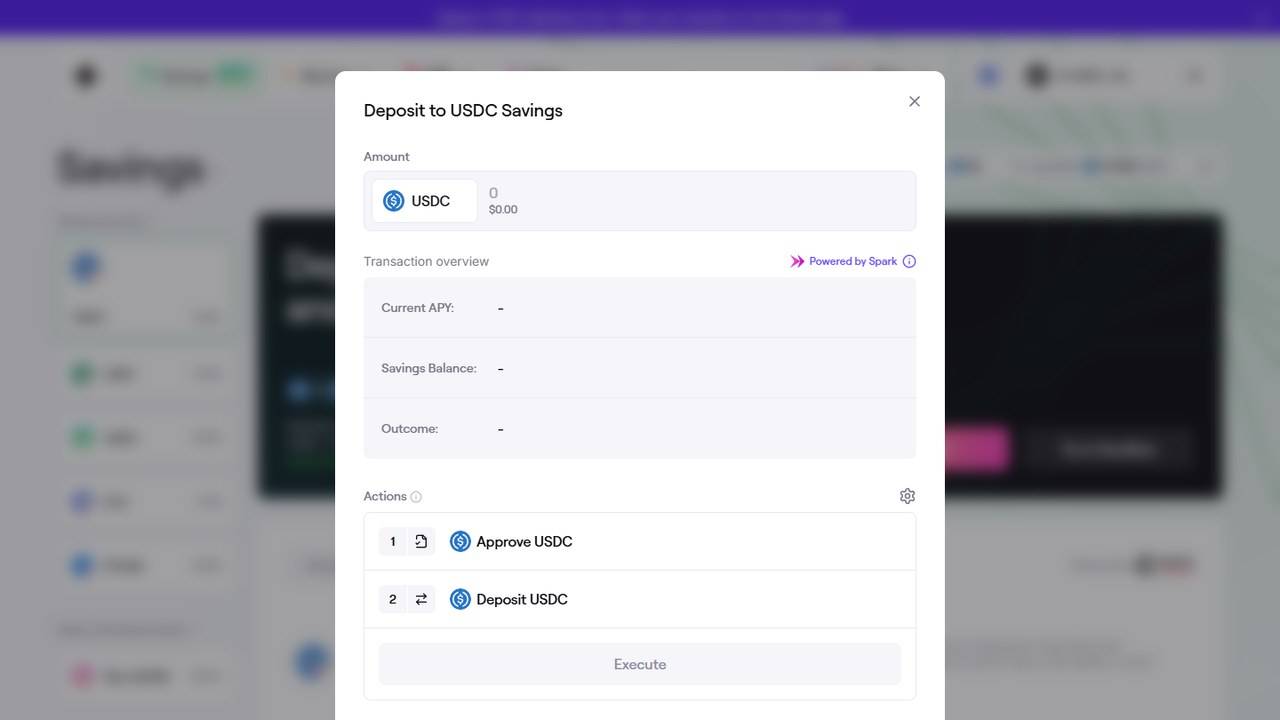
The deposit window. Two onchain steps, so you pay gas twice the first time you use a token.
We stopped at this window. The docs say Spark Savings V2 vaults are backed by Sky's balance sheet to support 24/7 withdrawals at any individual depositor's size, and the Liquidity tab above shows the buffer behind that claim for the USDC vault. We did not test a withdrawal ourselves.
The higher-yield vault: Sky stUSDS (read the warning)
Under "Higher-yield Opportunities" the app lists Sky stUSDS at 13.87%. Clicking it opens a warning window before you can continue. It explains that stUSDS lends USDS only to borrowers who lock SKY tokens as collateral, that depositors take on a higher risk profile including possible haircuts if liquidations do not cover borrower debt, that loans have a maximum loan-to-value of 83.33% with liquidations disabled and the SKY oracle price capped at $0.03, and that withdrawals may be temporarily unavailable until deposits exceed a threshold. At capture the window read 161.8M of 161.8M filled, or 100.00%.
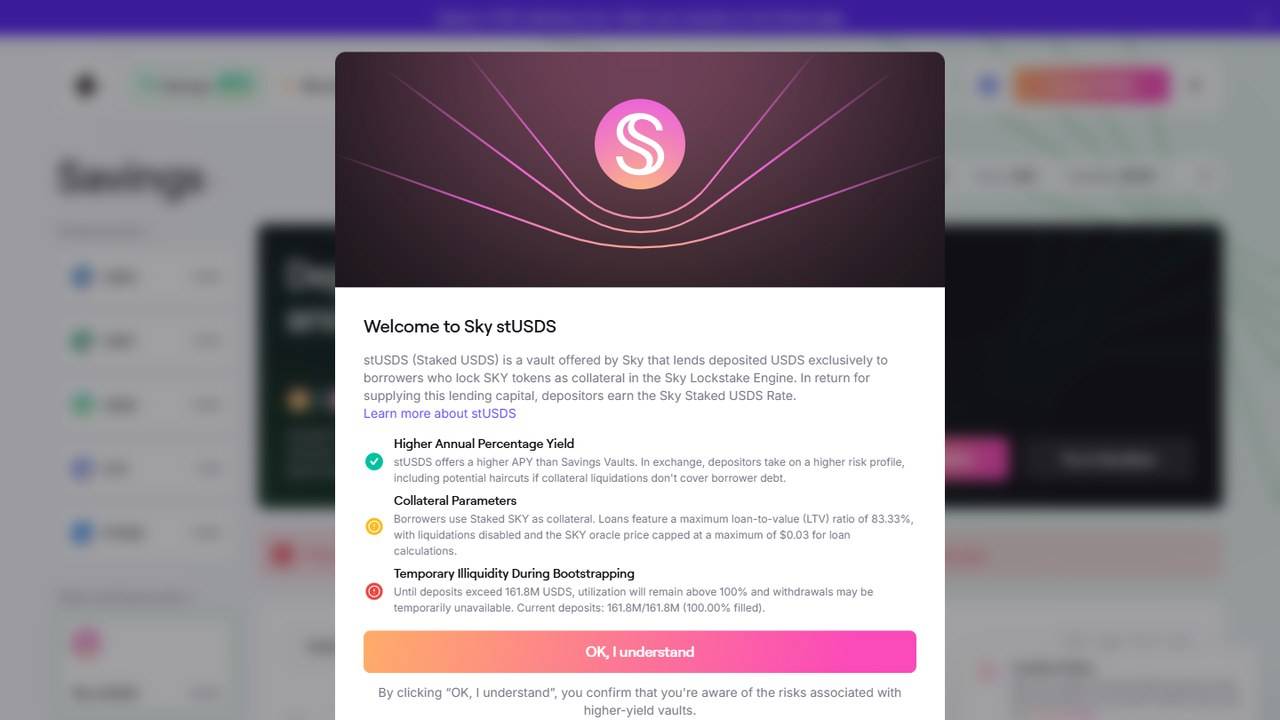
stUSDS warning. A high rate comes with a clear note that withdrawals can be restricted. You have to press "OK, I understand" to continue.
This is exactly the kind of screen we want to see on a yield product. It also means the 13.87% number is not comparable to the 3.80% USDC vault, because the risk is different.
Other vault details
The Savings page also has a collapsed "Legacy accounts" section for the older sUSDC and sDAI vaults. The docs encourage users to migrate to the V2 vaults. A separate "Savings Liquidity Intents" guide describes a way to queue a larger withdrawal request, which matters mainly for institutions. The USDT vault has its own strategy page in the docs because USDT liquidity is managed differently from USDC.
2. SparkLend (Borrow Stablecoins)
Easy Borrow
The default borrow screen is called Easy Borrow. You pick a supply asset and a borrow asset, and a bar shows your loan-to-value from Conservative to Liquidation.
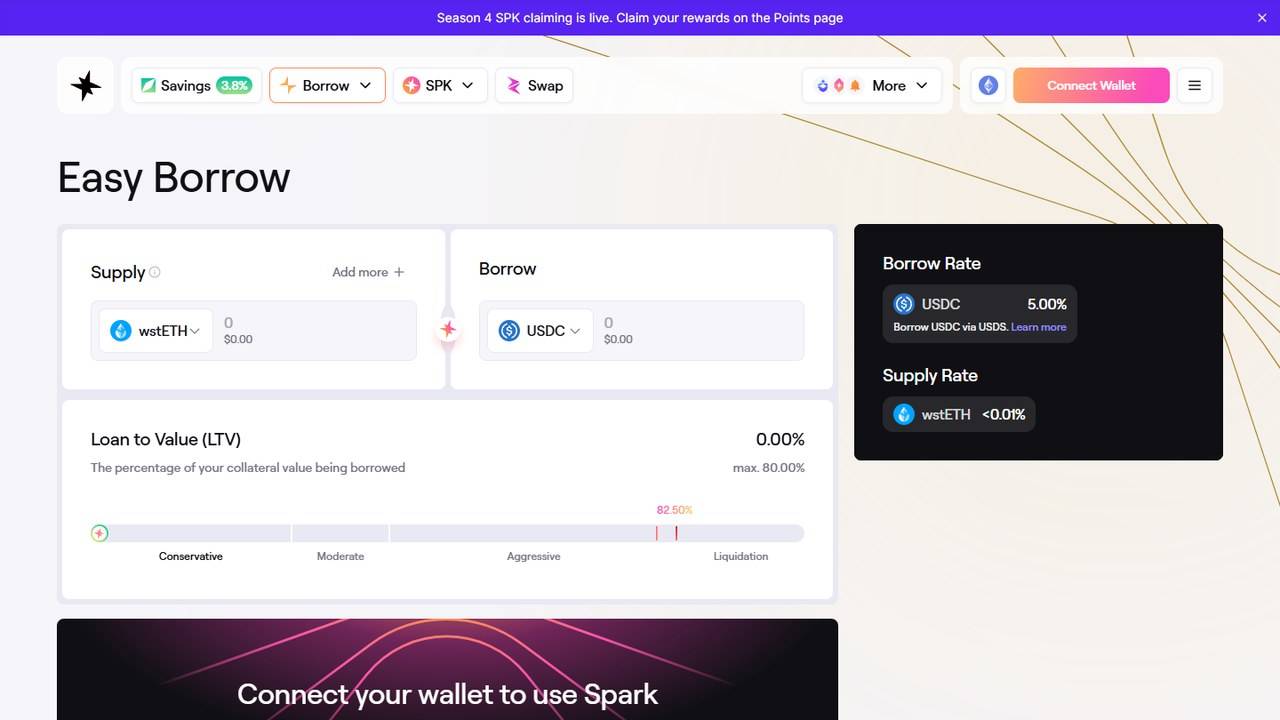
Easy Borrow after connecting. Supply wstETH, borrow USDC at 5.00%, maximum loan-to-value 80% and a liquidation marker at 82.50%.
The asset lists on the page showed supply options of wstETH, WBTC, weETH, cbBTC and ETH, and borrow options of USDC, USDT and USDS. This matches the docs, which say stablecoins are borrow-only on Ethereum.
The Borrow menu
The Borrow button opens a menu with two groups: SparkLend (Borrow stablecoins, My Portfolio, Markets) and Spark Isolated Markets, which carries a NEW tag.
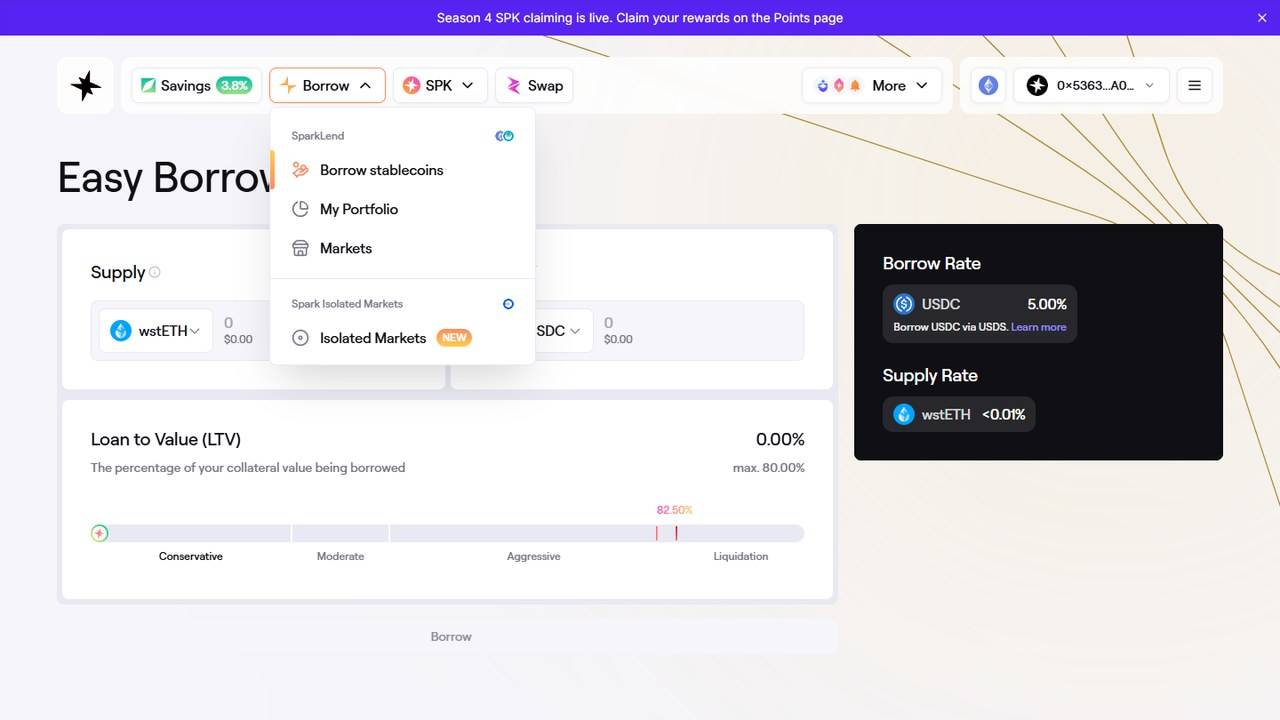
Borrow menu. One entry point for both the pooled market and the Morpho-powered markets.
Markets page
The Markets page is the full SparkLend table. At capture it showed Total Market Size $6.382B, Total Value Locked $4.056B and Total Borrows $2.326B. These match DefiLlama's SparkLend TVL of $4.09B closely, which helps explain why the homepage figure of $5.33B looked high: it appears to count something wider than the app's own TVL box. We could not confirm what, so we use the app and DefiLlama numbers.
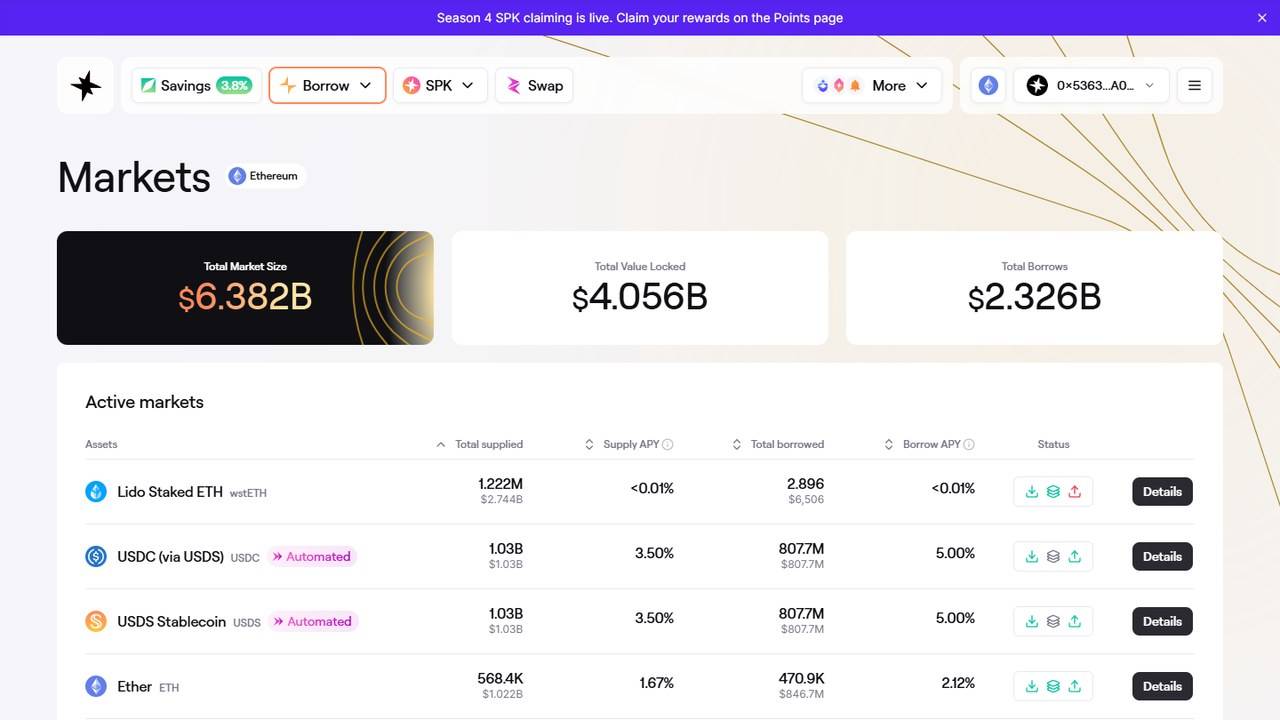
Markets page. Each row shows supplied, supply APY, borrowed, borrow APY and what you can do with the asset.
| Asset | Supplied | Supply APY | Borrow APY |
|---|---|---|---|
| wstETH | $2.744B | under 0.01% | under 0.01% |
| USDC via USDS | $1.03B | 3.50% | 5.00% |
| USDS | $1.03B | 3.50% | 5.00% |
| ETH | $1.022B | 1.67% | 2.12% |
| cbBTC | $477.5M | under 0.01% | 0.04% |
The USDC and USDS rows carry an "Automated" tag, which refers to the Liquidity Layer adding or removing liquidity automatically.
My Portfolio
My Portfolio shows your supplied and borrowed amounts, a Health Factor gauge from 1 to 4, a wallet donut chart and the Supply and Borrow tables. With an empty wallet it simply invites you to create a position.
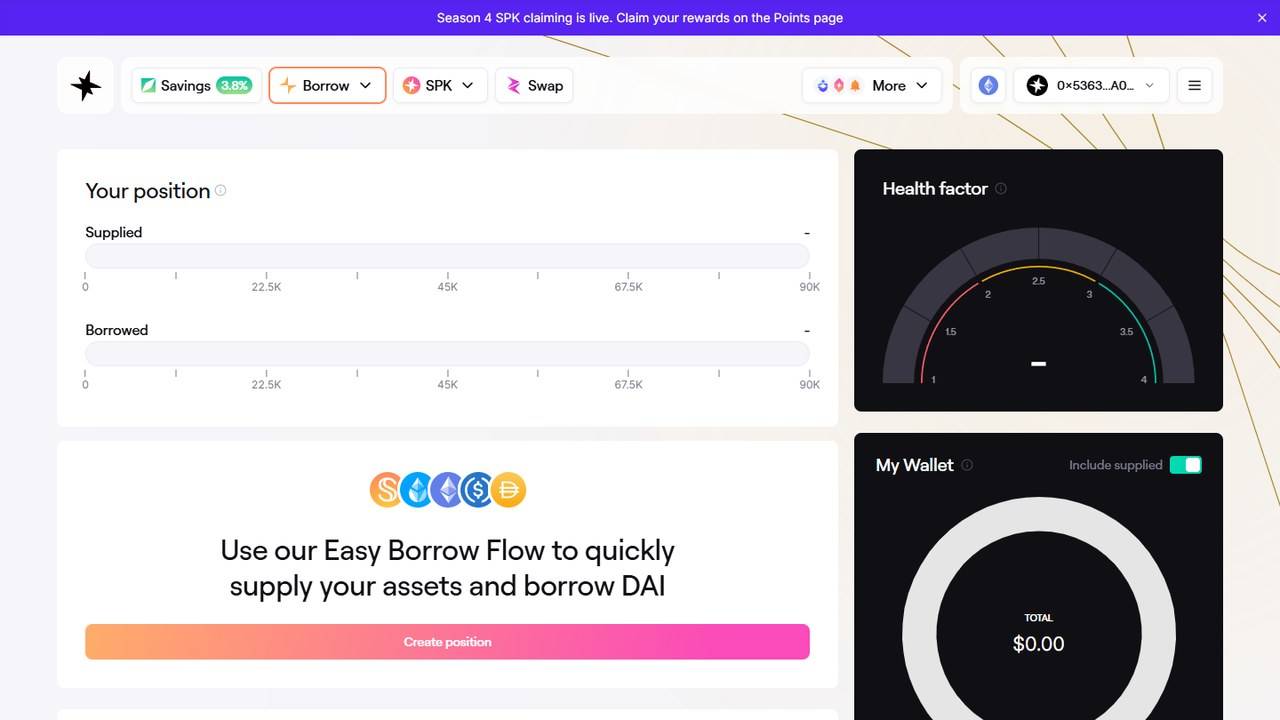
My Portfolio with a new wallet. One small oddity: the prompt says "borrow DAI", while the borrow list shows USDC, USDT and USDS, so that wording looks stale.
How to borrow (step by step)
- Connect your wallet and open Borrow, then Borrow stablecoins.
- Choose a collateral asset such as wstETH and enter an amount.
- Choose what to borrow, for example USDC, and watch the loan-to-value bar.
- Stay in the Conservative zone. The docs suggest a health factor above 2 for a safer margin.
- Approve and confirm the transactions in your wallet.
- Use My Portfolio to add collateral or repay.
We did not execute these steps, so gas costs and confirmation times are not from our own testing.
Rules inside SparkLend
SparkLend is based on the Aave v3 code, so advanced users will recognise its features. The docs describe them like this.
| Feature | How it works on SparkLend |
|---|---|
| E-Mode | ETH-correlated category lets WETH and wstETH be used at 92% LTV and a 93% liquidation threshold, for example when borrowing ETH |
| Isolation Mode | Isolated assets have a debt ceiling and can only be the sole collateral of a position |
| Liquidations | Open to anyone. At health factor between 0.95 and 1, up to 50% of debt can be repaid, at or below 0.95 up to 100% |
| Oracles | Median of RedStone, Chainlink and Chronicle |
| Killswitch | Pegged collateral that drifts from its underlying halts new borrowing |
| Flash loans | Supported, but SparkLend disables turning a flash loan into debt |
| Gnosis Chain | Deprecated, markets frozen and withdrawals still allowed |
Two recent changes matter. The docs say rETH has been frozen since 23 April 2026, and BTC e-mode was removed in the June 2026 spell, with remaining positions force-liquidated on 8 June 2026. That shows Sky governance will shrink a market when it wants to, using a publicly telegraphed timeline.
3. Isolated Markets (Powered by Morpho)
Isolated Markets are separate, single-pair loan markets. Each one has one collateral asset, one loan asset, its own price feed, its own liquidation limit and its own rate curve, and those five settings cannot change after the market is created. A problem in one market does not spill into another.
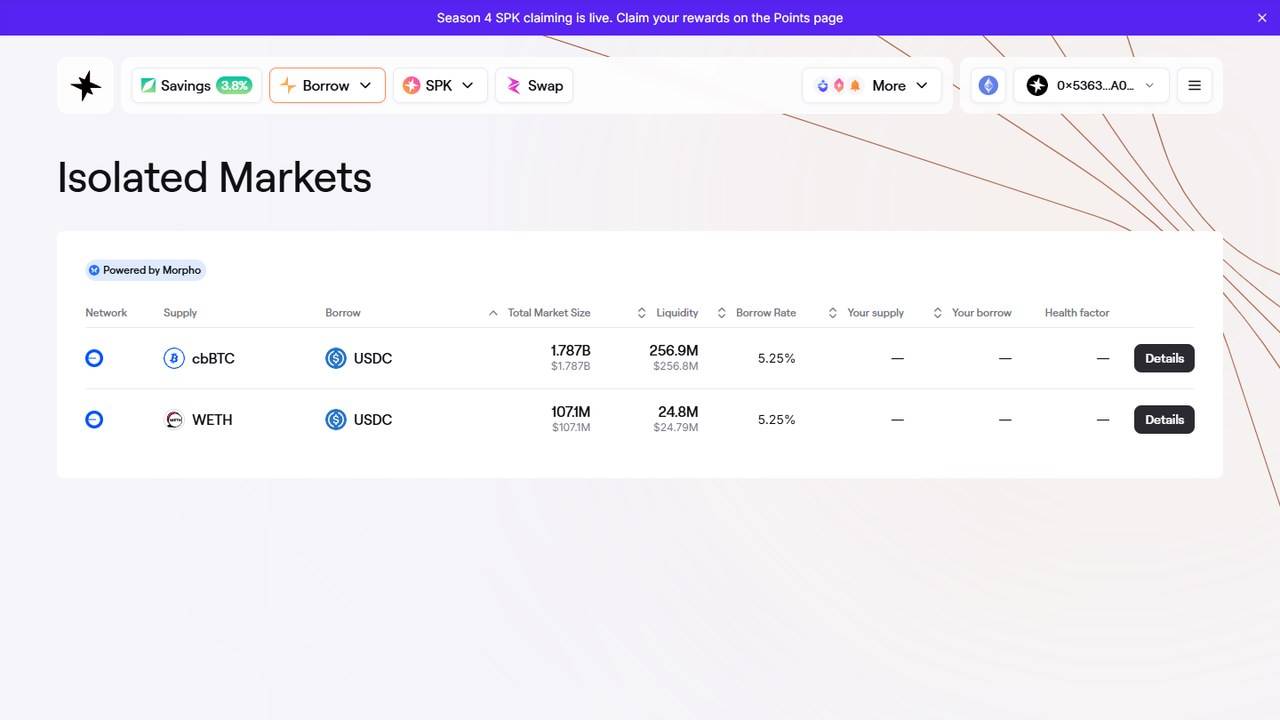
Isolated Markets page. "Powered by Morpho" appears at the top, and each row has a Details button.
At capture the page listed two markets. The cbBTC to USDC market showed a total size of $1.787B, $256.8M of liquidity and a 5.25% borrow rate. The WETH to USDC market showed $107.1M, $24.79M of liquidity and the same 5.25% rate.
| SparkLend | Isolated Markets | |
|---|---|---|
| Design | One shared pool | One market per collateral and loan pair |
| Collateral | Several assets in one position | One asset per market |
| Risk | Protocol-wide controls | Contained within each market |
| Powered by | Aave v3 fork | Morpho |
| Best for | Flexible positions | Targeted, higher-LTV loans |
The docs add a Public Allocator, which can pull liquidity from other Morpho markets so a large borrow can be filled. We did not test it. Because this product runs on Morpho's contracts, you also accept Morpho's own disclaimer, as the terms window told us.
4. Spark Liquidity Layer and the Data Hub
The Liquidity Layer is the engine that most users never touch. It moves Spark's stablecoin capital between venues such as lending markets, swap pools and tokenised assets under strict limits. The docs describe rate limits that refill up to a hard ceiling, slippage floors for each venue and tightly bounded over-the-counter exposure. They also say it has run without fault since November 2024, which is a claim we could not verify independently.
The best window into it is the Spark Data Hub, a separate dashboard with live numbers.
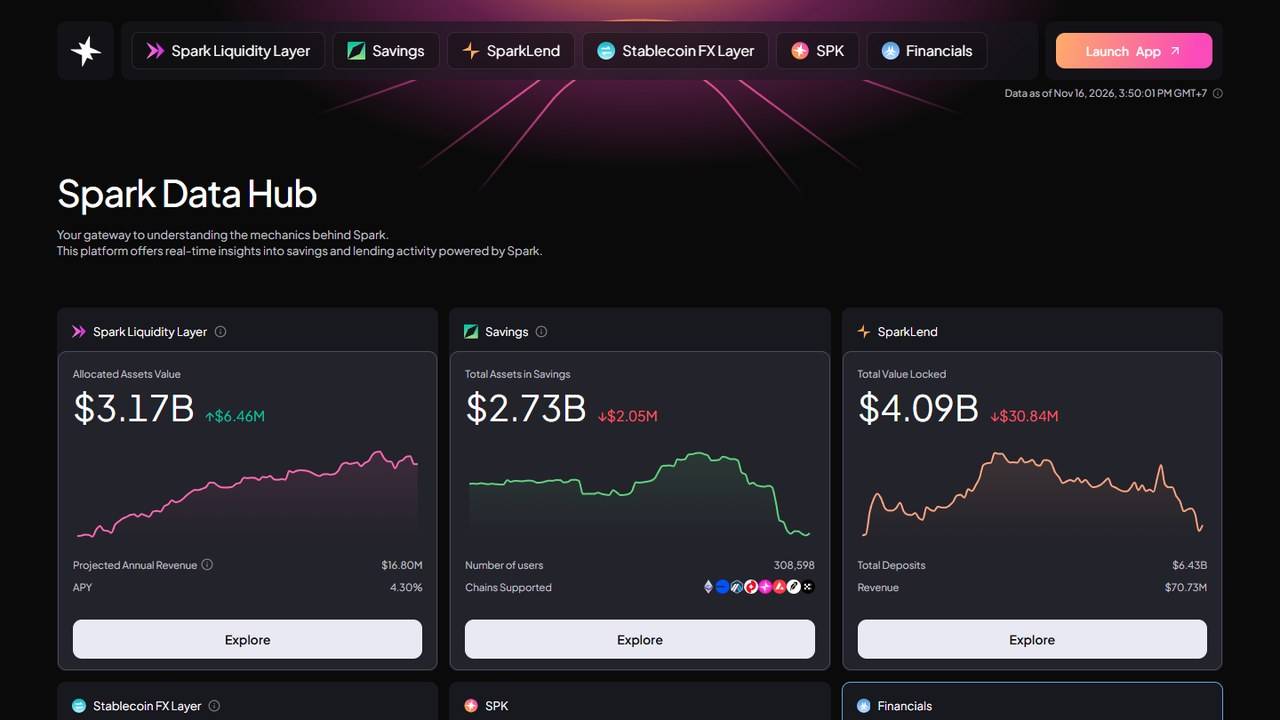
Data Hub on 16 November 2026. Liquidity Layer allocated assets $3.17B, savings total $2.73B and SparkLend TVL $4.09B.
| Panel | Figure shown |
|---|---|
| Liquidity Layer allocated assets | $3.17B |
| Liquidity Layer projected annual revenue | $16.80M |
| Liquidity Layer APY | 4.30% |
| Savings total assets | $2.73B |
| Savings users | 308,598 |
| SparkLend total deposits | $6.43B |
| SparkLend revenue | $70.73M |
| Stablecoin FX Layer 30-day volume | $5.66B |
| SPK total staked | 735.28M |
| Financials, projected yearly net returns | $20.92M |
The Data Hub also has a Financials tab, and the docs point to a live treasury view showing over $35 million in stablecoin equity capital that sits first in line to absorb losses.
Institutions
The Institutions menu on the website describes services for builders who want to bootstrap stablecoins, new chains or financial products. The page showed partner names including Coinbase, PayPal and Base.
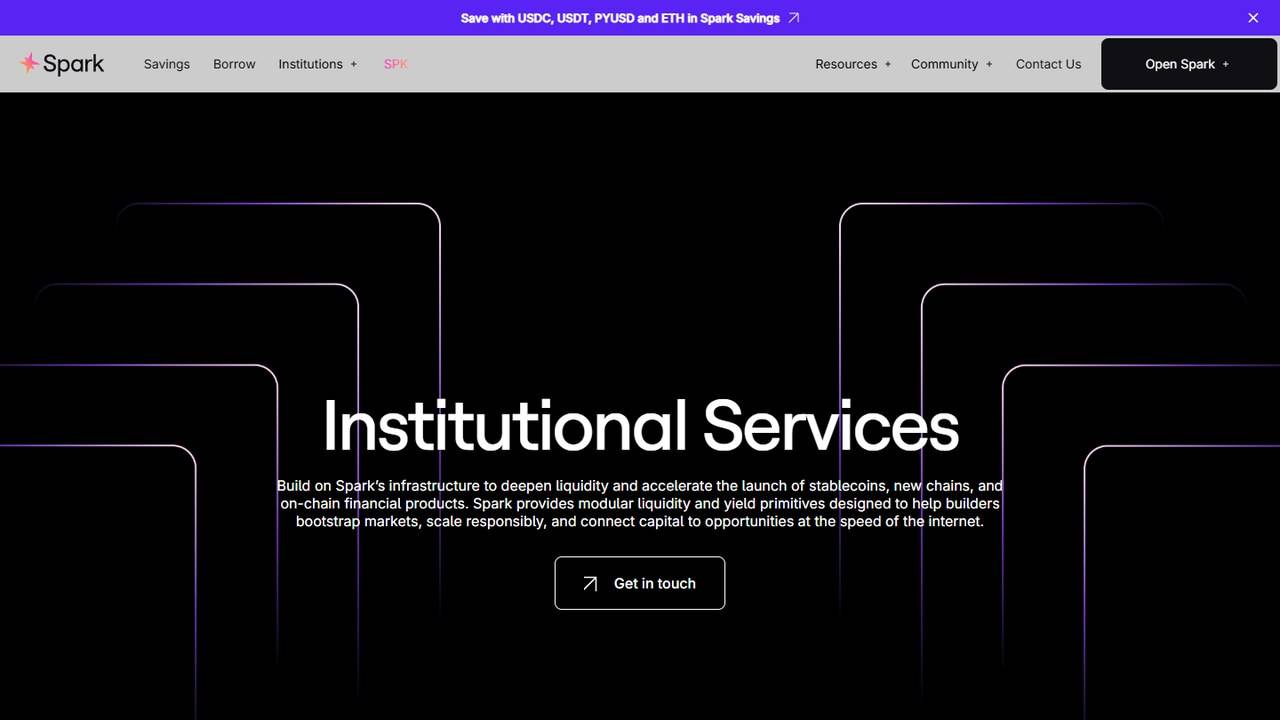
Institutional Services page. It is a pitch page with a Get in touch button, not a product you can use directly.
5. Swap
The Swap tab converts between USDS, USDC and DAI at a fixed rate. The docs say there is no slippage and, under current settings, no protocol fee beyond gas. On Ethereum it routes through Sky's LitePSM.
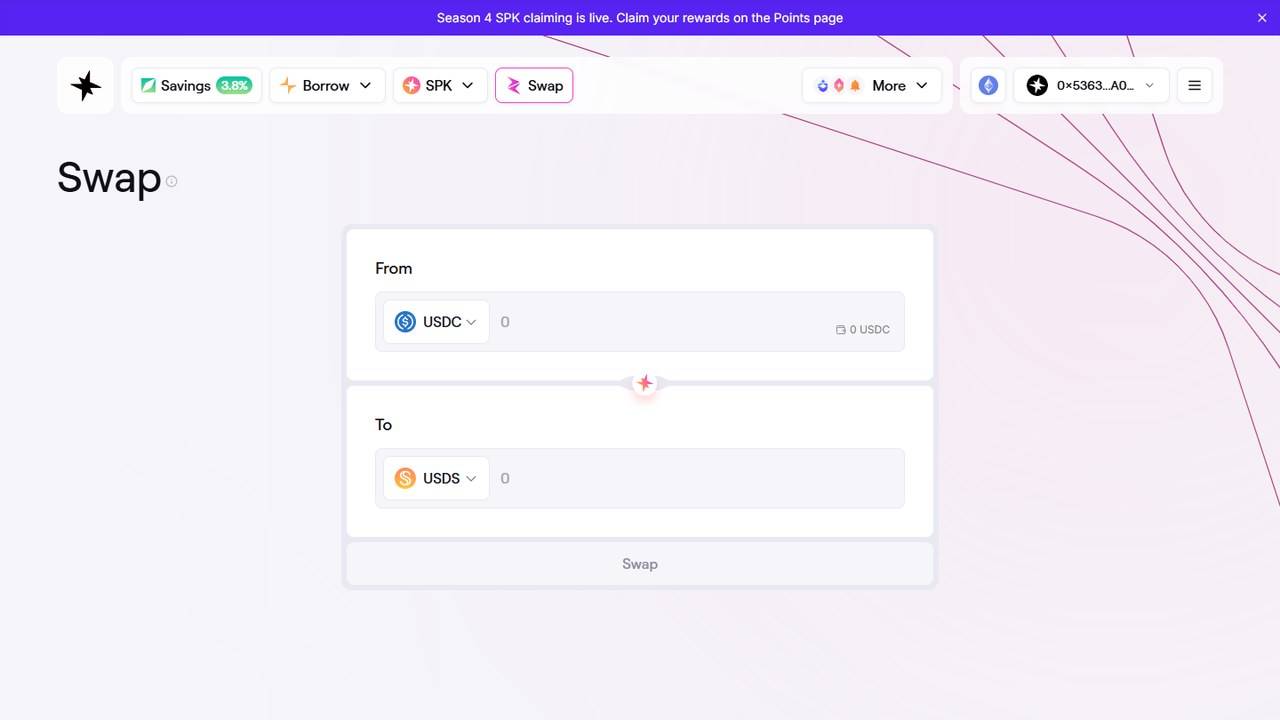
Swap with a connected wallet. USDC to USDS by default, with a balance of 0 in our test wallet.
It is a simple tool and useful if you need USDS for the SPK Farm. It is not a general token exchange.
6. The SPK Token: Farm, Staking, Points and Governance
SPK is Spark's governance and staking token. You do not need it to use savings or lending, so think of it as an optional layer.
Token facts
On 16 November 2026 CoinGecko showed SPK at about $0.0136, a market cap near $47.0M and a fully diluted value near $135.7M. Circulating supply was 3.46B of a 10B total, 24-hour volume was about $3.7M and the price was down roughly 32% over 30 days.
| Metric | Value |
|---|---|
| Price | $0.0136 |
| Market cap | $47.0M |
| Fully diluted value | $135.7M |
| Circulating supply | 3.46B of 10B |
| 30-day change | -32% |
According to the docs, 10 billion SPK were minted at genesis. The Sky ecosystem received 65%, and 35% went to the Spark ecosystem and team (23% ecosystem and 12% team). Sky distributes 4.55 billion of its share to USDS users through a 10-year farming campaign. The airdrop has ended, and the final claiming date was 17 December 2025. The docs warn that any site offering SPK claims today is a scam.
SPK Farm
You deposit USDS and earn SPK. At capture the APY read 4.38%, and the chart showed a spike above 15% in the early period that settled around 4% to 5%. The docs say funds in the farm are not lent out and can be withdrawn at any time with no fee beyond gas, but the rewards are paid in SPK, so their dollar value moves with the token price. You cannot earn the Sky Savings Rate and the farm rate on the same USDS at once.
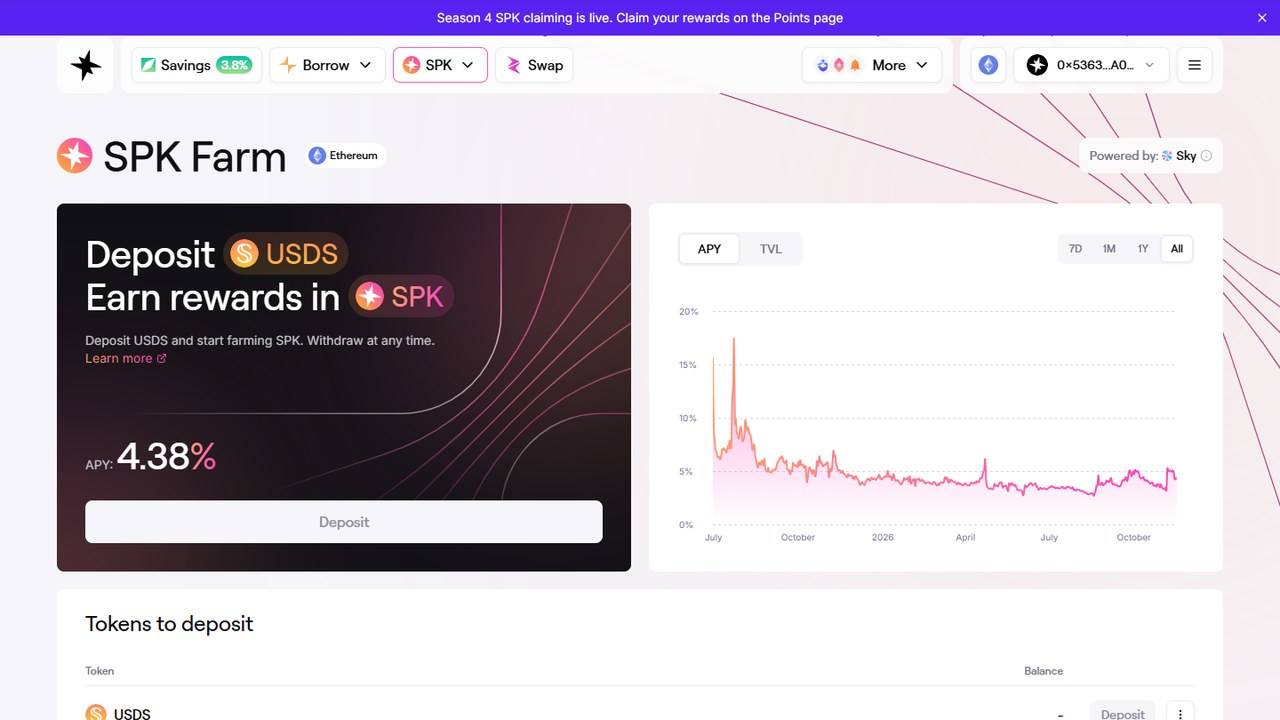
SPK Farm. Deposit USDS, earn SPK. The APY depends on the current SPK price.
SPK Staking
Staking uses Symbiotic's infrastructure. You stake SPK, and in return you earn Spark Points, not a cash yield. At capture the page showed about 6K stakers, 735.3M SPK staked and a 3x multiplier. The staking banner says the withdrawal delay is between 2 and 4 weeks, while the docs state a minimum of 2 weeks, so plan for the longer end.
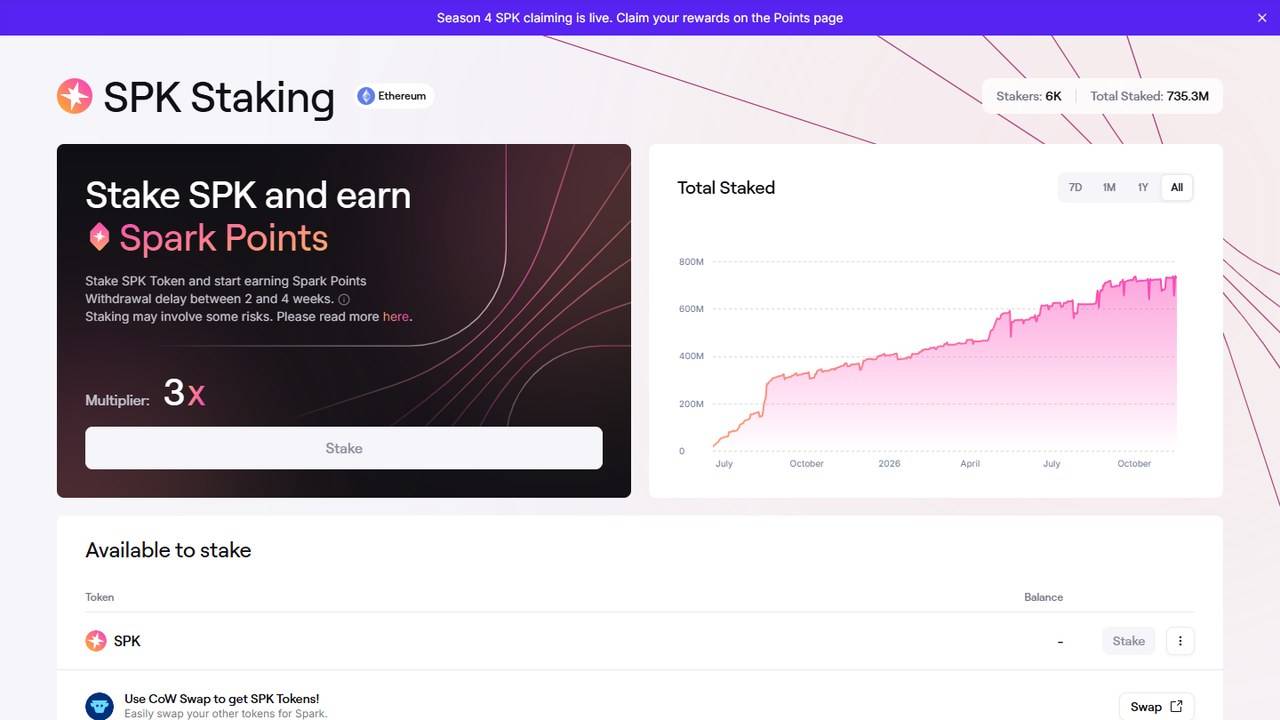
SPK Staking after connecting. The page also offers a CoW Swap shortcut if you need to buy SPK first.
To unstake you press Unstake, queue the amount, wait out the delay, then press Finalize. The page warns that staking may involve risks, which the docs link to.
Spark Points
Points are the loyalty system. Season 5 started on 12 August 2026 and runs to December. The Points page lists three actions: Loyalty (a boost for people who stayed from the previous season), Referral boost (about 10% extra) and Stake SPK. When we opened the page it asked for a six-character invite code, with a link to skip it.
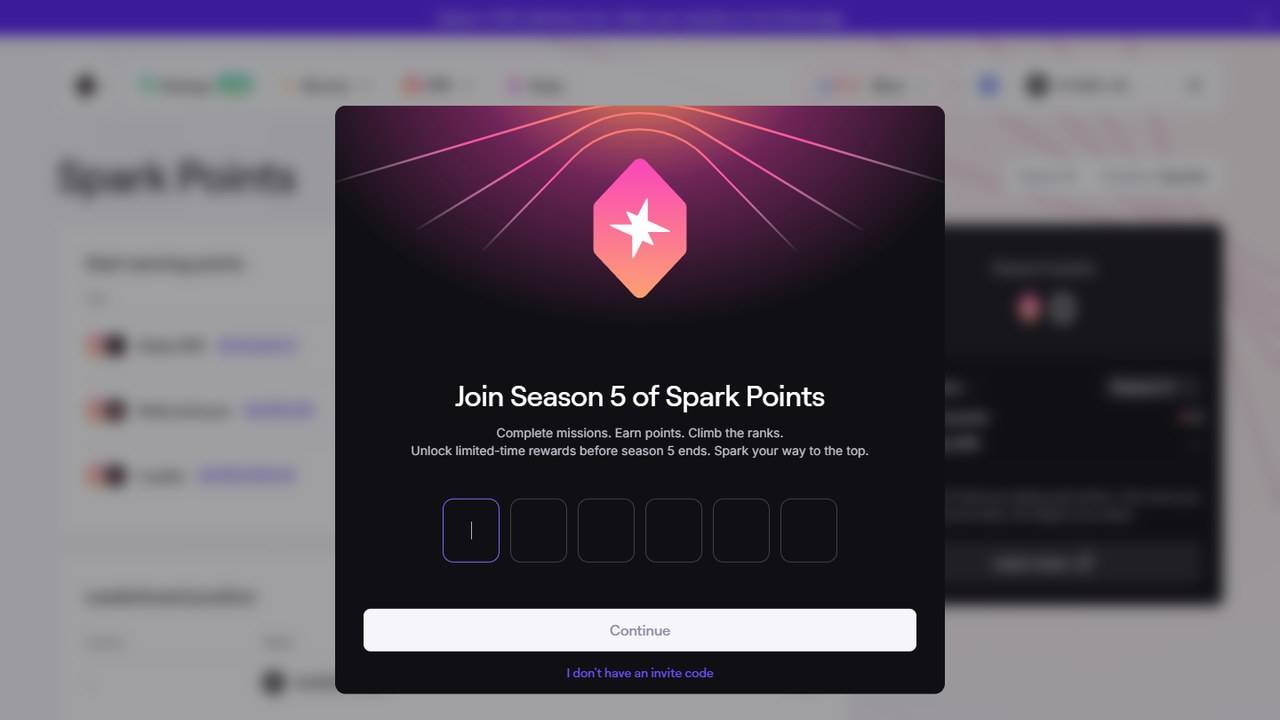
Points sign-up. You can enter a referral code or press "I don't have an invite code".
The public leaderboard on points.spark.finance listed 3,350 wallets and about 208.7 billion points in total. Points are not a token, and Spark does not promise what they will convert to, so do not treat them as a sure reward.
Governance
SPK holders vote on Spark Artifact Edit Proposals on Snapshot. A proposal passes with more than 50% of votes cast over a 3-day poll, after which changes are made through a Spark spell. Submitting a proposal needs 1% of total supply (100 million SPK) or a nested contributor status. Delegates must be whitelisted, and the weekly cycle starts every Monday with a Friday 8:00 UTC submission deadline.
7. Notification Center
The Notification Center lives under the More menu. It warns you by email or Telegram when a SparkLend position falls below a health factor you choose. The welcome window shows an example alert with a threshold of 1.20. You sign in with an email and a one-time code sent from the notifications.spark.finance domain, then add the wallets you want to monitor.
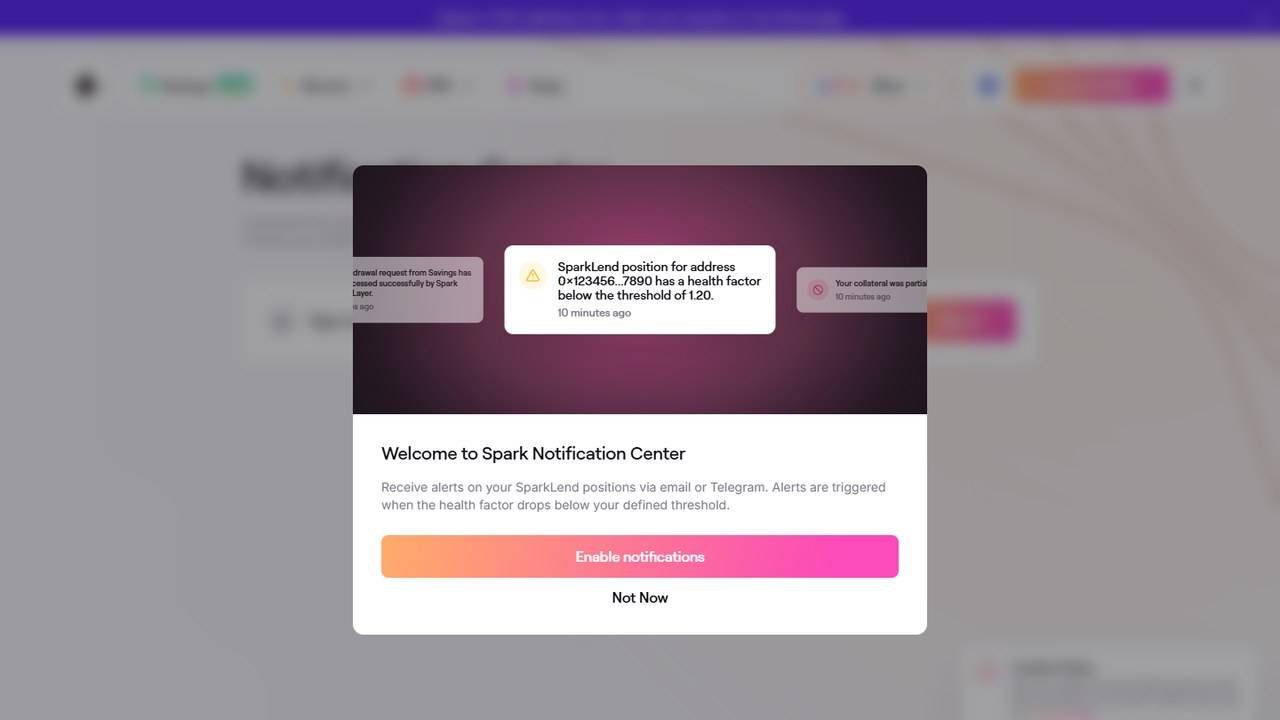
Notification Center welcome window. Alerts fire when health factor drops below your threshold.
We saw the welcome screen but did not enter an email, so we did not test delivery speed or reliability. If you borrow, this is worth setting up before you need it.
8. Tools for Builders and Integrators
Spark also sells itself to developers. Integrators receive a three-digit referral code (100 to 999) that they pass into the vault deposit function, which emits an onchain event so deposits can be traced to the partner. Each code gets a reporting dashboard that tracks time-weighted TVL. Vault tokens follow ERC-4626, and the docs offer a Savings Data API, example code for viem, ethers and Solidity, and a cross-chain savings rate oracle. We read these pages but did not build an integration.
Fees and Costs
| Cost | Detail |
|---|---|
| Account fee | None |
| Savings and farm | Docs describe them as fee-free beyond gas |
| Borrowing | Variable interest, for example 5.00% on USDC at capture |
| Swap | No slippage and no protocol fee beyond gas under current settings |
| Network gas | Every approve, deposit, borrow or repay is a transaction |
| Unstaking SPK | 2 to 4 week wait |
Gas is the hidden cost on Ethereum, especially for small deposits that need two transactions.
Security: What You Need to Know
Audits. SparkLend is built on Aave v3 code, which has been extensively audited, and Spark publishes audit folders for its own changes: core updates, SparkLend Advanced, the Cap Automator, the ALM Controller, the PSM, cross-chain helpers and the governance relay. We confirmed the list exists but did not read the individual reports. The Credora page inside the app mentions a $10M bug bounty programme.
Loss absorption. The docs describe a stack of protections for savings vaults. Spark's own junior capital (over $35M in stablecoin equity capital) takes losses first, followed by capital from other Sky participants, a planned senior pool, Sky's surplus buffer, an aggregate buffer and finally a token backstop where Sky mints SKY. Only if all of that is used up would losses be shared across USDS holders. This is a strong design on paper, but none of it has been tested by us, and a backstop that mints tokens depends on the market valuing those tokens.
Track record. DefiLlama's hacks list had no entry named Spark or SparkLend when we checked. That is not a safety guarantee, only the absence of a recorded incident.
| Risk | Why it matters |
|---|---|
| Governance dependence | Collateral, caps, oracles and vault rates are controlled through Sky governance |
| Smart contract risk | Audits reduce risk but do not remove it |
| Oracle and peg risk | A collateral that drifts from its peg can hurt borrowers and savers |
| Higher-yield vaults | stUSDS can restrict withdrawals and carries haircut risk |
| Liquidation | Borrowers can lose collateral if health factor falls below 1 |
| Token risk | SPK is small, volatile and diluting |
| Interface risk | Fake spark.fi lookalikes exist, and the domain recently moved |
Spark vs Competitors
| Spark | Aave V3 | Compound V3 | Morpho Blue | |
|---|---|---|---|---|
| Main idea | Savings plus lending backed by Sky | Largest pooled money market | Single-asset pooled markets | Isolated markets |
| TVL (DefiLlama) | $4.09B | $13.97B | $1.07B | $10.02B |
| Collateral list | Short, governance-controlled | Wide | Per-market | Per-market |
| Savings product | Yes, built in | Separate | No | Via vaults |
| Token | SPK | AAVE | COMP | MORPHO |
| Best for | Stablecoin yield, ETH-backed loans | Broad borrowing | Simple one-asset loans | Custom isolated loans |
Spark's edge is the savings side and the transparency tabs. Aave has more liquidity and assets, and Morpho has more flexibility. Spark even uses Morpho for its isolated markets, so they are partly partners rather than pure rivals.
Pros and Cons
| Pros | Cons |
|---|---|
| Clear collateral, liquidity and risk tabs on every vault | Heavy dependence on Sky governance |
| Independent Credora ratings shown in the app | Different TVL numbers on different pages |
| Short, conservative collateral list | Several products can confuse new users |
| Public Data Hub with revenue and capital figures | SPK token is small and dropped about 32% in 30 days |
| Fixed-rate swap and alerts for borrowers | Higher-yield stUSDS can restrict withdrawals |
| Works on desktop, tablet and phone | Docs and app sometimes disagree, for example on staking delay and rating figures |
Who Should Use Spark
Good fit: stablecoin holders who want a transparent rate with a visible breakdown of where the money sits, ETH holders who want a stablecoin loan with a clear loan-to-value guide, and builders who need ERC-4626 vaults or institutional liquidity.
Think twice: anyone who cannot monitor a health factor, anyone chasing the 13.87% stUSDS rate without reading the warning, small depositors on Ethereum mainnet where two transactions of gas can erase the yield, and people who expect SPK points to be worth a set amount.
Verdict
Spark earns 4.3 out of 5. It does the basics well, shows more of its inner workings than most competitors, and backs its numbers with independent ratings and a live data hub. It loses points for governance concentration, inconsistent headline figures, a volatile token and a product list that is wider than a beginner needs. If you want a calm place to hold stablecoins, start with the USDC or USDT savings vault, read all four tabs and begin small.
FAQ
Is Spark safe?
It is non-custodial, built on audited code and rated A- by Credora for the USDC vault, but it is still smart contract software that depends on Sky governance. Start small.
Do I need SPK to use Spark?
No. Savings, borrowing and swapping work without it.
Is Spark the same as Sky?
No. Spark borrows liquidity from Sky and builds products on top of it, so the two are closely linked but separate.
What is the difference between SparkLend and Isolated Markets?
SparkLend is one shared pool with several collateral types. Isolated Markets are single-pair loans powered by Morpho where each market stands alone.
Why do the TVL numbers differ?
The app and DefiLlama show about $4.06B to $4.09B for SparkLend, while the homepage shows $5.33B. We could not confirm what the homepage includes.
Can I lose money in the stUSDS vault?
Yes. The warning window says depositors can face haircuts and that withdrawals may be unavailable at times.
What happens if my health factor falls below 1?
Liquidators can repay part or all of your debt and take your collateral at a discount, according to the docs.
Did you spend real money?
No. We used an empty wallet, opened the deposit window and did not sign any transaction.
Quick Links
| Resource | Link |
|---|---|
| Website | spark.finance |
| App | app.spark.finance |
| Docs | docs.spark.finance |
| Data Hub | data.spark.finance |
| Points leaderboard | points.spark.finance |
| Security and audits | devs.spark.fi/security |
| DefiLlama | SparkLend |
| CoinGecko | SPK |
Editorial credits
Checked by TokenTopNews QC Team before publishing on November 18, 2026 for headline accuracy, original value, factual consistency, metadata, authorship claims, review evidence and risk disclosure: our AI review system checks every article before it goes live, and our duty editor monitors it after publication. Report an error.
TokenTopNews uses AI for research, drafting and review. Our editorial team is responsible for every article and corrects or withdraws articles when needed. How we review.
Disclaimer: this is an editorial review, not financial advice. DeFi carries risk of loss. Rates, TVL and token prices change constantly and were captured on 16 November 2026. Statements about risk controls are Spark's own descriptions unless we say we tested them.