



Last updated: November 17, 2026. Independent editorial review. We have no commercial relationship with Sanctum. Market and treasury figures in this review are dated observations from the named sources; retrieval times and timezones were not recorded, so intraday comparisons are approximate.
Who This Guide Is For
This guide is for people who have heard that you can "stake" Solana's coin, SOL, and earn a yield, and who keep seeing the name Sanctum next to it. You do not need to know what a liquid staking token, a validator, a multisig or an epoch is. We explain each word the first time it appears, with an everyday comparison.
It is also for readers who already know Sanctum as the team behind many branded staking tokens, and who want to know what the company looks like now. The site we opened has a staking app, a pool called Infinity, a transaction delivery service called Gateway, a developer platform called Ironforge, a page for institutions, an investor dashboard, a docs site and a phone wallet app that the company calls Sanctum App 2.0.
We did not only read the marketing. We opened the live site, the staking app, the docs and the investor page on a desktop, a tablet and a phone. We connected a fresh MetaMask wallet to the staking app, opened every tab we could reach, typed an amount to see a quote, and compared the numbers on the screen against CoinGecko, DefiLlama and Sanctum's own quarterly report. We deposited nothing, staked nothing, swapped nothing and signed nothing. Where we could not test something, we say so.
How We Tested Sanctum
| Device | Viewport | What we did |
|---|---|---|
| Desktop | 1440 x 900 | Homepage, staking app (Stake, Swap, Migrate, Unstake), Infinity page, Explore page, institutions page, app landing page, Gateway, Ironforge, docs, investor page, blog |
| Tablet | 1024 x 768 | Homepage, institutions page, staking app quote screen |
| Phone | about 430 px wide | Homepage, staking app, investor page, app landing page, quote screen |
Two kinds of pages are in this review. The marketing pages tell you what Sanctum wants you to know. The staking app is the working tool. We tried to keep the two apart, and we label every claim as either something we saw in the app, something the docs say, or something Sanctum reports about itself.
The Wallet We Used
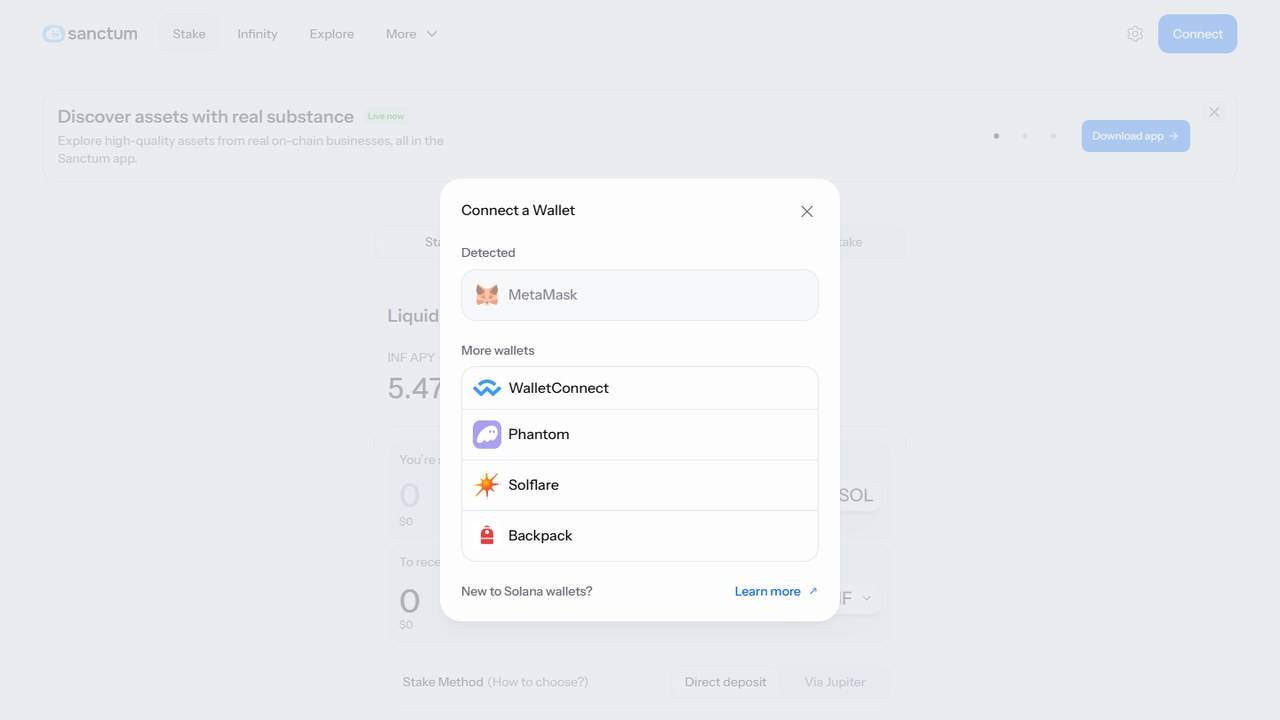
We used a brand new, throwaway MetaMask profile with no funds. We pressed Connect in the top right corner of the staking app, and a window listed MetaMask as "Detected" with Phantom, Solflare, Backpack and WalletConnect under "More wallets". We picked MetaMask. A MetaMask pop-up then said the site could see addresses, balances and activity and could ask for transactions, and that it cannot move funds without your permission. We pressed Connect on that pop-up and nothing else. Our test helper was set to press only that one button this time, and we read the text of the pop-up first.

The short address you see at the top of our later screenshots belongs to this empty test wallet. When we came back in a second session, the app recognized the wallet and showed it as connected without asking again. That is normal for a wallet connection, and you can disconnect at any time from the wallet.
Quick Verdict
Sanctum is a serious piece of Solana plumbing with a clear consumer face. The staking app was fast, plain and easy to follow on all three device sizes, the fee labels were visible before any click, and the docs page about the phone wallet openly lists what its security design does not protect against, which is rare. Our concerns are about numbers and proof. Several figures differ between Sanctum's own pages, CoinGecko and DefiLlama. DefiLlama shows no audit for its two largest Sanctum entries, and we found no bug bounty page. The company's own Q3 report says one large exit made up about 90 percent of one product's quarterly profit. The SANC token is about 89 percent below its high. This is a well-built tool for people who already want SOL staking, and a product whose business numbers you should read with care.
| Item | Detail |
|---|---|
| Project | Sanctum (site at sanctum.so, app at app.sanctum.so, docs at learn.sanctum.so) |
| Products | SOL liquid staking, Infinity pool (INF), LST swaps, stake account migration, Reserve, Router, Gateway, Ironforge, white-label staking for institutions, Sanctum App 2.0 |
| Chain | Solana |
| Token | SANC (formerly CLOUD) |
| Our editorial score | 3.8 out of 5 |
| Wallet needed to browse | No |
| Money at risk in our test | None |
What Is Sanctum (Plain English)
Think of a coat check at a big event. You hand over your coat, which is locked away for the evening, and you get a numbered ticket. You cannot wear the coat while it is checked, but you can pass the ticket to a friend, lend it, or use it as proof to get something else. When you give the ticket back, you get the coat. Staking SOL works like this. You lock your SOL with a "validator", a computer that helps run the Solana network, and the network pays you a reward. The locked SOL cannot be spent while it is locked.
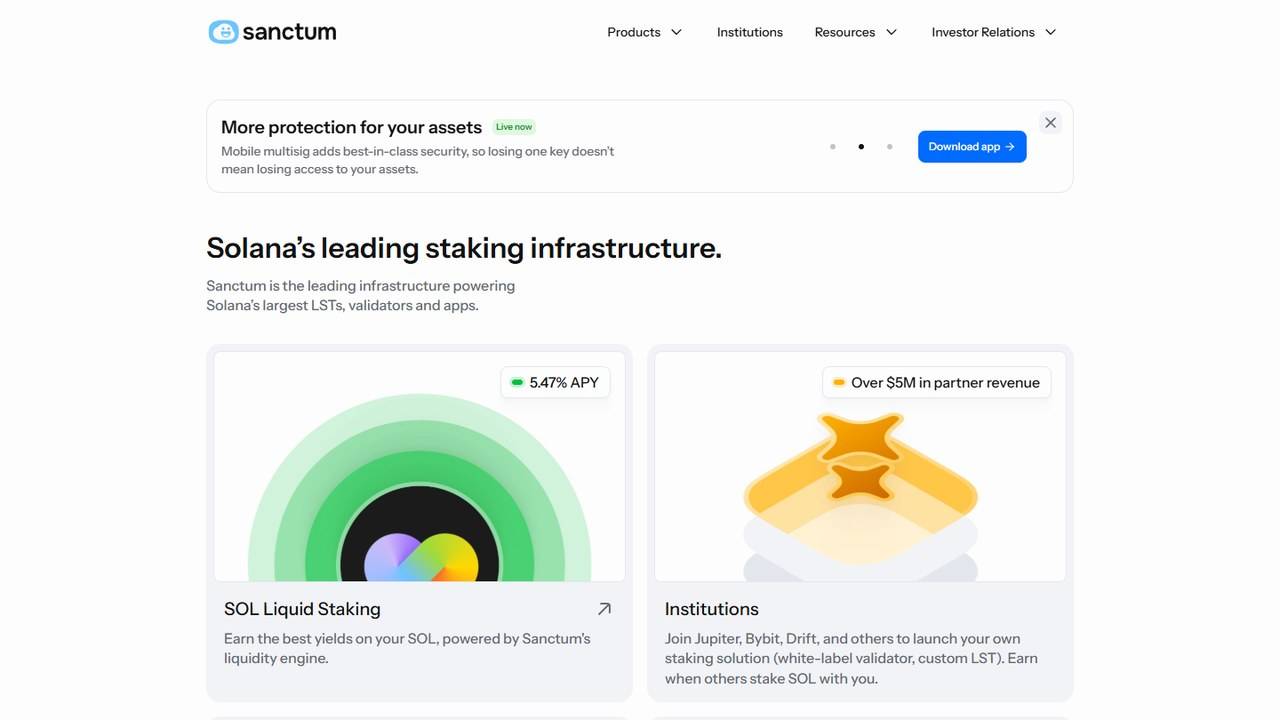
A "liquid staking token", or LST, is the ticket. You deposit SOL, you get a token that represents your SOL plus the rewards it earns, and you can use that token in other apps while the real SOL keeps earning. Sanctum is a company that builds the machinery for those tickets. Its own docs say the team has worked on Solana since 2021, was once called Socean, and has helped launch more than 1,361 LSTs, including branded ones for Jupiter (jupSOL), Bybit (bbSOL), crypto.com (cdcSOL), Drift (dSOL) and DeFi Development Corp (dfdvSOL).
In Plain Terms
- Sanctum is mostly a business-to-business company. Other companies use its tools to offer staking to their own users.
- It also runs a consumer staking app, where one token called INF is the main product.
- It has a phone wallet app, launched in 2026 and redone as App 2.0, which splits your keys across your phone, your cloud account and an email-linked recovery key.
- It has a token, SANC, that is traded on exchanges. The token is separate from the staking products.
The Four Roles
| Role | Who | What they do |
|---|---|---|
| Staker | You | Deposit SOL and receive a token that earns rewards |
| Partner | Jupiter, Bybit, Drift, crypto.com and others | Launch their own staking token on Sanctum's machinery and earn when others stake with them |
| Liquidity pools | Infinity and the Reserve | Let people swap one staking token for another, or for SOL, without waiting |
| Developer | Teams building apps | Use Router, Gateway and Ironforge to move and monitor transactions |
Key Facts at a Glance
| Fact | Value | Source and date |
|---|---|---|
| Staking yield shown for INF | 5.47% APY | Sanctum app and homepage, Nov 17, 2026 |
| Total value locked, Sanctum Validator LSTs | $1.343 billion | DefiLlama, Nov 17, 2026 |
| Total value locked, Infinity | $133.97 million | DefiLlama, Nov 17, 2026 |
| Total value locked, Reserve | $44.56 million | DefiLlama, Nov 17, 2026 |
| Total value locked shown by Sanctum | $1.53 billion | Sanctum investor page, Nov 17, 2026 |
| Infinity holders | 41,000 | Sanctum Infinity page, Nov 17, 2026 |
| Revenue, last 12 months | $5.37 million | Sanctum investor page, Nov 17, 2026 |
| Gross profit, Q3 2026 | about $0.83 million | Sanctum Q3 2026 report (self-reported) |
| SANC price | $0.06774 | CoinGecko, Nov 17, 2026 |
| SANC market cap | $33.06 million | CoinGecko, Nov 17, 2026 |
| SANC fully diluted value | $49.45 million | CoinGecko, Nov 17, 2026 |
| Staked SOL listed in the app | 237 LSTs, $1.52 billion | Sanctum Explore page, Nov 17, 2026 |
Why the Numbers Differ
We read the same fact on several pages and often got different answers. None of these are proof of a problem, but a careful reader should know about them.
- Market cap. Sanctum's investor page showed $31.20 million on our desktop pass and $31.33 million a few minutes later on the phone pass. CoinGecko showed $33.06 million. Prices move every minute, and the three sources probably use different supply counts.
- Total supply. The Q3 report says about 259 million SANC were burned from a community reserve and total supply fell from 1 billion to 740,678,163. CoinGecko shows 729.96 million for total supply, a gap of about 10.7 million (our calculation), and still lists a maximum supply of 1 billion. Our reading is that CoinGecko's data is not fully updated.
- Number of LSTs. The docs say more than 1,361 LSTs have been built on Sanctum. The Explore page in the app lists 237. Our reading is that the second number counts only the ones that are live and listed, but no page says so.
- Total value locked. DefiLlama's three Sanctum entries add up to about $1.52 billion (our calculation), which matches the $1.53 billion on the investor page. The Q3 report says 18.62 million SOL. At the roughly $118 SOL price the report names for October 1, that would be about $2.2 billion (our calculation). At the SOL price shown in the app on November 17, $72.61, $1.53 billion would be about 21 million SOL (our calculation). We cannot tell which of these is a growth story and which is a counting difference.
The Big Drop
SANC reached a high of $0.625 on November 13, 2024. At $0.06774, it trades about 89 percent below that high (our calculation). Its low was $0.01277 on June 7, 2026, and the price is now about 5.3 times that low (our calculation). The Q3 report says the market cap bottomed near $6 million in June and was $35.8 million on October 1. That is a large recovery from the bottom and a large drop from the top, in the same chart. CoinGecko shows a 7 day gain of 54.8 percent and a one year loss of 13.8 percent, so the token is very volatile.
Related Entries
DefiLlama splits Sanctum into several listings: Sanctum Validator LSTs, Sanctum Infinity and Sanctum Reserve. The hacks database lists no Sanctum incident under the names Sanctum, Socean or Infinity. This matters when you compare Sanctum with others, because the largest listing may include tokens that other listings also count. See the competitor section for how we handled that.
How Sanctum Looks on Your Device
Desktop
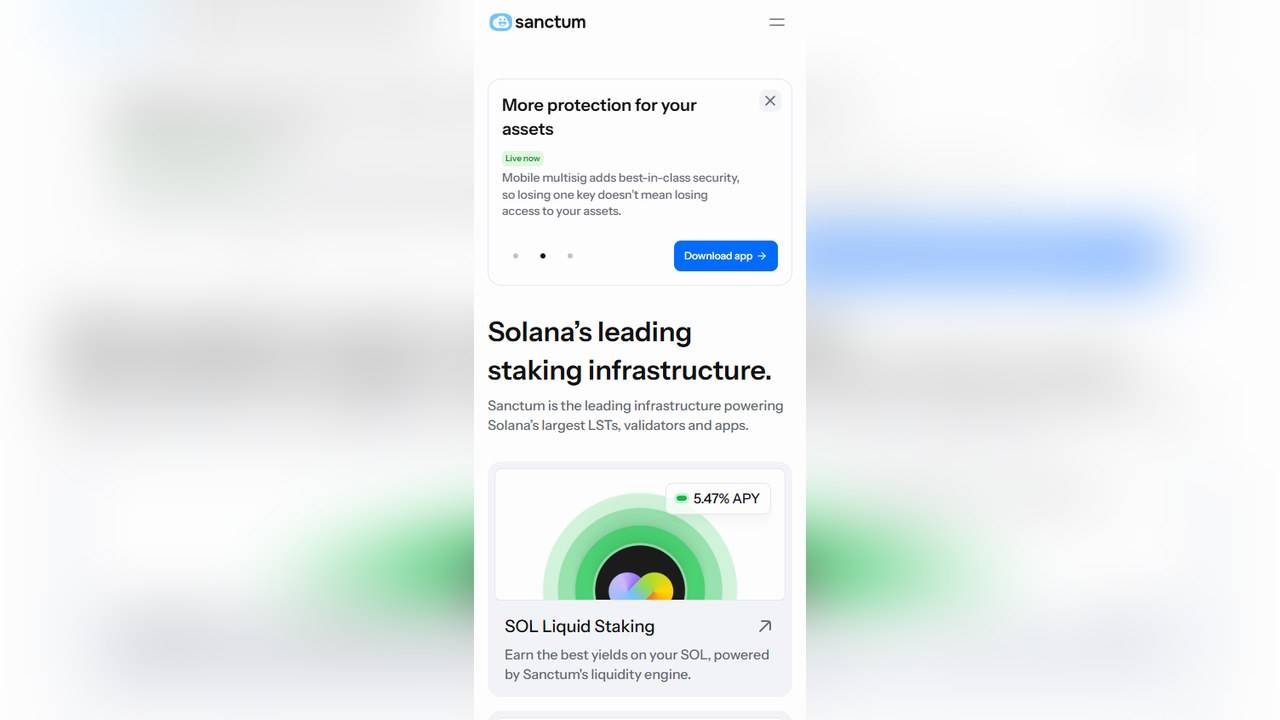
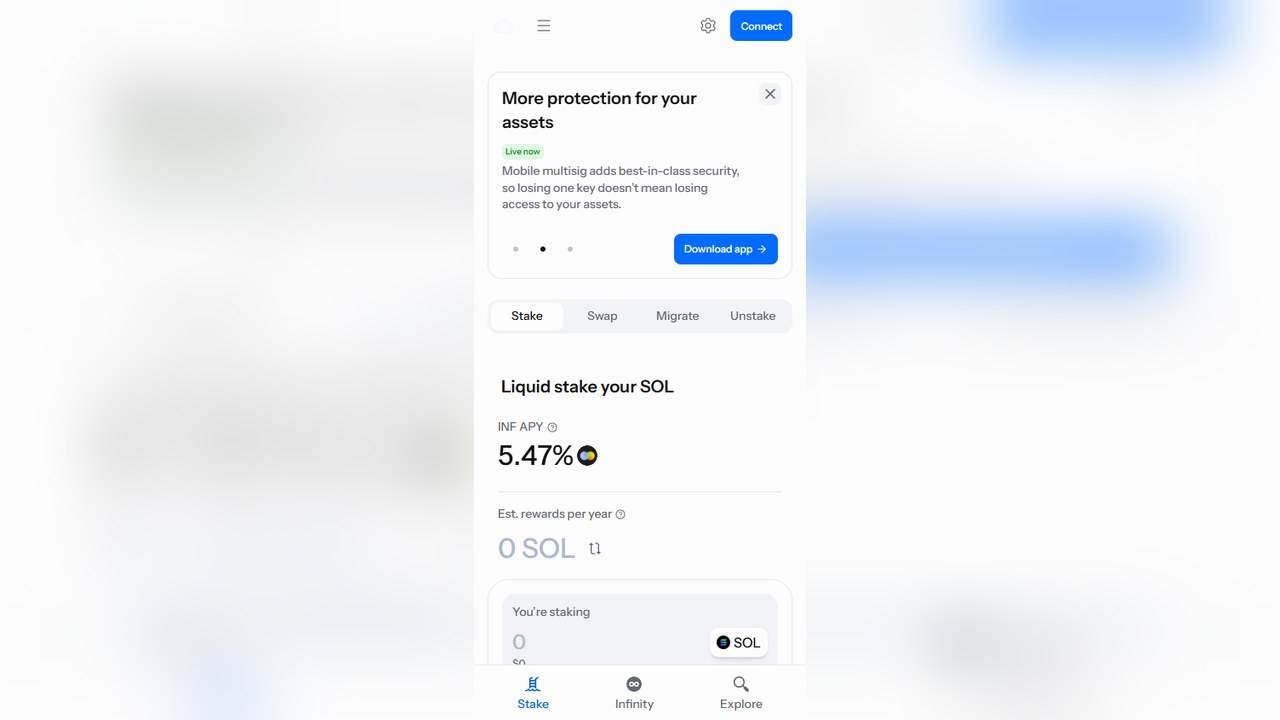
The staking app opens straight onto the Stake tab with one form: you type an amount of SOL, you see how much INF you would receive, and a button says what is missing, for example "Enter amount" or "Insufficient SOL". Above the form is a rotating banner with three messages, "Earn SOL every second", "More protection for your assets" and "Discover assets with real substance". Each has a Download app button. The banner stays on every tab, which is a little repetitive, but it can be closed.
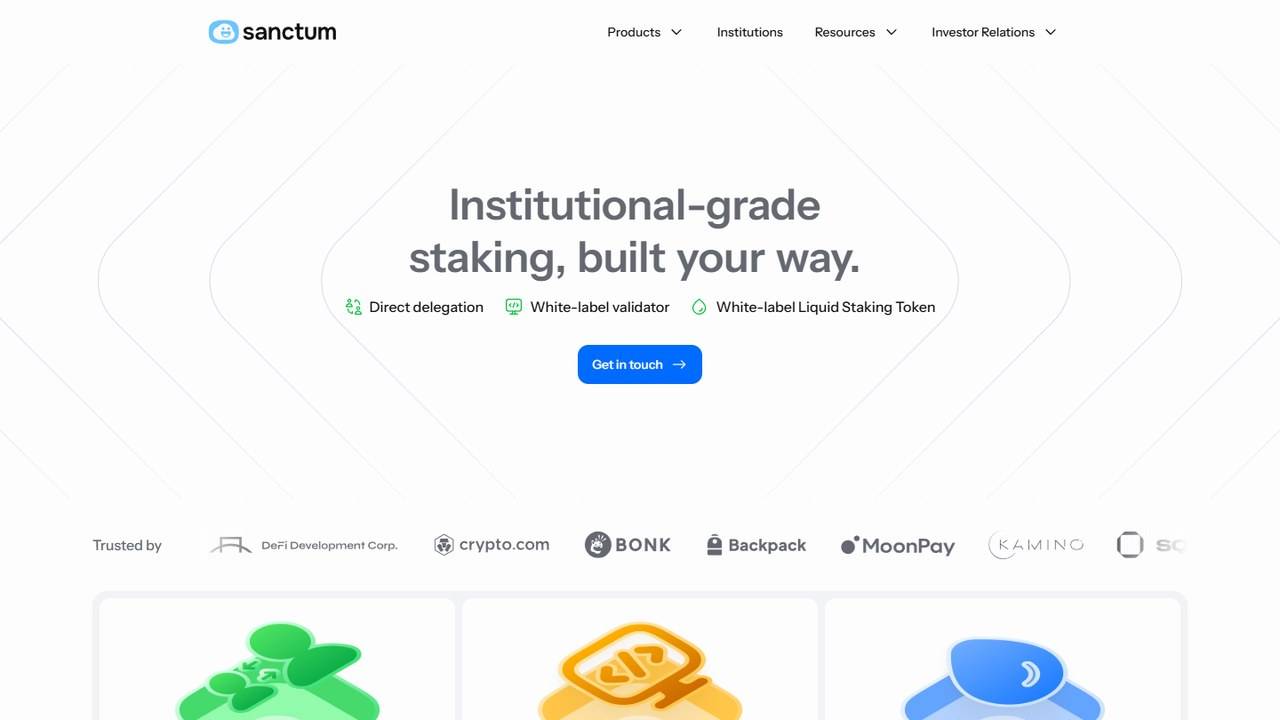
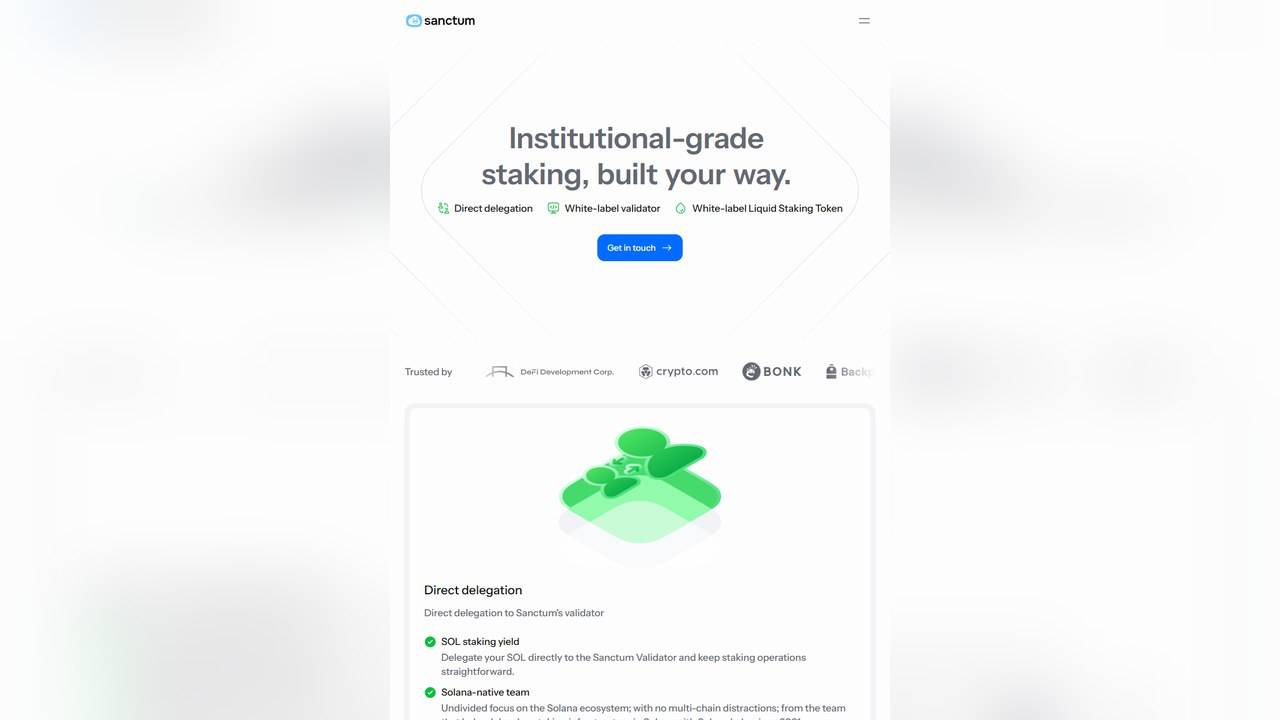
The marketing site is clean and light. The institutions page opens with "Institutional-grade staking, built your way" and a row of logos labeled "Trusted by". The docs, hosted on GitBook, have a left menu with the phone wallet pages first, then the introduction, then technical pages for Router, Infinity, the Reserve and swSOL.
Tablet
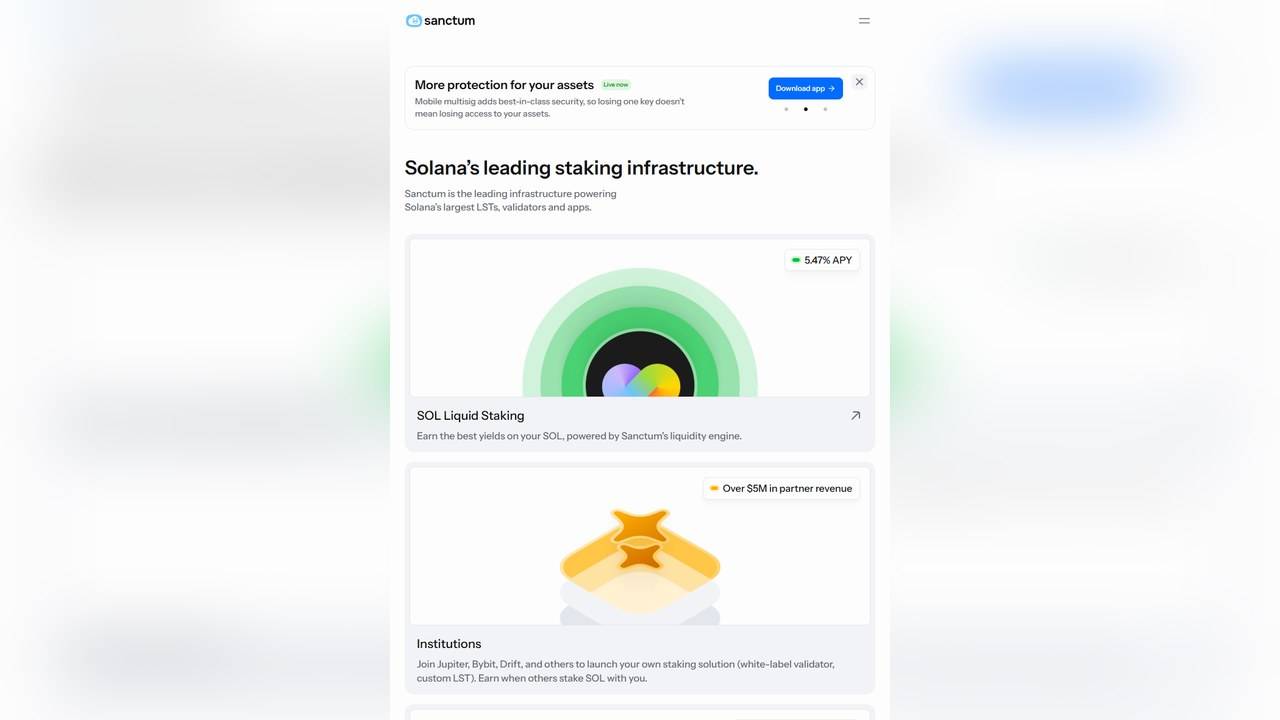
On a tablet width, the homepage turns into a single column of cards with a menu button in the corner. It is easy to read and nothing was cut off. The institutions page does the same, with three short labels under the headline: direct delegation, white-label validator and white-label liquid staking token.
Phone
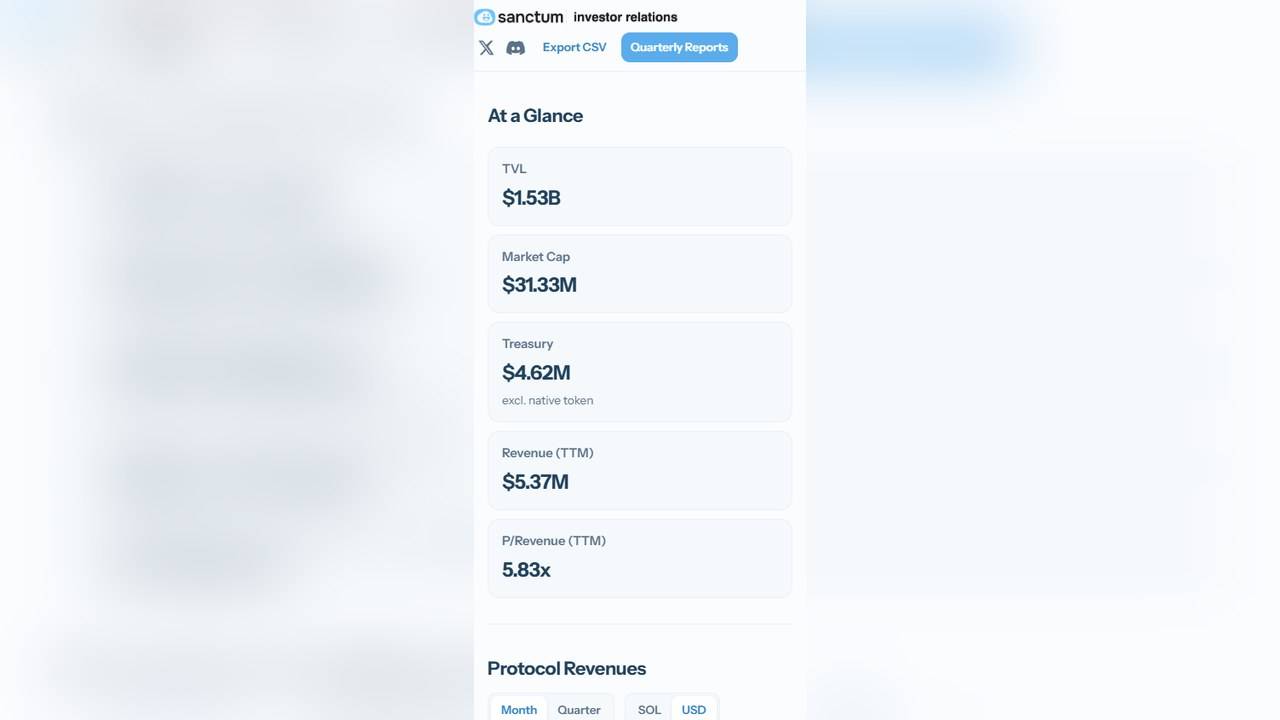
On a phone, the staking app swaps the top menu for a bottom bar with three buttons: Stake, Infinity and Explore. The form fits the screen, the buttons are large and the fee line is still shown. The investor page turns into a stack of cards with one number each, which is much easier to read on a small screen than a table.
Bugs and Rough Edges We Found
| Item | What we saw | Why it matters |
|---|---|---|
| docs.sanctum.so | Returned a server error (522) when we tried it; the docs worked at learn.sanctum.so | A reader who guesses the obvious address may think the docs are down |
| Pop-up on tablet | A floating "Sanctum App 2.0 is here" card sat on top of the Direct deposit button on the tablet quote screen | It hides a control until you close it |
| Repeated banner | The same three-message banner shows on every tab | Takes space from the form on small screens |
| Zero yield on Swap | The Swap tab shows an APY of 0.00 percent before you pick a token | It looks like a broken number but is only an empty field |
| Zero yield on one token | The Explore page text listed BulkSOL at 0 percent APY | Could be a new token or a gap in the data; no note explains it |
| Number mismatches | Market cap, supply and token counts differ between pages | See the section above |
Connecting Your Wallet
- Open app.sanctum.so. You do not need a wallet to browse the tabs.
- Press Connect in the top right corner.
- Pick your wallet. MetaMask appeared first because it was detected in our browser.
- Read the wallet pop-up. It should list only your account and the permissions to see balances and ask for transactions.
- Press Connect in the pop-up. Do not press anything that says Sign, Approve or Confirm unless you know what it does.
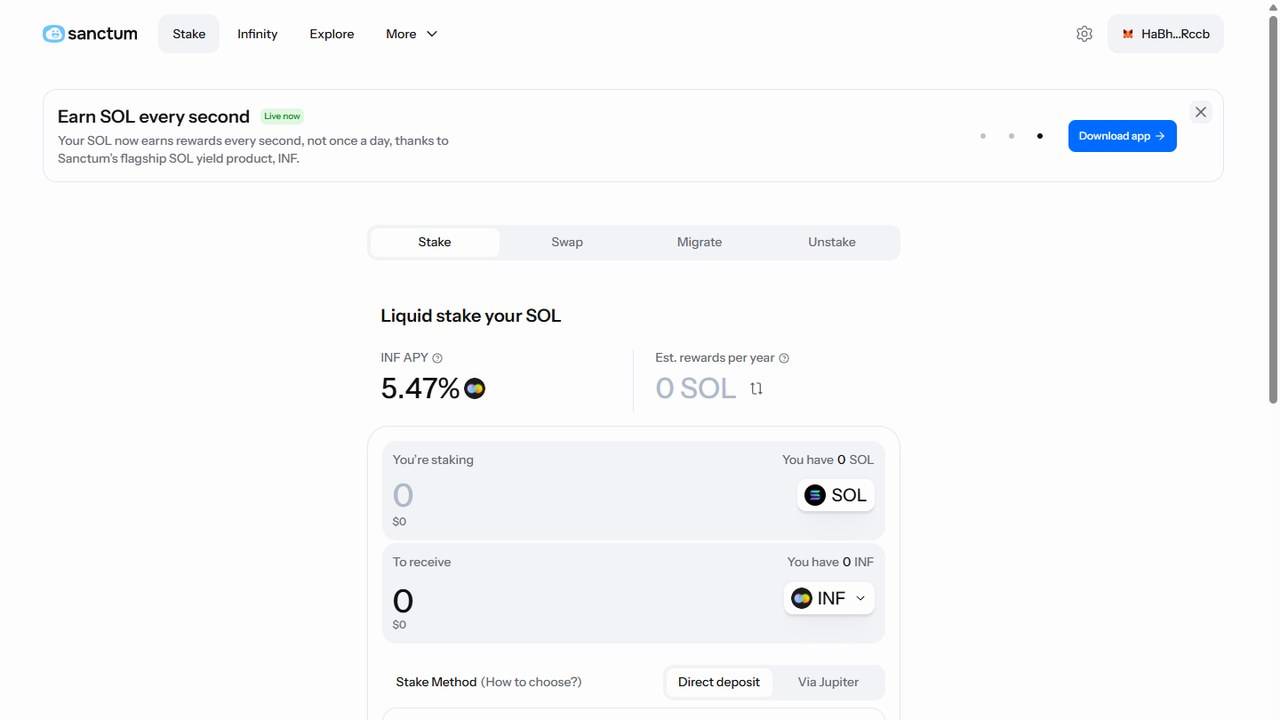
- The top right corner now shows a short form of your address.
A beginner safety tip. Use a separate browser profile and a separate wallet for trying new apps. Keep only the amount you plan to use in it. The staking app is at app.sanctum.so; check that exact address before you connect, because fake copies of popular apps are common.
Core Features at a Glance
| Feature | What it does | Tested by us |
|---|---|---|
| Stake | Turn SOL into INF or another staking token | Opened, typed an amount, read quotes; no deposit |
| Swap | Trade one staking token for another | Opened; no token picked, no swap |
| Migrate | Turn existing stake accounts into tokens | Opened; our wallet had no stake accounts |
| Unstake | Turn a staking token back into SOL, instantly or after a delay | Opened; no token picked, no unstake |
| Infinity page | Explains INF and shows its yield, value locked and holders | Read on desktop |
| Explore | Lists every staking token built on Sanctum | Read on desktop |
| Reserve and Router | Liquidity back-up and the routing layer used by other apps | Docs only |
| Gateway | Paid service that sends transactions to Solana | Marketing page only; no account |
| Ironforge | Developer operations platform | Marketing page only; no account |
| Institutions | White-label validators and staking tokens | Marketing page only; no contact form sent |
| Sanctum App 2.0 | Phone wallet with a 2-of-3 multisig | Marketing page and docs only; app not installed |
| swSOL | A wrapped SOL that puts part of the SOL to work | Docs and Q3 report only |
Feature 1: Staking SOL into INF
What it is
Staking in the app means you swap SOL for INF. INF is a token that is backed by a basket of other staking tokens held in a shared pool. Think of a fruit basket: instead of owning one kind of fruit, you own a slice of a basket that contains many kinds, and the basket owner also earns a small fee whenever someone swaps one fruit for another.
How the docs describe it
The docs say Infinity is a multi-token shared liquidity pool. Holders earn the staking rewards of the tokens in the pool, plus swap fees paid by traders. The Infinity page in the app says it is the only liquid staking strategy that earns trading fees as well as staking, MEV and block rewards. "MEV" is extra income validators can earn from ordering transactions. We could not check the claim that no other token does this, and we did not compare it against every rival.
What we saw
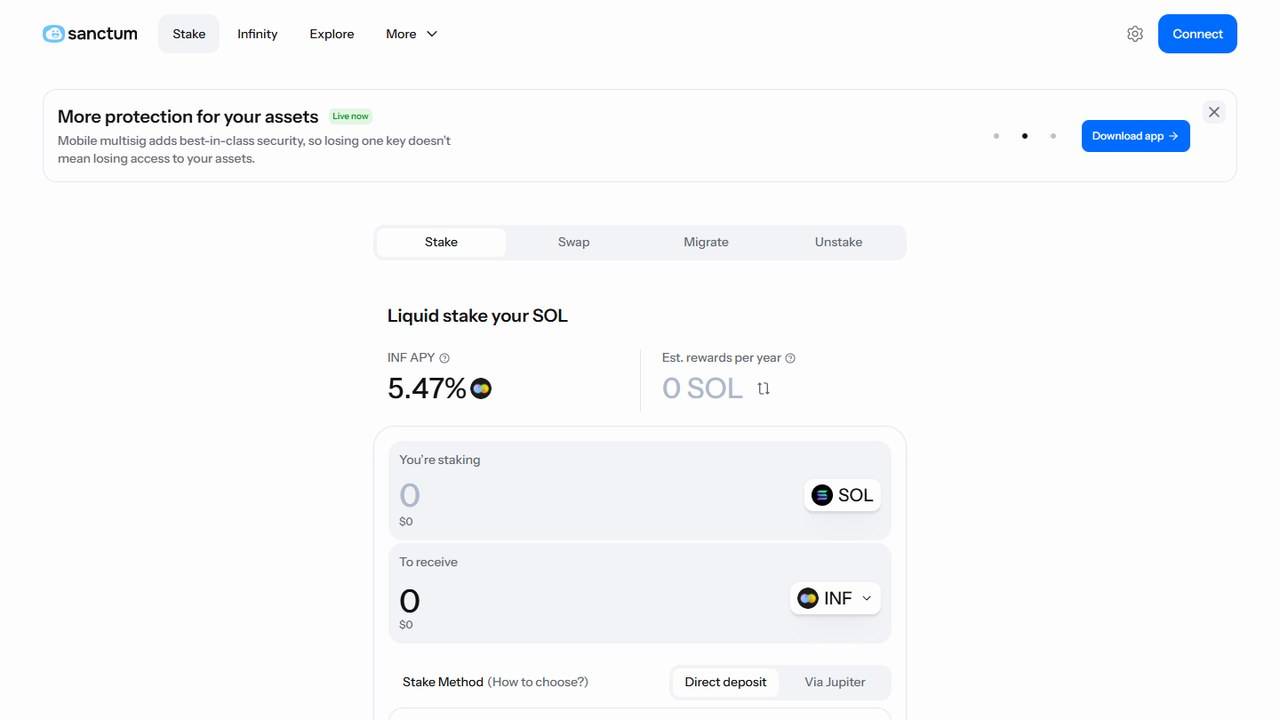
The form shows "INF APY 5.47%" and "Est. rewards per year". When we typed 1 SOL, the app showed $72.61 as the value of 1 SOL, a quote of 0.68216129 INF worth $72.49, and an estimated yearly reward of 0.0547 SOL. A button said "Insufficient SOL" because our wallet was empty, which is the correct and safe behavior.

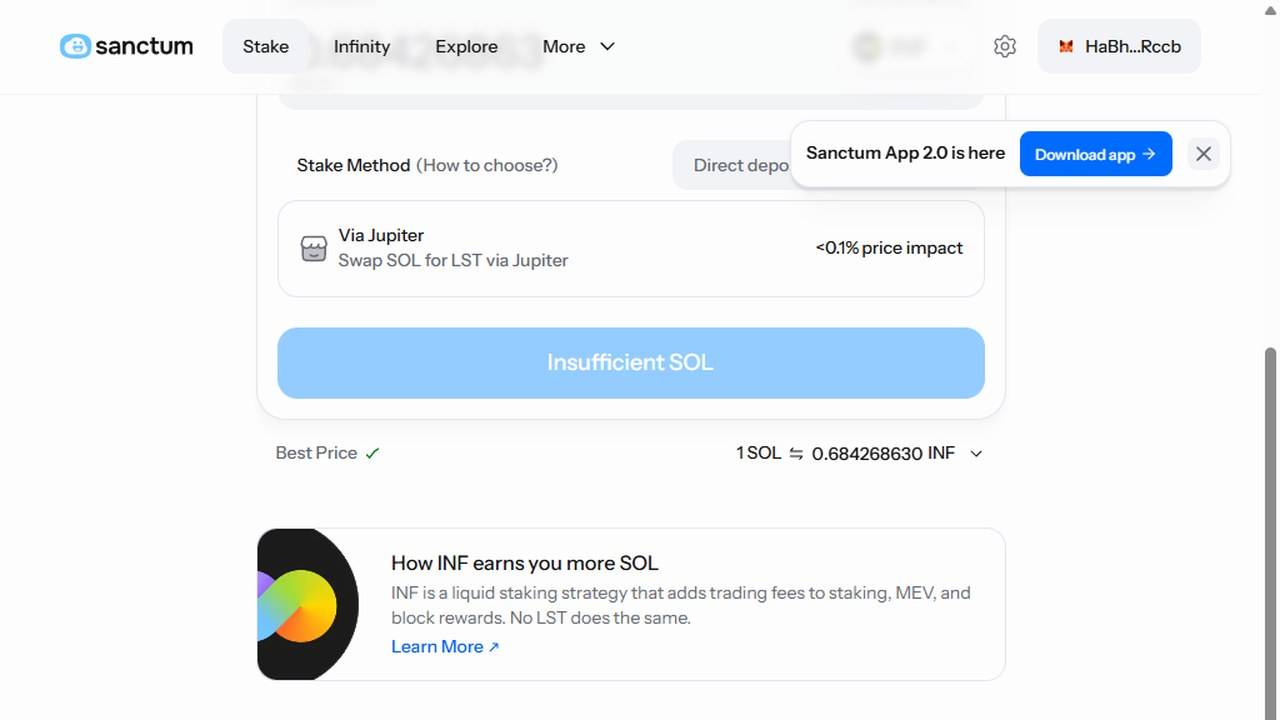
There are two ways to stake. "Direct deposit" mints the token through its own pool and is labeled "0% Deposit Fee" and "0% Price Impact". "Via Jupiter" swaps SOL for the token on the Jupiter trading app and is labeled "<0.1% price impact". The two quotes we saw, taken a short time apart, were 0.68216129 INF for direct deposit and 0.68426863 INF through Jupiter. The Jupiter quote was about 0.3 percent higher (our calculation). That is a snapshot and not a rule, since prices change by the second, but it shows that "0% fee" does not always mean the best result. The app has a "(How to choose?)" link next to the toggle and a line that says "Best Price" under the form.

On the tablet, the same screen is scrolled to the lower part, and the quote line reads "1 SOL for 0.684268630 INF". On the phone it is identical, with the bottom navigation bar below.

Our rating
4.2 out of 5. The form is simple, shows two ways to stake, and puts the fee wording where you can see it. We deduct for not being able to test a real deposit, and because a 0% label hides the fact that the quote can be slightly worse than the alternative route.
Feature 2: Swap
What it is
Swap lets you trade one staking token for another, for example a Jupiter token for INF, without going back to SOL first.
How the docs describe it
The docs say Infinity supports swaps between tokens, from a token to SOL, and from SOL to a token. The app's own FAQ on this tab asks "Why can't I swap to or from SOL here?", which tells us that this tab handles token to token trades and that SOL has its own tabs. We did not open that answer.
What we saw
The tab shows two boxes, "You're swapping" with a Select button, and "To receive" already set to INF. Below them are two numbers, APY and INF APY, and a button that says "Select a token". Nothing happens until a token is chosen.

Our rating
3.8 out of 5. It is clear and uncluttered. We could not test routing, price impact on a real token, or the wait time, so the rating reflects the design only.
Feature 3: Migrate
What it is
If you already staked SOL the old way, the coins sit in a "stake account" that unlocks slowly. Migrate turns that account into a liquid token so you can use it again.
How the docs describe it
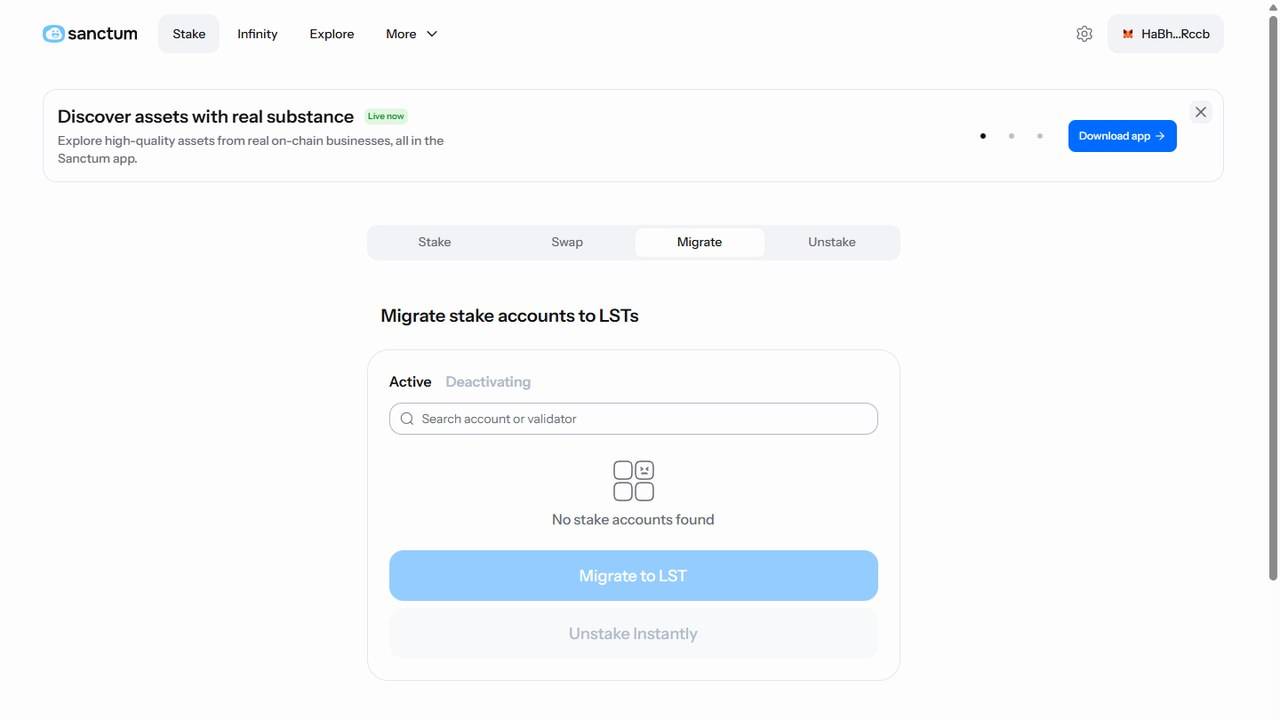
The tab has two lists, Active and Deactivating, a search box and two buttons, "Migrate to LST" and "Unstake Instantly". The FAQ lists questions such as why you should migrate, what a stake account is, and why some accounts cannot be migrated.
What we saw
Our wallet had no stake accounts, so the screen said "No stake accounts found" and both buttons were greyed out. That is the right response for an empty wallet, but it means we saw none of the real flow.
Our rating
3.5 out of 5. A useful tool for people who already staked, but we could not exercise it. The rating reflects the screen and the FAQ titles only.
Feature 4: Unstake
What it is
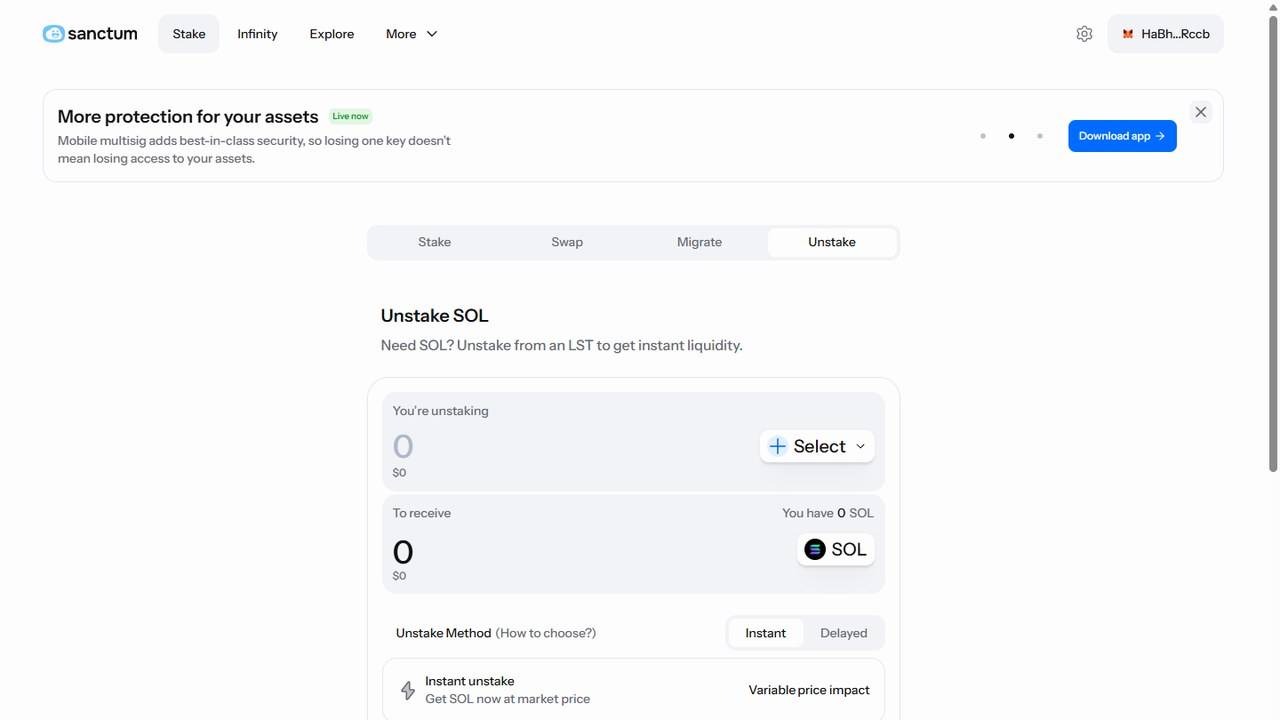
Unstake turns a staking token back into SOL. You can do it "Instant", which pays you now at a market price, or "Delayed", which waits until the network releases your SOL.
How the docs describe it
The tab says "Need SOL? Unstake from an LST to get instant liquidity." Under Instant it says "Get SOL now at market price" with a label "Variable price impact". The docs describe the Reserve as the back-up pool behind instant exits, and the dynamic fee for it is covered in the fees section. The tab's FAQ has questions on when you can unstake, whether to pick instant or delayed, and why INF cannot be delay-unstaked. We did not open the answers.
What we saw
The screen has a "You're unstaking" box with a Select button, "To receive" fixed to SOL, and a yellow "Select a token" button. Our reading is that the yellow color marks this as the exit tab, but no page says so. A word of caution on "variable price impact": the app cannot tell you the cost until you choose a token and an amount, so we did not see a number.
Our rating
3.8 out of 5. The choice between instant and delayed is explained in plain words. We could not see the price impact on a real amount, which is the single most important number on this tab.
Feature 5: Infinity Page and Explore
What it is
Infinity is the page that explains INF. Explore is a list of every staking token built on Sanctum, with yield, size and holders.
What we saw
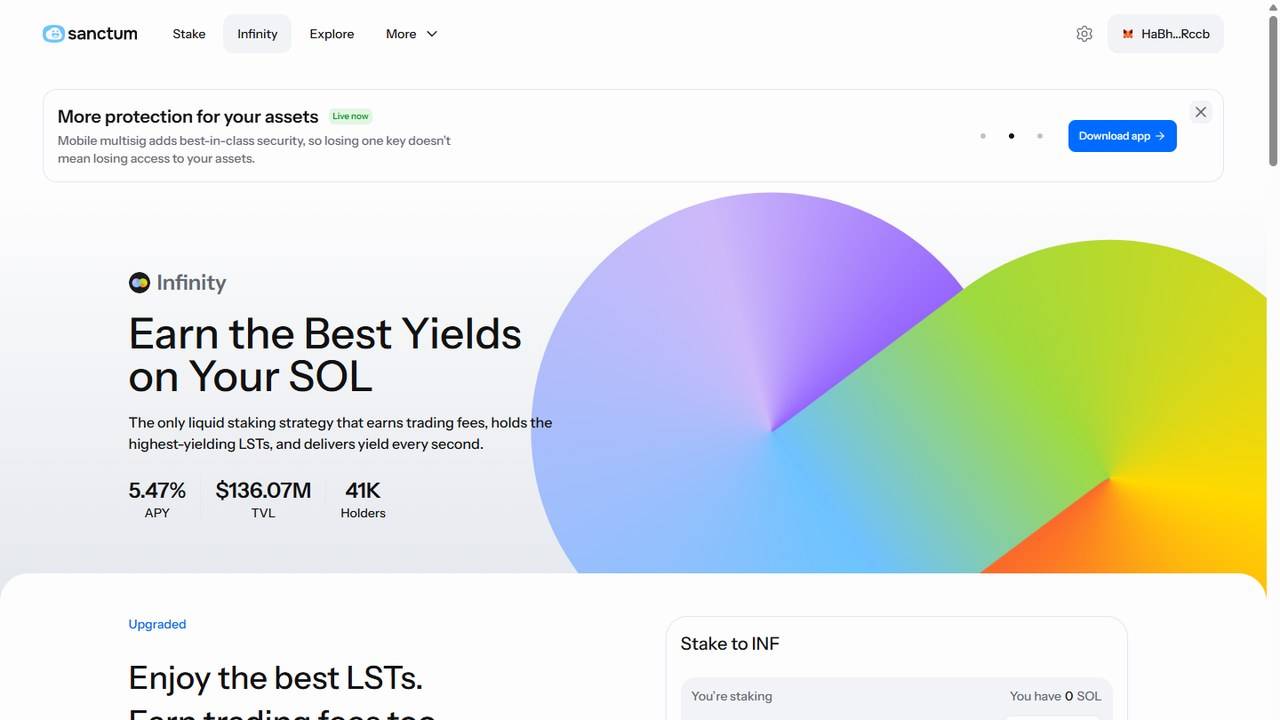
The Infinity page shows 5.47% APY, $136.07 million in total value locked and 41,000 holders at the top, followed by a stake box and sections on trading fees, the best-yielding tokens, DeFi use, and the three reward types. The value locked is $136.07 million on the page and $133.97 million on DefiLlama, a gap of about 1.6 percent (our calculation), which is the kind of difference you expect from different refresh times.
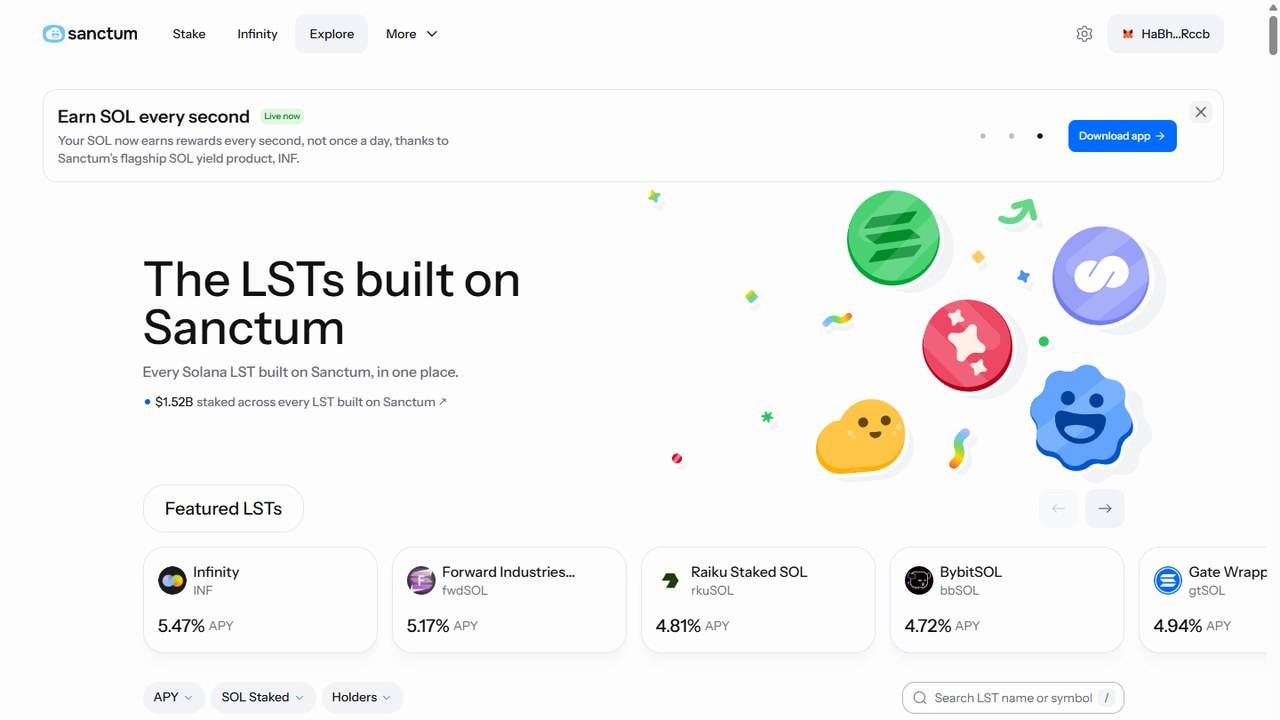
The Explore page reads "The LSTs built on Sanctum" and says $1.52 billion is staked across every token built on it. A row of featured tokens shows yields: INF 5.47%, Forward Industries 5.17%, Raiku 4.81%, BybitSOL 4.72% and Gate 4.94%. Below that is a table that says "237 LSTs" with columns for yield over 10 epochs, total SOL staked and holders. An "epoch" is a Solana time unit of about two days.
Our rating
4.0 out of 5. It is a useful directory that shows its sources of yield. The gap between 237 listed tokens and the docs' claim of more than 1,361 built is left unexplained.
Feature 6: The Phone Wallet and Its Multisig
What it is
Sanctum App 2.0 is a phone wallet. A "multisig" is like a safe deposit box that needs two of three keys: one key alone cannot open it. This is the part of Sanctum that is aimed at ordinary savers, and the marketing line is "The safest way to build long-term wealth in crypto".
How the docs describe it
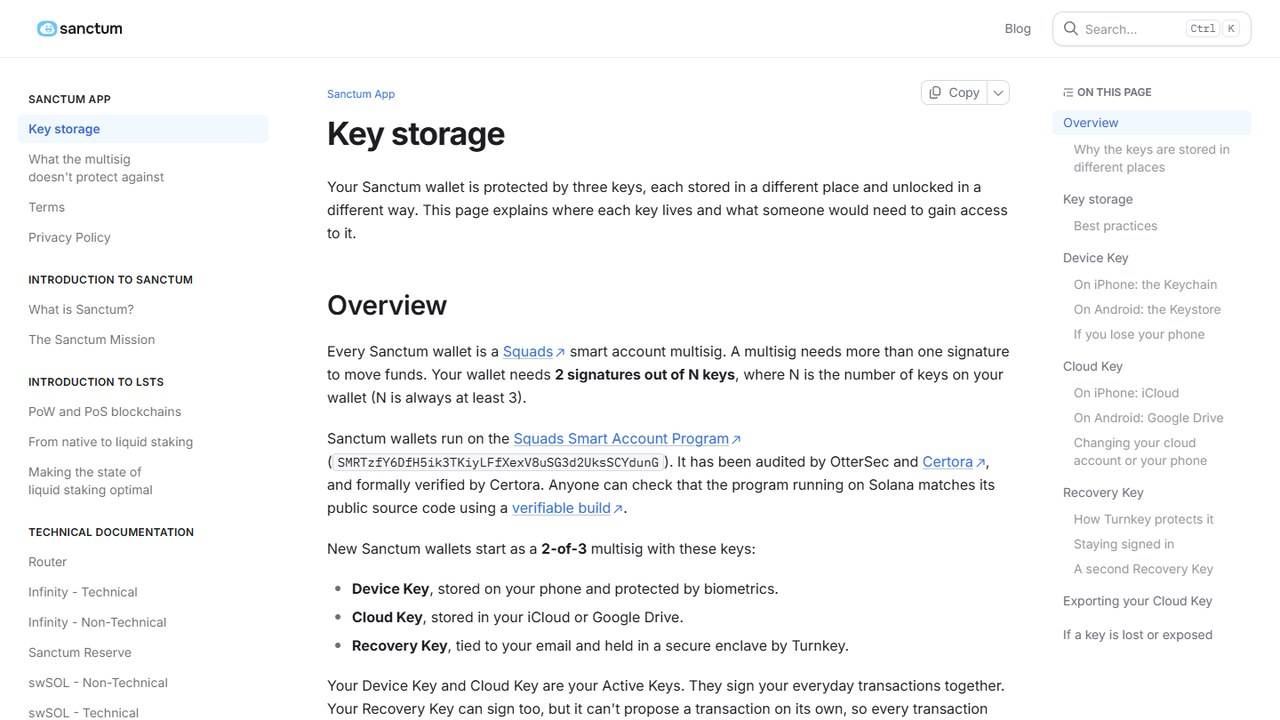
The docs page "Key storage" says every Sanctum wallet is a Squads smart account multisig. It says the Squads program has been audited by OtterSec and Certora and formally verified by Certora, and that anyone can compare the code on Solana with the public source code using a "verifiable build". New wallets start as 2-of-3, with three keys:
| Key | Where it lives | Notes from the docs |
|---|---|---|
| Device Key | Your phone, behind biometrics | Stored in the iPhone Keychain or Android Keystore |
| Cloud Key | Your iCloud or Google Drive | Can be exported as a phrase |
| Recovery Key | Tied to your email, held in secure enclaves by a company called Turnkey | Cannot start a transaction alone |
The docs say the Device Key and Cloud Key sign everyday transactions, and the Recovery Key is mainly used with one of them to replace a lost key. They also say Sanctum's servers never see the keys. In plain terms, someone who gets two of the three keys can move your money, and one stolen key is not enough.
What the multisig does not protect against
We want to give credit to a docs page called "What the multisig doesn't protect against". It lists, in a table, the cases where the design cannot help you. As we read it, those are a bug in the Squads program, a thief who learns your phone passcode, using the same login for your recovery email and your cloud account, Apple or Google reading your Cloud Key, being tricked into adding someone else's key, a leaked exported Cloud Key phrase, the app or its partners going down (funds stay in the wallet), losing two keys, and an app bug or a malicious update. Most wallets do not publish a page like this. It is a strong sign of honest design, and it is also the best checklist for a user.
What we saw
We saw the marketing page and the docs. We did not install the app on a phone and did not create a wallet, so we cannot say how setup feels. The landing page shows store buttons for the App Store, Google Play and the Seeker Store, plus a sample phone screen with example balances. Those numbers are a mockup and not real data.


Our rating
4.0 out of 5. The design is sound on paper and unusually honest in the docs. We could not test the app, so the rating is for the documents only.
Feature 7: Reserve and Router
What they are
The Reserve is a pool of SOL that is kept ready to pay instant exits. The Router is a piece of code that other apps, such as Jupiter, call to swap staking tokens through Sanctum. You will almost never use either one directly, but your swap may go through them.
How the docs describe them
The docs say the Reserve holds over 600,000 SOL, deposits are not open to retail users, and fees are dynamic, from 8 to 800 basis points (a basis point is one hundredth of a percent). DefiLlama's Reserve listing is $44.56 million, which is about 614,000 SOL at the app's $72.61 price (our calculation), so the two sources agree. The Router has a few fixed fees, listed in the fees section. The docs call the Router a wrapper with "no value at risk".
Our rating
3.9 out of 5. The numbers agree across sources and the fee rules are explicit. We tested neither with money.
Feature 8: Gateway and Ironforge
What they are
These are two products for developers, not for savers. Gateway is a service that helps an app get its transactions into a Solana block, even when the network is busy. Ironforge is a monitoring and operations platform for teams that run apps on Solana. Think of Gateway as a courier with several routes, and Ironforge as the tracking dashboard for the couriers.
How the docs describe them
The Gateway docs say it routes transactions through several paths, including normal RPC servers, Jito bundles and partner senders, and that it can refund Jito tips if a transaction goes through by RPC. Sanctum's own sender is listed at 0.0001 SOL per transaction, which the docs call 10 percent of the price of rivals such as Helius Sender and Nozomi. We did not compare these prices ourselves. The homepage says Gateway "delivered 350,000 txs" and the Ironforge card says it handles "300M requests handled daily". Both are Sanctum's own numbers and we could not verify them.
What we saw
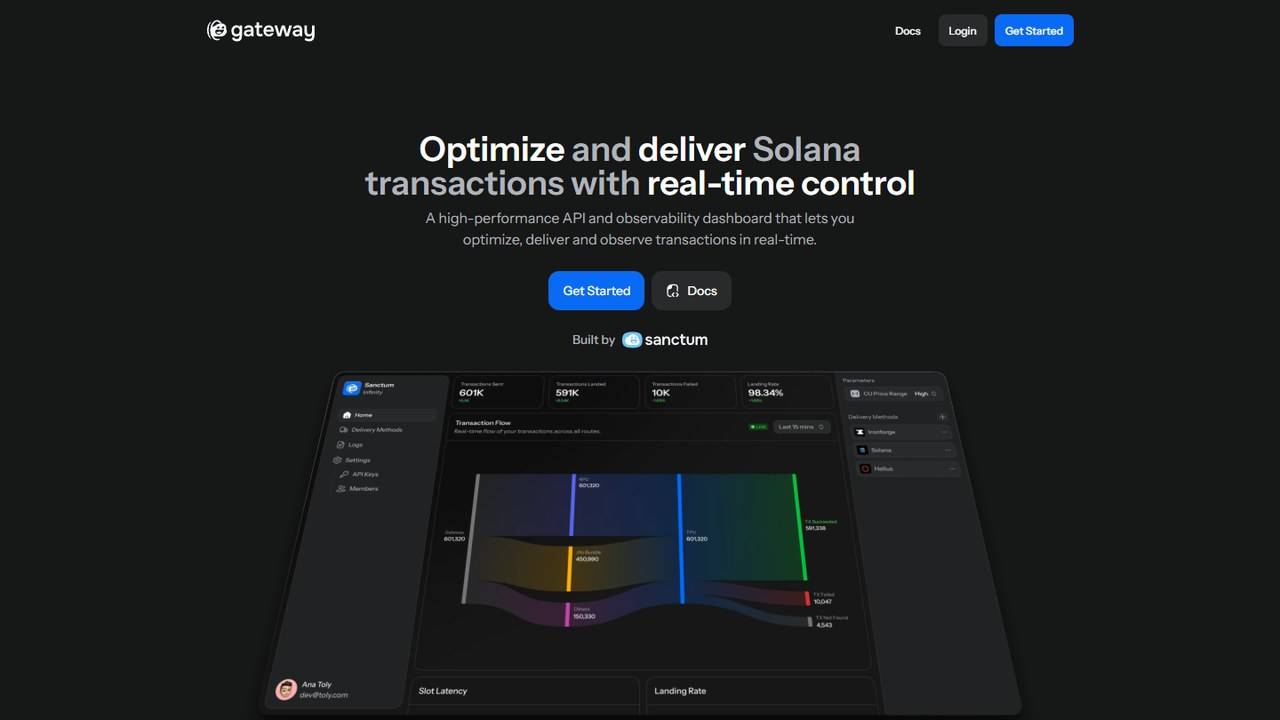
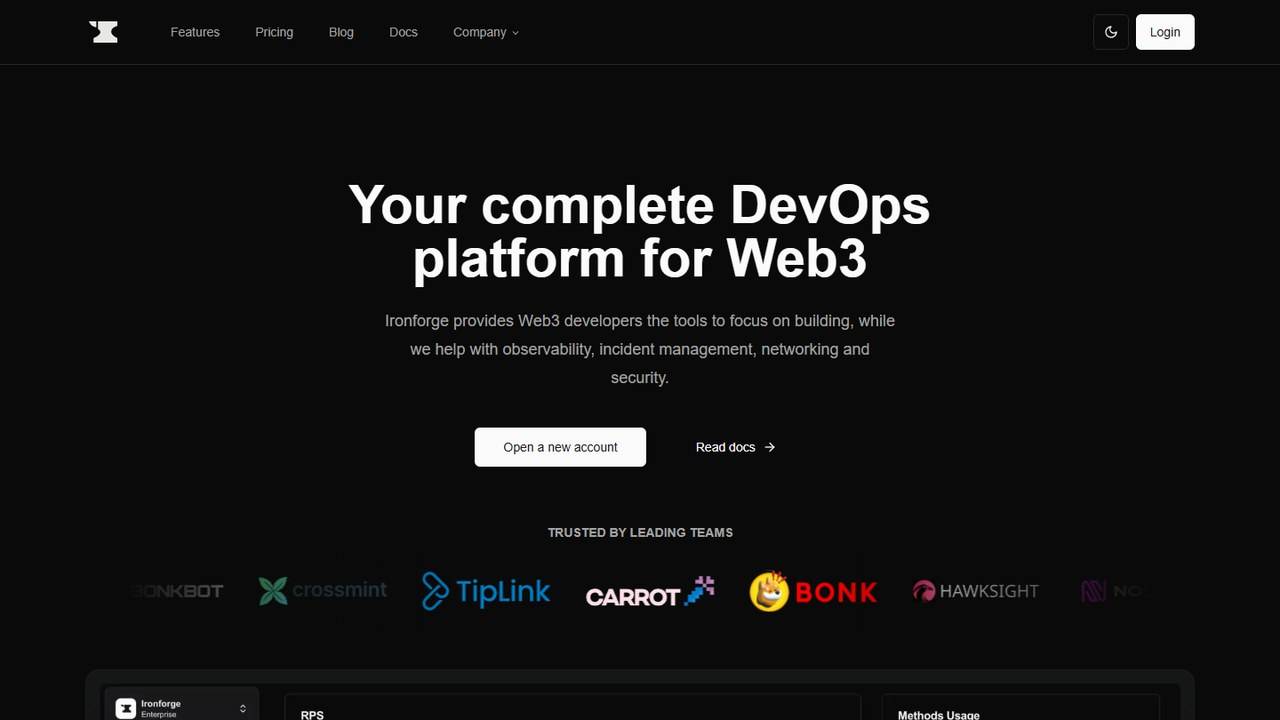
The Gateway page shows a dark dashboard picture with a flow chart, a landing rate and a Get Started button. The Ironforge page says "Your complete DevOps platform for Web3" and lists a row of customer logos. The pictures on both pages are product mockups with sample data, and the sample names and numbers in them should not be read as real. We did not log in to either one.
Our rating
3.5 out of 5. Clear pages and plain claims, but nothing here is testable without an account and the usage numbers are self-reported.
Feature 9: swSOL
What it is
swSOL is a new kind of wrapped SOL. "Wrapping" means putting SOL inside a token so that apps can use it. The normal version, wSOL, is always worth exactly 1 SOL but leaves the SOL idle.
How the docs describe it
The docs say swSOL also stays worth 1 SOL, but it puts part of the SOL to work in staking. The pool keeps part liquid for exits and stakes the rest, and the docs give a current reserve ratio of 50 percent. The docs add that holding swSOL by itself does not earn rewards: the yield goes to the apps that mint it, and each app decides how to share it. The Q3 report names DiversiFi, Lavarage, Lexur, Omnipair and ORE as integration partners.
The Q3 report also gives a scenario. About 12 million SOL sits in wSOL earning nothing, and if swSOL took 15 percent of it, Sanctum estimates about 41,000 SOL, or about $5 million, per year. The report itself says these are scenarios and not forecasts. We did not test swSOL, and we have no way to confirm the 12 million figure.
Our rating
3.6 out of 5. The idea is simple and the docs are clear about who gets the yield. It is early, it is untested by us, and the revenue case is a scenario.
Feature 10: Institutions
The institutions page offers three things: direct delegation to Sanctum's validator, a white-label validator and a white-label staking token. A partner launches its own branded token and earns when users stake with it. The homepage claims "Over $5M in partner revenue" and lists Jupiter, Bybit, Drift and others. That figure is self-reported, and we did not contact anyone. The Q3 report puts the stake and validator line at about 66 percent of Q3 gross profit (our calculation from its figures), which makes the partner relationships the main business risk.
Fees and Costs
| Item | Cost | Source |
|---|---|---|
| Direct deposit into INF | 0% deposit fee, 0% price impact | Sanctum app label; not tested with a real deposit |
| Stake via Jupiter | Under 0.1% price impact | Sanctum app label |
| Router, StakeWrappedSol | No fee | Docs |
| Router, WithdrawWrappedSol | 1 basis point | Docs |
| Router, DepositStake | 10 basis points, no fee if the output is SOL via the Reserve | Docs |
| Reserve instant exit | 8 to 800 basis points, depends on how full the pool is | Docs |
| Typical unstake from the Reserve | about 0.11% | Q3 report (self-reported) |
| Gateway, Sanctum Sender | 0.0001 SOL per transaction | Docs |
One check on the report. It says the July 10 exit of 162,000 SOL earned the Reserve about 1,651 SOL, and also that the fee on that exit was just over 2 percent. 1,651 divided by 162,000 is about 1.0 percent (our calculation), which does not match 2 percent. The report may be counting only Sanctum's share, but the part we read does not say so, and we could not reconcile the two.
The SANC Token
What it is
SANC is Sanctum's token. It was called CLOUD until 2026. The Q3 report says the contract address did not change, so there was no migration. The token is separate from INF. The Q3 report says an "Active Staking Rewards" program ended with a final distribution of 15 million SANC between August 24, 2025 and July 28, 2026.
CoinGecko Data (Nov 17, 2026)
| Metric | Value |
|---|---|
| Rank | 542 |
| Price | $0.06774 |
| Market cap | $33.06 million |
| Fully diluted value | $49.45 million |
| 24 hour volume | $1.43 million |
| Circulating supply | 487.99 million |
| Total supply | 729.96 million |
| Max supply | 1 billion |
| All time high | $0.625 on Nov 13, 2024 |
| All time low | $0.01277 on Jun 7, 2026 |
| Change over 24 hours, 7 days, 30 days, 1 year | -1.8%, +54.8%, +9.2%, -13.8% |
Why the Numbers Differ
The investor page and CoinGecko disagree on market cap, and the Q3 report and CoinGecko disagree on total supply, as covered above. The Q3 report is a self-published PDF, so all of its numbers are "Sanctum Q3 2026 report (self-reported)".
How to Read This
- About 66.8 percent of total supply is circulating (our calculation), so a third is still to come.
- The fully diluted value is about 1.5 times the market cap (our calculation), so unlocks could weigh on the price.
- The 24 hour volume is about 4.3 percent of market cap (our calculation), which is thin for a token that moved 55 percent in a week.
- SANC trades on Bybit, KuCoin, Kraken and Gate, according to the Q3 report.
- Sanctum says it has never sold equity, so investors hold SANC only.
Distribution and Burn
The report says about 25 percent of the supply, 259,321,837 tokens, was burned from the Community Reserve. We did not check that on chain.
Governance
We found no governance voting page, forum link or proposal list in the pages we read. The investor page and quarterly report are the main sources of company news. If you want to vote with your tokens, check the project's channels first.
Business Numbers (Self-Reported)
Sanctum publishes an investor page and a quarterly report. This is unusual for a crypto project and useful for readers. Everything in this section comes from Sanctum itself and we could not verify it.

The investor page showed TVL of $1.53 billion, a treasury of $4.62 million excluding the native token, revenue over the last 12 months of $5.37 million and a price-to-revenue ratio of 5.81. Dividing the $31.20 million market cap by the $5.37 million revenue gives 5.81, so the ratio matches its own inputs (our check). For October 2026 it showed revenue of $408,000 and gross profit of $290,000.
| Product | Q3 2026 gross profit | Change |
|---|---|---|
| Stake and validator services | $544,000 (6,146 SOL) | Down 29.4% in SOL |
| Reserve and Router | $147,800 (1,860 SOL) | Up 98.1% in SOL |
| Infinity | $134,000 (1,441 SOL) | Down 11.1% in SOL, up 2.8% in USD |
Total gross profit was about $0.83 million, down 6.15 percent from the quarter before in dollars. The report says total value locked grew to 18.6 million SOL, up 11.9 percent, which was the twelfth quarter in a row of growth. It lists a treasury of $6.02 million, of which $3.52 million is stablecoins and $2.50 million is SOL and staking tokens. The $4.62 million on the investor page is a different date and a different definition, and we did not try to reconcile them.
Two details in the report matter for risk. First, one holder unstaked 162,000 SOL through the Reserve on July 10, and that one exit was about 90 percent of the Reserve's Q3 gross profit. Profit that depends on one exit is not a steady income. Second, much of the growth in partner TVL came from two new partners, DeFi Development Corp (about 1.05 million SOL) and Forward Industries (about 724,000 SOL). That is real growth, and it is also concentration: if a big partner leaves, the numbers move.
Security
Audits and Bug Bounty
| Item | What we found | Source |
|---|---|---|
| Stake pool program | Audited by Halborn, Kudelski, OtterSec, Neodyme and Quantstamp | Docs page on Sanctum LSTs |
| Squads smart account program (phone wallet) | Audited by OtterSec and Certora, formally verified by Certora | Docs, Key storage page |
| Reserve | One audit by Sec3, dated July 24, 2023 | DefiLlama link |
| Sanctum Validator LSTs | DefiLlama lists audits as 0 | DefiLlama |
| Sanctum Infinity | DefiLlama lists audits as 0 | DefiLlama |
| Bug bounty | Not found in the docs we read | Docs |
The docs say the stake pool program is based on the Solana Labs stake pool program, and the audit list is for that base. We found no audit report that names the Infinity pool itself. That does not mean none exists, only that DefiLlama and the docs we read do not show one. A new reader who sees a 1.3 billion dollar total value locked would expect a clear, current list of reports and a public bug bounty, and we did not find them.
Track Record
DefiLlama's hacks database has no entry for Sanctum, Socean or Infinity (checked Nov 17, 2026). That is a good sign, but it is only as good as the database, and it says nothing about the future.

The blog has posts that explain the safety model, such as "How LSTs protect your SOL" (September 30, 2026), and a post asking why yields went down after Solana got faster. We read only the titles.
Risks
| Risk | What it means |
|---|---|
| Smart contract bug | Funds in staking tokens and pools sit in programs that can have bugs |
| Token price gap | A staking token can trade below the SOL it represents, especially in a hurry |
| Partner concentration | A few partners supply most of the growth |
| Reserve income swings | One exit made up about 90 percent of one product's quarterly profit |
| Phone wallet risks | See the docs table above; two stolen keys are enough |
| SOL price | Staking pays in SOL, so a falling SOL lowers the dollar value of everything |
| Token risk | SANC is thin, volatile and far below its high |
| Self-reported data | Most business numbers come from Sanctum |
Sanctum vs Competitors
| Project (Solana liquid staking) | TVL on DefiLlama (Nov 17, 2026) |
|---|---|
| Sanctum Validator LSTs | $1,342.6 million |
| Binance Staked SOL | $743.5 million |
| Jito Liquid Staking | $726.7 million |
| Jupiter Staked SOL | $371.3 million |
| Forward Industries SOL | $289.8 million |
| Drift Staked SOL | $201.0 million |
| Marinade Liquid Staking | $162.7 million |
| Sanctum Infinity | $134.0 million |
A caution on this table. Several tokens on the list, for example Jupiter's and Drift's, are described in Sanctum's own docs as built on Sanctum. So the Sanctum Validator LSTs line may overlap with other lines. Our reading is that the ranking mixes the infrastructure and the products built on it, and we could not tell how DefiLlama avoids counting twice. For a plain staking product, compare INF with the other tokens above on yield, size and exit cost.
Pros and Cons
| Pros | Cons |
|---|---|
| Clear, quick staking app on desktop, tablet and phone | We could not test a real deposit or exit |
| Fee labels shown before you act | DefiLlama shows no audit for its two largest listings; no bug bounty found |
| Honest docs page on what the multisig does not protect against | Some numbers differ between pages, CoinGecko and the Q3 report |
| Public investor page and quarterly report | Business numbers are self-reported |
| No incident listed on DefiLlama | One exit was about 90 percent of one product's quarterly profit |
| Many big partners and a wide range of tokens | SANC is about 89 percent below its high and thinly traded |
Who Should Use Sanctum
- Good fit: people who want to stake SOL and keep it liquid, with a small amount first.
- Good fit: developers and companies who want a white-label staking token or better transaction delivery.
- Maybe: savers curious about the phone wallet, once they have read the limits table and tested with a small amount.
- Poor fit: anyone who expects a fixed yield. The 5.47 percent shown today will change.
- Poor fit: people who want to speculate on SANC without reading the supply numbers.
Verdict
Sanctum is a polished, professional and mostly honest project. We liked the plain staking form, the visible fee labels, the public investor numbers and especially the page that says what its wallet cannot protect against. We did not like the missing audit trail for the largest listings, the mismatched figures and the reliance on self-reported data. The token is a separate bet from the product, and the product is only as safe as its smart contracts.
Our editorial score: 3.8 out of 5. A strong tool for people who want SOL staking and are happy to start small.
FAQ
What is Sanctum?
It is a Solana company that builds liquid staking tools. It runs a staking app with a token called INF, helps partners launch their own staking tokens, offers developer services and has a phone wallet app. It has a separate token called SANC.
Is Sanctum safe?
The app worked well in our test and the wallet pop-up said the site cannot move funds without permission. DefiLlama lists no incident for Sanctum. But it also lists no audit for its two largest Sanctum entries, and we found no bug bounty page. Staking always carries smart contract risk, so start with a small amount.
What is INF?
INF is the main token of the Infinity pool. You get it when you stake SOL in the app. The pool holds many staking tokens and earns their rewards plus swap fees, and the app showed 5.47 percent APY on November 17, 2026. The yield changes over time.
What is a liquid staking token?
It is a token you receive when you stake SOL. It stands for your staked SOL plus the rewards, and you can use it in other apps while your SOL keeps earning.
Is the 5.47 percent yield guaranteed?
No. It is an estimate shown by the app that changes over time. A Sanctum blog post asks why yields went down after Solana got faster, which is a reminder that rates move.
Is Direct deposit always better than Via Jupiter?
Not in our test. Direct deposit is labeled 0 percent fee and Via Jupiter is labeled under 0.1 percent price impact, but the Jupiter quote gave about 0.3 percent more INF at that moment. Quotes change by the second, so compare both before you act.
How does the phone wallet keep my money safe?
It splits control across three keys, on your phone, in your cloud account and with an email-linked recovery key, and two are needed to move funds. The docs also list the cases it cannot protect against, such as a thief who knows your phone passcode.
What is SANC and what happened to CLOUD?
SANC is the new name of the CLOUD token. The Q3 report says the contract address did not change. SANC is a separate token from INF.
Why are the supply numbers different?
The Q3 report says about 259 million tokens were burned and total supply is 740,678,163. CoinGecko shows 729.96 million and a maximum supply of 1 billion. Our reading is that CoinGecko has not fully updated.
Do I need a wallet to look around?
No. You can browse every tab without connecting. You only need a wallet to stake, swap, migrate or unstake.
What did you not test?
We did not stake, swap, migrate or unstake, and we made no deposit. We did not install the phone wallet app, create a wallet, or try Gateway, Ironforge or the institutions contact form. We did not test swSOL. We did not check the burn or any figure in the Q3 report against the chain. We connected an empty wallet and pressed only the Connect button.
Quick Links
- Sanctum site
- Sanctum staking app
- Sanctum docs
- Sanctum investor page
- CoinGecko page for SANC
- DefiLlama page for Sanctum
Disclaimer
This article is an independent editorial review for information only. It is not financial advice. Staking, liquid staking tokens, liquidity pools and crypto tokens carry the risk of loss, including from smart contract bugs and falling prices. We made no deposit and no trade in this test, so we cannot confirm how any order is filled. Figures come from CoinGecko, DefiLlama, Sanctum's own pages and Sanctum's Q3 2026 report on the dates shown and may have changed. Always check the address of the site you are on, and only use money you can afford to lose.
Editorial credits
Checked by TokenTopNews QC Team before publishing on November 18, 2026 for headline accuracy, original value, factual consistency, metadata, commercial disclosure, authorship claims, review evidence and risk disclosure: our AI review system checks every article before it goes live, and our duty editor monitors it after publication. Report an error.
TokenTopNews uses AI for research, drafting and review. Our editorial team is responsible for every article and corrects or withdraws articles when needed. How we review.