
Decibel is a fully on-chain exchange built on Aptos that combines perpetual futures, spot trading, managed vaults, and a points program in one dark, professional-looking terminal. Its clearest differentiator is not simply leverage. It is the breadth of the public market board: crypto sits beside stocks, ETFs, commodities, and technology-themed products in the same interface.
This review is based on a public walkthrough completed on October 29, 2026, covering the Trade, Markets, Vaults, Portfolio, and Points pages. The visible order controls were also reconciled with Decibel's official documentation. Prices, open interest, volume, vault returns, and reward details are dated snapshots, not permanent figures.
What is Decibel?
Decibel is a decentralized exchange protocol on Aptos for perpetual futures and spot markets. Its official trader overview states that order placement, matching, and settlement occur on-chain. The product combines an order-book trading terminal, cross-margin accounts, multi-chain USDC deposits, strategy vaults, the protocol-owned DLP liquidity vault, and an Amps points program.
The app is designed as a global-markets venue rather than a crypto-only terminal. During the walkthrough, the public market board included crypto assets, stocks, ETFs, commodities, and other thematic products. Wallet support described in the documentation covers EVM, Solana, Sui, and Aptos wallets, while the underlying execution venue remains Aptos.
Key Decibel features
| Feature | What Decibel offers | Why it matters |
|---|---|---|
| On-chain order book | Orders, matches, and settlement recorded on Aptos | Provides transparent protocol-level execution and account state |
| Perpetual and spot markets | Crypto plus stock, ETF, commodity, and other themed products | Lets traders access multiple market categories from one terminal |
| Cross-margin trading | Shared collateral across positions, with market-specific leverage | Improves capital efficiency but links risk between open positions |
| Multi-chain deposits | USDC routes from Ethereum, Arbitrum, Base, Solana, Sui, and Aptos | Expands wallet access without changing the Aptos execution layer |
| Trading vaults | Public strategy statistics and fungible on-chain vault shares | Offers delegated strategies with visible returns, drawdown, and manager data |
| DLP Vault | Protocol-owned market-making and liquidation backstop | Supports initial liquidity and absorbs positions in the liquidation waterfall |
| Amps points | Season-based rewards for trading, streaks, referrals, and DLP deposits | Creates a measurable path toward potential token distribution at TGE |
| Sponsored gas | The app sponsors gas for standard supported transactions | Reduces the need to hold APT for routine app actions |
First look: polished terminal, assertive onboarding
The default route redirected to the BTC/USD trade screen. The layout follows the proven perpetual DEX pattern: market statistics across the top, TradingView-style charting in the center, order book next to it, order controls on the right, and account activity tabs along the bottom.
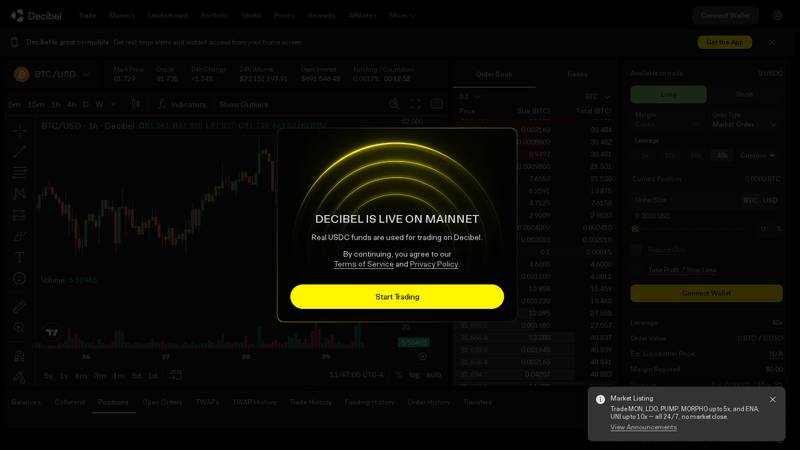
Figure 1. The first public visit presented a mainnet notice over the live BTC/USD terminal. Open the live Trade page. Captured October 29, 2026.
The modal is not subtle. It states that real USDC is used and links to the Terms of Service and Privacy Policy. A second listing notice advertised selected markets with maximum leverage of 5x or 10x. This is good risk signaling, although two overlays plus a mobile-app banner make the opening experience busier than it needs to be.
Behind the notice, the interface exposed useful data immediately: mark price, oracle price, 24-hour change, volume, open interest, and the funding countdown. The right-hand ticket showed Cross margin, Market Order, preset leverage buttons from 1x through 40x, Reduce Only, Take Profit / Stop Loss, estimated liquidation price, margin required, slippage, and fees. The visible base fee line matched the published fee schedule at 0.045% taker and 0.015% maker.
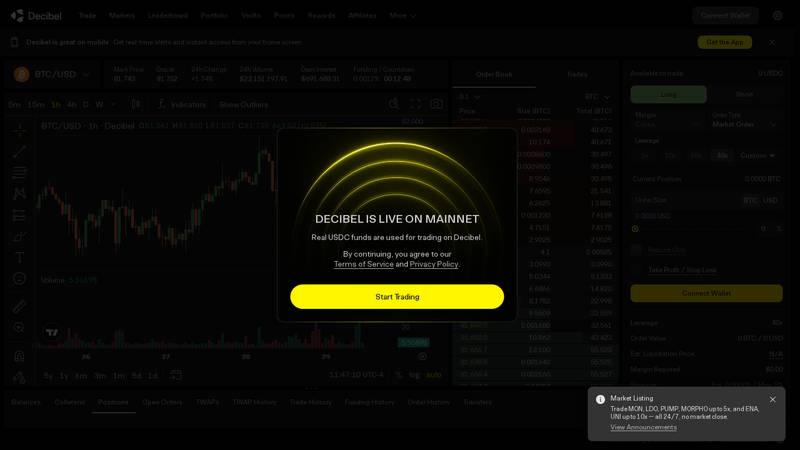
Figure 2. Order controls, including Cross margin, leverage presets, TP/SL, liquidation estimate, slippage, and fees, remain visible behind the first-visit notice. Open the trading terminal.
The Markets page is Decibel's best discovery feature
The public Markets page listed 76 markets during the test. Filters included Crypto, TradFi, L1/L2, DeFi, Meme, AI, Stocks, ETFs, and Commodities. The page also offered gainers and losers views, volume or 24-hour change sizing, a search field, and more filters.
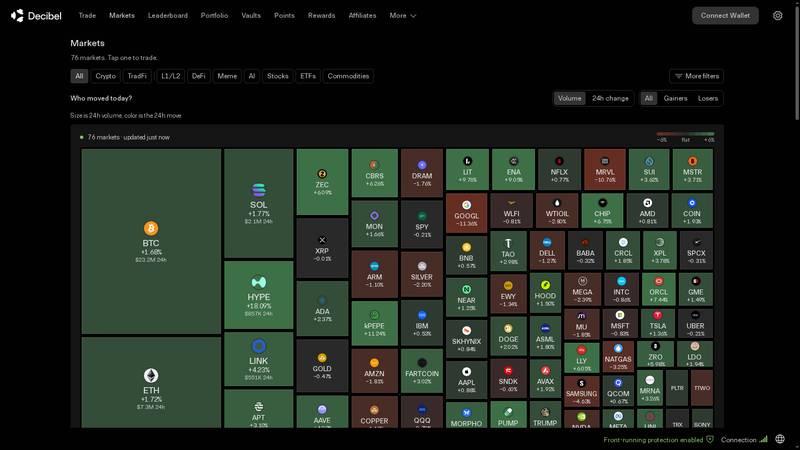
Figure 3. The Markets heat map displayed 76 markets across ten category filters. Tile size represented 24-hour volume and color represented the 24-hour move. View current Decibel markets. Captured October 29, 2026.
The heat map works well because it communicates market breadth and activity at a glance. BTC and ETH occupied the largest tiles in this snapshot, while products such as SOL, HYPE, LINK, GOLD, SPY, AAPL, AMZN, SILVER, COPPER, and WTI oil appeared in the same discovery surface. That mix is more useful than a long ticker list for traders looking for a theme rather than a specific symbol.
The interface also displayed "Front-running protection enabled" in its status bar. That is a protocol claim, not a substitute for checking actual execution. Traders should still compare mark price, oracle price, spread, order-book depth, and realized slippage on the market they intend to trade.
Decibel's trader overview says orders, matches, and settlement occur on-chain. The app uses Aptos as the execution layer and supports wallet entry from EVM, Solana, Sui, and Aptos ecosystems. Its docs describe deposits from Ethereum, Arbitrum, Base, Solana, Sui, and Aptos via Wormhole and Circle CCTP. That creates broad onboarding coverage, but users should distinguish the single-chain trading venue from the cross-chain route used to move collateral into it.
Order design, leverage, and margin
The ticket is compact and readable. Long and Short sit at the top, followed by margin type, order type, leverage, position size, Reduce Only, and TP/SL. Preset leverage choices make the common path fast, while Custom covers less standard sizing.
Decibel uses cross-margin by default. In simple terms, all credited collateral and unrealized PnL contribute to account equity. The documentation defines initial margin as 1 / selected leverage. A $10,000 position at 10x therefore requires $1,000 of initial margin before fees and other constraints.
Maintenance margin depends on maximum market leverage. The published formula is 1 / (maximum market leverage x 2). For a market capped at 40x, that produces a 1.25% maintenance-margin fraction. Cross-margin is capital-efficient because gains in one position can offset losses elsewhere, but it also joins risk across positions. A trader who wants clearly separated loss budgets should confirm whether the intended market and account configuration support isolated margin before opening exposure.
The funding documentation says the public product presents an hourly funding cadence, with annualized rates in the interface and a countdown in the market header. Funding is a transfer between longs and shorts, not revenue kept by the exchange. It should still be included in position cost, especially when holding a leveraged trade through repeated funding periods.
Fees: competitive at entry, better for high volume
Decibel combines perpetual and spot activity into one weighted 30-day tier. The formula is:
weighted volume = perpetual notional + 4 x spot notional
The official fee table starts below $1 million of weighted volume and falls across seven tiers.
| Weighted 30-day volume | Perpetual taker | Perpetual maker | Spot taker | Spot maker |
|---|---|---|---|---|
| Below $1M | 0.045% | 0.015% | 0.070% | 0.040% |
| At least $25M | 0.030% | 0.004% | 0.040% | 0.010% |
| At least $100M | 0.028% | 0% | 0.035% | 0% |
| At least $1B | 0.024% | 0% | 0.025% | 0% |
At the base tier, a $10,000 perpetual market order costs $4.50. Opening and closing the same notional as a taker costs $9 before funding and slippage. A resting maker fill costs $1.50 per $10,000 side at the base tier.
The documentation says there are no protocol deposit or withdrawal fees and that the Decibel app sponsors network gas for standard transactions. Some wallet types and independent integrations may still submit their own transactions and pay gas. Fee rates are on-chain parameters, so the account endpoint and live fee display are the final references for a specific trade.
Liquidation is documented, but leverage still deserves respect
Decibel publishes a two-stage liquidation process. Stage one sends an immediate-or-cancel margin-call order designed to restore account health to 105% of maintenance margin. Its slippage limit begins at 0.5% and can widen after an unfilled round. If equity falls below two-thirds of maintenance margin, stage two transfers the account to the backstop liquidator vault.
The documentation says the backstop absorbs remaining deficits, with auto-deleveraging as a final circuit breaker in extreme conditions. This design gives traders more detail than a generic "liquidation may occur" warning. Still, a public formula cannot guarantee a smooth close during a thin or rapidly moving market. The 40x option leaves little room for adverse movement, funding, fees, and slippage.
Vaults: strong public analytics, highly uneven risk
The Vaults page was accessible without an account. It showed $23.46 million in total value locked and $6.03 billion in total volume at capture time. The table included manager address, TVL, all-time return, APR, 90-day maximum drawdown, Sharpe ratio, weekly win rate, and vault age.
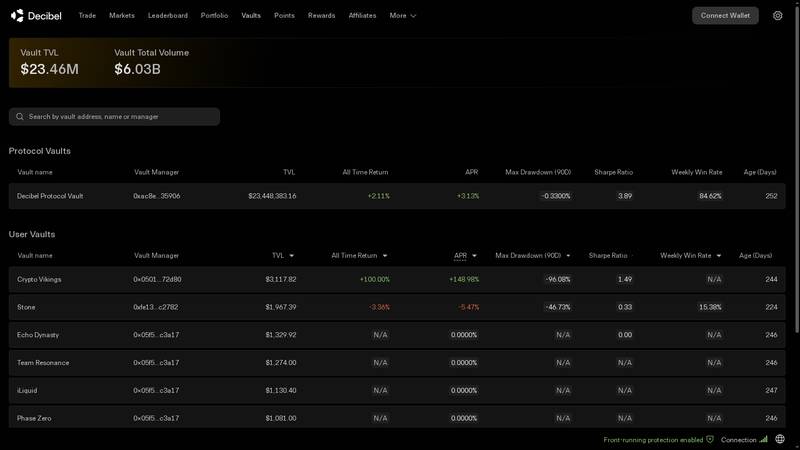
Figure 4. Decibel exposes useful vault performance fields publicly. Figures can change and should be rechecked before allocating. View current vaults. Captured October 29, 2026.
The distribution was extremely concentrated. The Decibel Protocol Vault held about $23.45 million of the $23.46 million total shown. Several user vaults had only hundreds or a few thousand dollars, and many fields were unavailable. One vault displayed a 100% all-time return alongside a 96.08% maximum drawdown. That combination is a reminder that headline APR is not a risk-adjusted decision rule.
According to the vault documentation, managers can charge 0% to 10% performance fees on intervals of 30 to 365 days. The mechanism is interval-based rather than a high-water-mark model, so each interval resets independently. The separate DLP Vault provides protocol liquidity and backstop capacity, applies a 72-hour lockup, and gives enabled DLP shares 90% collateral credit. Using a vault share as trading collateral combines strategy risk, market-making risk, and leverage risk in one account.
Portfolio, Decibel airdrop, and Amps points
The public Portfolio page was deliberately minimal before connection: one central Connect Wallet button and no demo balances or account statistics.
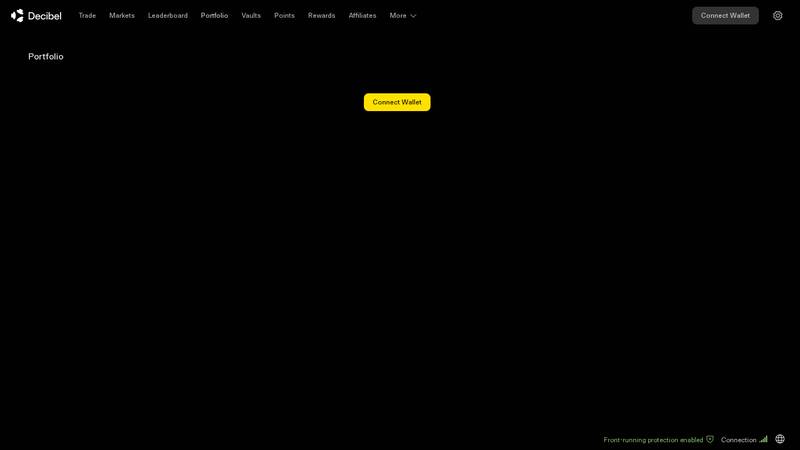
Figure 5. The pre-connection Portfolio state is a clean wallet gate rather than a public analytics page. Open Portfolio.
The Points page was much more expressive. It identified the current program as Season 1, "Launch Liquidity," and exposed fields for Season 0 points, total Season 1 Amps, rank, referrals, tier, and trading streaks. The live page also stated that Season 1 totals include trading, referral, and DLP vault points.
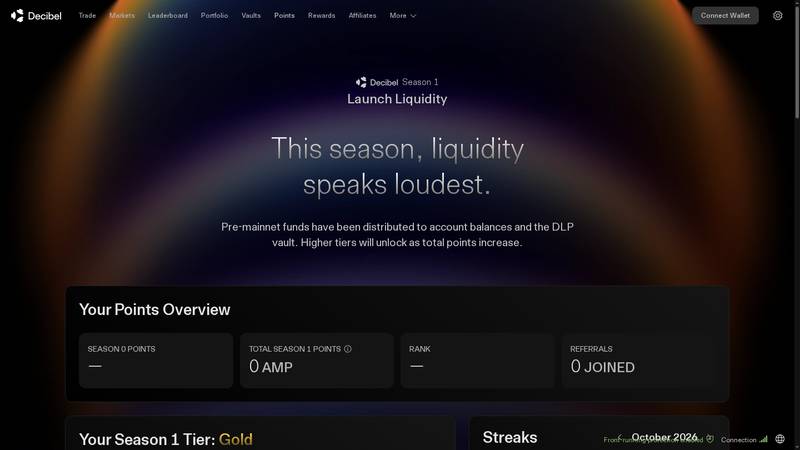
Figure 6. Decibel's Season 1 Points page puts liquidity, tier, streak, and referral incentives at the center of the account experience. View the live Points page. Captured October 29, 2026.
Is there a Decibel airdrop?
Decibel has not published a guaranteed claim date, fixed points-to-token conversion, or final individual allocation schedule. However, the official Amps documentation explicitly says that Amps are a primary factor in determining access to protocol tokens at TGE, using DCBL as its example token name. It also says that a significant portion of supply is expected to be allocated to Season 0 and Season 1 participants.
This makes Amps relevant to a potential Decibel airdrop, but "expected" is not the same as guaranteed. The documentation does not establish the final token supply, valuation, eligibility cutoff, snapshot date, vesting schedule, or conversion rate. Any estimate that assigns a fixed dollar value to one Amp would therefore be speculative.
How to earn Decibel Amps
Season 1 distributes points from four separate daily emission pools:
- Trading activity: scoring considers activity quality, frequency, moderate leverage, position duration, market exploration, and consistency rather than raw volume alone.
- Trading streaks: consistent eligible trading days add streak Amps. The dashboard states that trading days reset at 00:00 UTC.
- DLP liquidity: points scale with both the amount supplied to the DLP Vault and the length of time capital remains committed.
- Referrals and affiliates: rewards depend on the measurable activity of referred users, rather than registrations alone.
The exact scoring formula is intentionally undisclosed. Decibel says device signals, behavior analysis, and network graphs are used for Sybil resistance, with penalties or disqualification possible for non-organic activity. Repetitive self-trading, account farming, or unnecessary leverage can therefore create both trading losses and eligibility risk.
The practical approach is to treat Amps as an additional benefit attached to genuine product use. Trading fees, hourly funding, liquidation exposure, DLP lockups, and vault risk remain real costs even if a future token distribution occurs.
Security and legal structure
Decibel's audit page lists OtterSec reviews for the perpetual exchange, liquidations and vaults, order book, pre-deposit contract, and spot exchange. Publishing multiple scope-specific reports is better than presenting one generic badge. An audit reduces certain smart-contract risks but does not remove oracle, bridge, market-liquidity, wallet, governance, or operational risk.
The Terms of Service, last updated October 13, 2026 at the time checked, identifies Amplify Labs Inc. as the website operator and describes the protocol as decentralized infrastructure on Aptos. The terms also say the company does not control protocol activity or transaction validation. Traders should verify local eligibility and understand that interface operation, smart-contract execution, and asset movement can involve different entities and risk layers.
Decibel vs Hyperliquid, Extended, and dYdX
| Exchange | Base perpetual fees | Execution identity | Standout strength | Main trade-off |
|---|---|---|---|---|
| Decibel | 0.045% taker, 0.015% maker | Fully on-chain on Aptos | 76-market discovery board, TradFi mix, public vault analytics | Younger liquidity venue; cross-chain deposit route adds another layer |
| Hyperliquid | 0.045% taker, 0.015% maker at the base tier | Purpose-built HyperCore execution | Deep crypto-native ecosystem and mature on-chain market structure | More crypto-centric discovery; separate fee treatment can apply to HIP-3 markets |
| Extended | 0.025% taker, 0% maker in its published standard schedule | Starknet-based self-custodial trading | Lower headline standard trading fees | Smaller product and ecosystem footprint than the market leader |
| dYdX | Volume-tiered; check current schedule | dYdX Chain order-book exchange | Long operating history and mature perpetual tooling | Fee and market details require live schedule comparison |
Sources: Decibel fees, Hyperliquid fees, Extended fees, and dYdX fees.
Decibel and Hyperliquid begin at the same published maker and taker percentages for ordinary perpetual activity. Extended wins the simple headline-fee comparison, while Decibel gives spot volume a 4x weight toward a shared fee tier. Decibel's more distinctive advantage is product presentation: a single board can move from BTC and HYPE to AAPL, SPY, gold, silver, and oil themes.
The comparison should not stop at fees. Spread, depth, price impact, funding, oracle behavior, withdrawal path, collateral rules, and liquidation execution can outweigh a few basis points. The best venue is the one that is strongest for the exact market, order size, and holding period being traded.
Decibel strengths and areas for improvement
| Strengths | Areas for improvement |
|---|---|
| The Markets heat map makes a broad product catalog genuinely navigable. | First-visit overlays obscure the product while a new user is trying to understand it. |
| The order ticket exposes leverage, risk controls, liquidation estimate, slippage, and fees in one column. | Portfolio offers little pre-connection education or sample analytics. |
| Public vault analytics include drawdown and risk-adjusted metrics, not just APR. | Several vaults lack enough history for meaningful comparison, while total TVL is highly concentrated. |
| Fee, margin, funding, and liquidation documentation is unusually specific. | The relationship between Aptos execution and cross-chain deposit infrastructure needs clearer in-app explanation. |
| Perpetuals, spot, vaults, points, and multi-chain onboarding share one navigation system. | Maximum leverage is prominent, while maintenance margin and liquidation mechanics require a documentation visit. |
| Amps documentation explains the main earning categories and anti-Sybil approach. | The potential token allocation still lacks a confirmed snapshot date, conversion rate, claim schedule, and vesting terms. |
Final verdict
Decibel is already more than a generic perpetual front end. Its best ideas are visible without an account: a highly scannable 76-market board, a serious order ticket, detailed risk documentation, and vault analytics that expose uncomfortable numbers as well as attractive ones.
Its next challenge is depth rather than surface area. Traders will want to see durable order-book liquidity across the long tail, useful history for more vaults, clear cross-chain risk communication, and incentives that support organic activity after launch excitement fades. If those pieces mature, Decibel has a credible path to becoming a major Aptos trading venue rather than simply another points-driven DEX.
For experienced traders who understand cross-margin and want both crypto and traditional-market perpetual exposure, Decibel belongs on the shortlist. Start with the specific market's spread, funding, maximum leverage, and liquidation parameters, then treat points and headline APR as secondary considerations.
Frequently asked questions
What is Decibel?
Decibel is a fully on-chain exchange on Aptos offering perpetual futures, spot products, vaults, and rewards. Its public app groups crypto, stock, ETF, and commodity-themed markets in one interface.
How much does Decibel charge?
The published base perpetual fee is 0.045% for takers and 0.015% for makers. Higher weighted 30-day volume reduces rates, with maker fees reaching 0% at the $100 million tier. Always check the current fee page and account-specific rate before trading.
What leverage does Decibel offer?
The tested BTC/USD ticket showed presets up to 40x. Maximum leverage is market-specific, and listing notices showed lower caps for some products. Higher leverage reduces initial margin but sharply narrows the distance to liquidation.
Does Decibel have spot trading?
Yes. Decibel's documentation describes both spot and perpetual products. Spot and perpetual activity contribute to one fee tier, with spot notional weighted four times in the tier calculation.
How do Decibel vaults work?
Vault managers trade pooled capital and contributors receive fungible on-chain shares. Managers may set interval-based performance fees from 0% to 10%. The DLP Vault also provides liquidity and backstop capacity and has a 72-hour lockup.
Are Decibel Amps a guaranteed token allocation?
No. Decibel says Amps are a primary input when it evaluates token distribution at TGE, but that does not specify a guaranteed token amount, valuation, or conversion rate.
Has Decibel been audited?
Decibel publishes OtterSec audit links covering its perpetual exchange, order book, liquidations and vaults, pre-deposit contract, and spot exchange. Audits are useful evidence of review, not a guarantee against every technical or market risk.