



Bitcoin Treasury Holdings Tracker: How to Verify Company BTC Balances
Learn how to verify a company's Bitcoin balance from filings, settled purchases, source dates, BTC/share and encumbrance records.
A reliable Bitcoin treasury tracker verifies each company’s balance from a dated primary source. Start with a filing-backed opening balance from SEC EDGAR, add only settled purchases, subtract sales or transfers, and record collateral, share count and evidence dates separately. An announcement date is not a settlement date, a homepage counter is not an audited balance, and a purchase target is not Bitcoin owned.

How to verify a company’s Bitcoin balance
Use the same five checks for every company: identify the latest settled balance, confirm the effective date, reconcile purchases and disposals, separate encumbered BTC, and refresh the share denominator. A company dashboard or aggregator can locate a lead, but the final number should trace back to a filing, exchange filing or dated issuer disclosure.
- Settled ownership: Confirm BTC legally owned at the stated effective date; do not count a purchase target or announced capacity.
- Evidence date: Record when the balance became effective and when it was published; do not rely on a live counter with no timestamp.
- Balance bridge: Reconcile opening BTC, settled purchases, disposals and adjustments; a headline purchase amount is not a closing balance.
- Encumbrance: Record BTC pledged, restricted or held under collateral terms; owned BTC is not automatically liquid BTC.
- Share denominator: Identify basic or fully diluted shares used for BTC/share; never combine a current BTC balance with an old share count.
Bitcoin treasury tracker snapshot
The table below is an unsynchronized research snapshot assembled from public tracker observations and issuer disclosures. Holdings and market fields may carry different source dates, so the status column prevents them from being mistaken for synchronized primary filings. Use the table to find the company, then open the issuer disclosure before publishing a mutable number.
| Company and primary source | Ticker | BTC balance shown | Latest purchase / BTC change | Market cap / mNAV* | Evidence date | Data status |
|---|---|---|---|---|---|---|
| Strategy Q2 Form 10-Q | MSTR | 843,775 | -2,225 BTC sold from July 1-24; no purchase in the linked period | $31.67B / 0.58x | July 24, 2026 | Primary filing-backed balance |
| Twenty One Capital Form 10-Q | XXI | 43,514 | 0 BTC change between Mar. 31 and Jun. 30 checkpoints | $3.48B / 1.24x | March 31, 2026 filing | Primary filing; later checkpoint needs direct filing link |
| Metaplanet company disclosure | 3350 | 43,000 | +2,823 BTC in the latest reported accumulation | $984.4M / 0.36x | July 22, 2026 observation | Company balance; purchase release should be attached |
| MARA Q2 Form 10-Q | MARA | 35,577 | No BTC purchased in Q2; +274 BTC from Mar. 31 to Jun. 30 | $4.06B / 1.79x | June 30, 2026 | Primary filing-backed balance |
| CEPO and BSTR transaction update | CEPO | 30,021 | No settled purchase verified; proposed transaction status changed | $271.1M / N/A | July 8, 2026 transaction update | Pending; exclude from settled holdings |
| Bullish Q2 results | BLSH | 24,400 | N/A; latest BTC purchase not disclosed in the linked results | $3.39B / 2.16x | Market snapshot; Q2 results dated Aug. 13 | Balance requires a company-level BTC disclosure |
| Strive Q2 results | ASST | 19,000 | +6,236 BTC in Q2; +303 BTC from Jul. 1-Aug. 7 | $868.5M / 0.71x | Aug. 10, 2026 release | Primary purchase data; balance needs reconciliation |
| Coinbase Q2 Form 10-Q | COIN | 15,389 | N/A; custody inventory and corporate balance must be separated | $41.60B / 42.00x | June 30, 2026 filing | Primary filing; corporate BTC amount needs row extraction |
| Riot Platforms Q1 Form 10-Q | RIOT | 15,679 | -2,326 BTC from Jan. 1 to Mar. 31, including 3,778 BTC sold | $6.35B / 6.29x | March 31, 2026 filing | Primary filing-backed balance |
| CleanSpark July operational update | CLSK | 13,931 | +586 BTC produced and -579 BTC sold or settled through call exercises; +7 BTC net from June 30 | $3.49B / 4.03x | July 31, 2026 | Primary operational disclosure |
*Market cap and mNAV are external market snapshots, not issuer-reported figures; refresh them at publication. The rows are intentionally not a final ranking. A miner’s retained BTC, an exchange’s corporate balance and a treasury-led issuer’s reserve do not represent the same shareholder exposure. The primary issuer link remains the controlling source for settled holdings and diluted shares.
To use the tracker without mixing dates:
- Start with the linked primary source and confirm the effective date of the BTC balance.
- Read the latest purchase or BTC change as a separate event; do not add it again to the ending balance.
- Treat market cap and mNAV as a separate market snapshot and refresh both together.
- Keep
N/Awhen an issuer has not disclosed the field; it is safer than filling a gap with an aggregator estimate.
Coverage and inclusion rules
This tracker covers public companies with a disclosed Bitcoin balance or a documented Bitcoin treasury policy. It separates treasury-led issuers, operating companies, miners, exchanges and financial platforms instead of combining them into one undifferentiated leaderboard. ETFs, funds, governments, private companies and unconfirmed wallet addresses remain outside the public-company table unless a separate scope is stated.
- Primary verified: A filing, exchange filing or dated issuer disclosure confirms the balance. It is eligible for the verified total.
- Company claim awaiting filing: An issuer dashboard or release states a balance without a matching filing. Show it with a warning and source date.
- Secondary cross-check: Tracker data agrees with the public record, but no same-date primary record is attached. Use it for discovery, not as sole proof.
- Pending or unresolved: The item is a target, announced transaction, disputed balance or unclear legal ownership. Exclude it from settled holdings.
BTC/share and latest-purchase fields
BTC/share is a denominator check, not a replacement for the holdings total. Use settled BTC divided by the relevant share count, then label whether the denominator is basic, diluted or company-defined. A tracker should never compare one company’s basic BTC/share with another company’s fully diluted figure without showing the difference.
- Settled BTC: Use the verified balance at the effective date and exclude targets or unclosed acquisitions.
- Basic BTC/share: Divide settled BTC by basic common shares and label the ratio clearly.
- Diluted BTC/share: Divide settled BTC by diluted or issuance-adjusted shares, including material warrants, converts and preferred conversion.
- Latest purchase: Record the most recent settled acquisition and BTC change with the release or filing that confirms settlement.
- Previous checkpoint: Preserve the prior verified balance and date so the change is calculated instead of copied from a dashboard.
When the share denominator or latest purchase date is unavailable, write N/A or not synchronized. A blank field is safer than a precise-looking ratio built from different reporting periods.
Use a source hierarchy instead of source averaging
Use the strongest available source for each field, then preserve weaker sources as discovery aids rather than blending them into the balance.
- Regulatory or exchange filing: Use for the opening balance, liabilities, collateral and share count.
- Dated official company release: Use for a subsequent settled purchase or financing event.
- Official company dashboard: Use for a recent company claim only when the capture timestamp is recorded.
- Specialized tracker: Use for discovery and discrepancy detection, not as the controlling source.
- News or social post: Use as a lead that requires corroboration.
The SEC EDGAR search provides the U.S. filing anchor. Non-U.S. issuers require their home exchange and investor-relations archive. A tracker should never treat the absence of an SEC filing as evidence that an international holding is unverified.
Reconcile opening and closing balances
Start with a source that states an ending balance, not only a purchase amount. Strategy’s June 22 release reported 847,363 BTC, creating a checkpoint. The previous verified balance was 845,256 BTC on June 8, so the bridge must explain a net increase of 2,107 BTC before accepting the later total.
The equation is simple:
Closing BTC = Opening BTC + settled purchases + acquired BTC - sales - disposals - other verified adjustments
Acquisitions may transfer another company’s wallet, a disposal may occur through operations, BTC may be pledged without leaving ownership, and one release may cover purchases across several days. Keep each case as a separate event with its own evidence note instead of classifying everything as a “buy.”
Separate settled holdings from announcements
Companies often announce financing and potential BTC capacity in the same release. The tracker should record the financing announcement, the purchase announcement and the settlement evidence as three separate events. A target belongs in a pending column; only a completed purchase changes settled holdings. This prevents a capital-raising headline from becoming a false BTC balance.
This rule applies to mergers. Announced BTC owned by a target remains with that target until closing changes legal control. The tracker should record “pending acquisition” as a separate event state, then move the holdings only after closing evidence is available.
The same discipline is required for token transfers visible onchain. A wallet movement does not prove beneficial ownership or the economic purpose of the transfer. Company attribution must come from a filing, signed disclosure or independently established address methodology.
Operating-company classifications
DigitalX and Rumble illustrate why the tracker also needs a company-model field. DigitalX describes a dedicated Bitcoin treasury inside an Australia-listed digital-asset business, while Rumble announced a policy to allocate part of excess cash to Bitcoin while remaining a video and cloud company. The tracker should not place those operating-company reserves in the same bucket as a pure treasury-led issuer without recording the difference.
- DigitalX: Record a settled purchase only if the latest company disclosure confirms it; classify it as a dedicated treasury inside a digital-asset company.
- Rumble: Keep a treasury policy or settled purchase separate; classify it as an operating company with a corporate BTC reserve.
Track encumbrance and liquidity separately
Owned BTC may be pledged as collateral. A tracker must record total holdings and encumbered holdings in separate fields because ownership does not equal immediate liquidity. The same rule applies to a custody restriction, a lending arrangement or a reserve held by a subsidiary: each needs a source, date and legal status before it enters an available-BTC calculation.
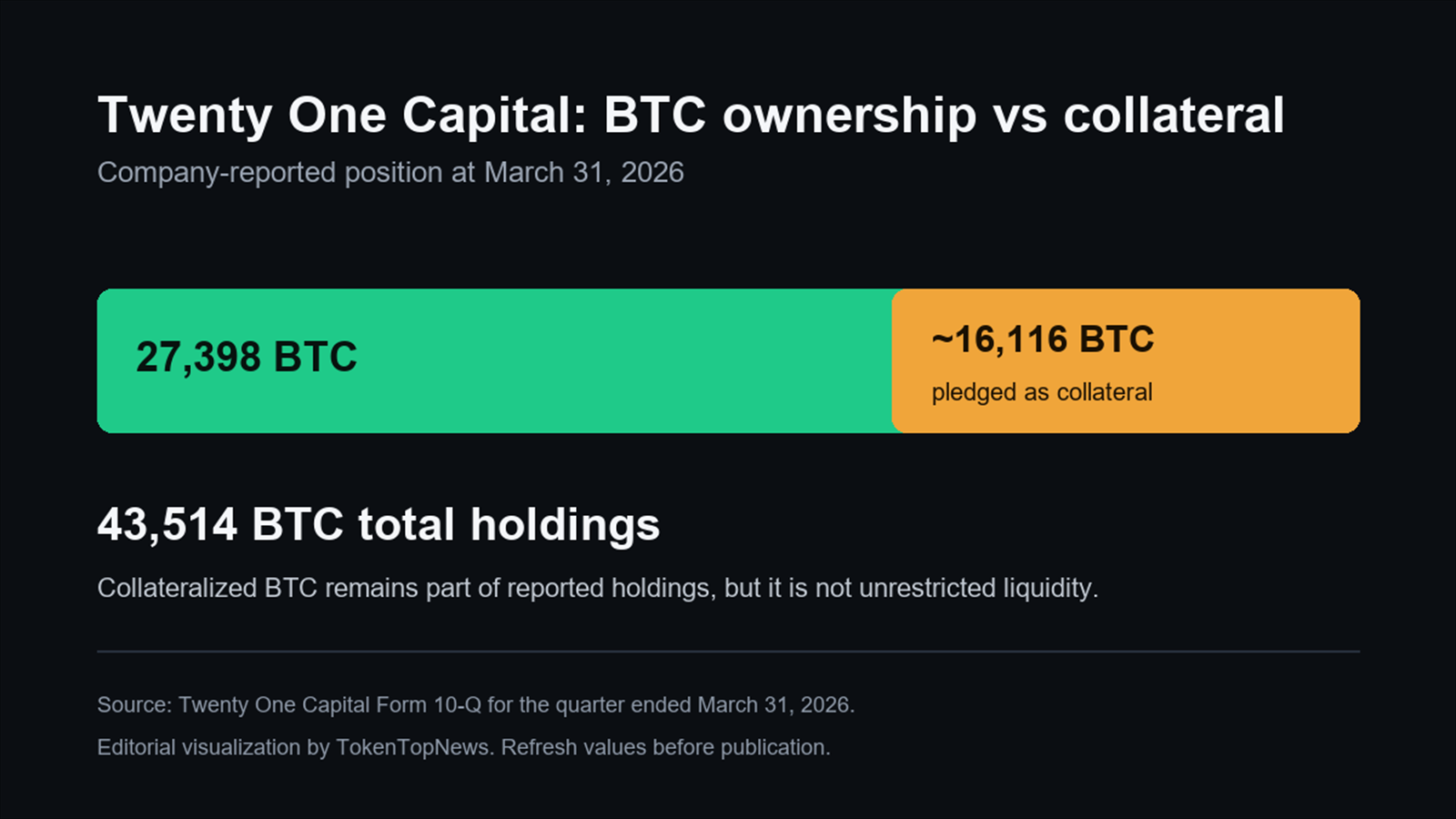
Do not calculate “available liquidity” as total BTC minus pledged BTC without reading the agreement. Twenty One Capital’s Q1 2026 Form 10-Q shows why collateral terms need their own field. Unencumbered Bitcoin may still be subject to board policy, tax consequences, custody withdrawal controls or operational limits. The tracker should report legal encumbrance and leave liquidity analysis to a documented model.
Share count belongs in a holdings tracker
Total BTC can rise while shareholder exposure falls. Add basic shares, fully diluted shares and the methodology date to every company record. When a financing closes, create both a financing event and a share-denominator event even if management does not purchase Bitcoin until later.
Twenty One reported 346,548,153 Class A shares at March 31 and calculated 12,557 satoshis per share. Strive’s May 14 release disclosed both common classes and SATA preferred shares. Capital B financings included shares and attached warrants. These instruments are not interchangeable, so the tracker should retain security-level fields rather than one unsupported “shares” number.
The BTC-per-share business model explains how to test accretion after the event ledger is complete. The tracker supplies facts; it should not quietly embed a favorable valuation assumption.
What a usable tracker record contains
The minimum usable record is not just a BTC total. It is a dated row that lets a reader reproduce the balance and see what is still unknown. The BitcoinTreasuries public table is useful for breadth, while this record design adds the event state and evidence boundary that a static leaderboard often hides.
| Required field | Publication rule | Why the field changes the result |
|---|---|---|
| Settled BTC | Use the effective ownership date | Prevents announced or proposed purchases entering the balance |
| BTC change | Show opening balance, additions and disposals | Exposes whether growth came from buying, mining, transfer or revision |
| Basic and diluted shares | Keep both denominators with their dates | Prevents BTC/share from looking accretive only because the denominator is stale |
| Encumbered BTC | Report pledged or restricted units separately | Total holdings are not the same as immediately available collateral |
| Market fields | Date market cap, price and mNAV independently | Stops an old balance from being presented as a live valuation |
| Next refresh trigger | Name the next filing, purchase or financing to monitor | Makes the page maintainable instead of pretending a snapshot is permanent |
Preserve the previous row, mark changed fields and keep revised balances, issuances and collateral releases as separate events.
Frequently asked questions
Should a tracker update when a purchase is announced or settled?
Use the effective ownership date when disclosed and keep the publication date separately. If settlement is uncertain, mark the event pending and exclude it from the ending balance.
Can onchain wallets verify a public company’s holdings?
They can corroborate movement when addresses are reliably attributed, but an address balance alone does not establish legal ownership, collateral or corporate control. Filing evidence remains necessary.
Why do major treasury databases show different totals?
They may use different cut-off dates, company categories, source priorities or treatments of pending transactions. Compare the underlying event records before deciding which figure is current.
How often should diluted shares be refreshed?
At every financing, conversion, warrant exercise, acquisition and periodic filing. Using a current BTC balance with an old share count produces a misleading per-share result.
Disclaimer: This article is for informational purposes only and does not constitute financial or investment advice. Cryptocurrency and digital asset markets carry significant risk. Always do your own research before making decisions.